
It is factors week, and the room has split in two. Half the class is sure that 9 is prime. The other half uses factor and multiple as if they were the same word. If that sounds like your Monday, this pack was built for that exact week. It teaches one idea at a time, in plain steps, with practice that looks like the test but feels like class work.
This factors and multiples grade 4 guide was built for that exact week.
Get the free lesson here:
Factor Pairs Without the Guesswork
Start with arrays. One rectangle for 24 can have sides of 6 and 4, so 6 and 4 are a factor pair. Pupils test each number in order, write the pair, and draw the pairs as a factor rainbow. The rainbow makes the list easy to check. The stop rule is simple. When the next pair would repeat pairs you already have, the list is done. Year 4 teachers in the UK meet factor pairs in the autumn Multiplication and Division A block, and this same lesson fits that work. The pack carries US standard codes.
Download this lesson:
A factor fits inside a number. A multiple grows out of it.
Multiples That Grow Out of a Number
Put a number line on the desk and skip count out loud. Count by 6 and you land on 6, 12, 18, and 24. Each landing spot is a multiple, because a multiple is what a number makes when you multiply it. Read 6 and 24 both ways to fix the mix up. Six fits inside 24, so 6 is a factor of 24. And 24 grows out of 6, so 24 is a multiple of 6. The Multiplication Chart helps pupils spot the landings, and Math Fact Practice builds the quick recall that makes the counting smooth.
Download this lesson:
Prime or Composite: The Two Factor Test
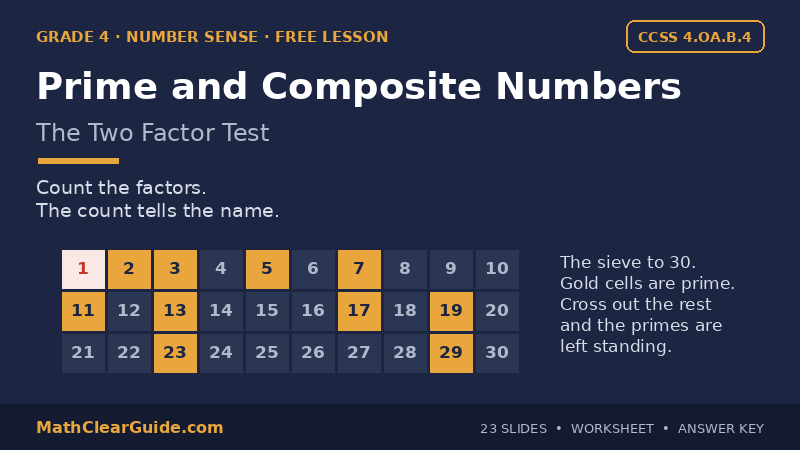
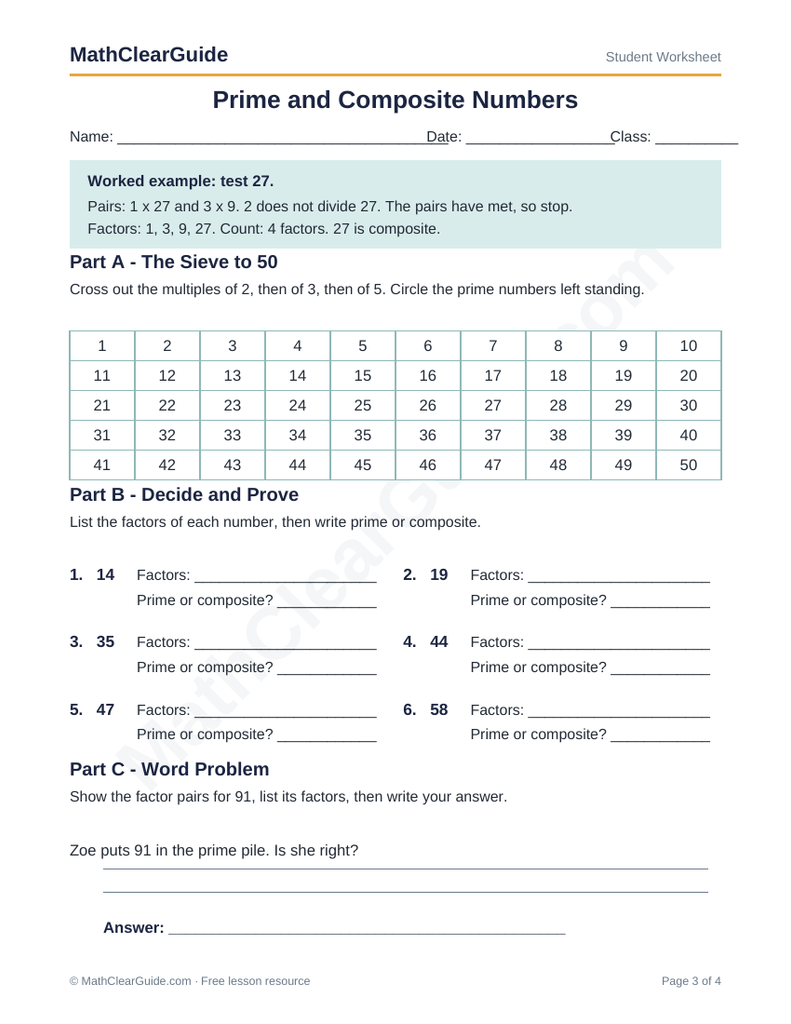
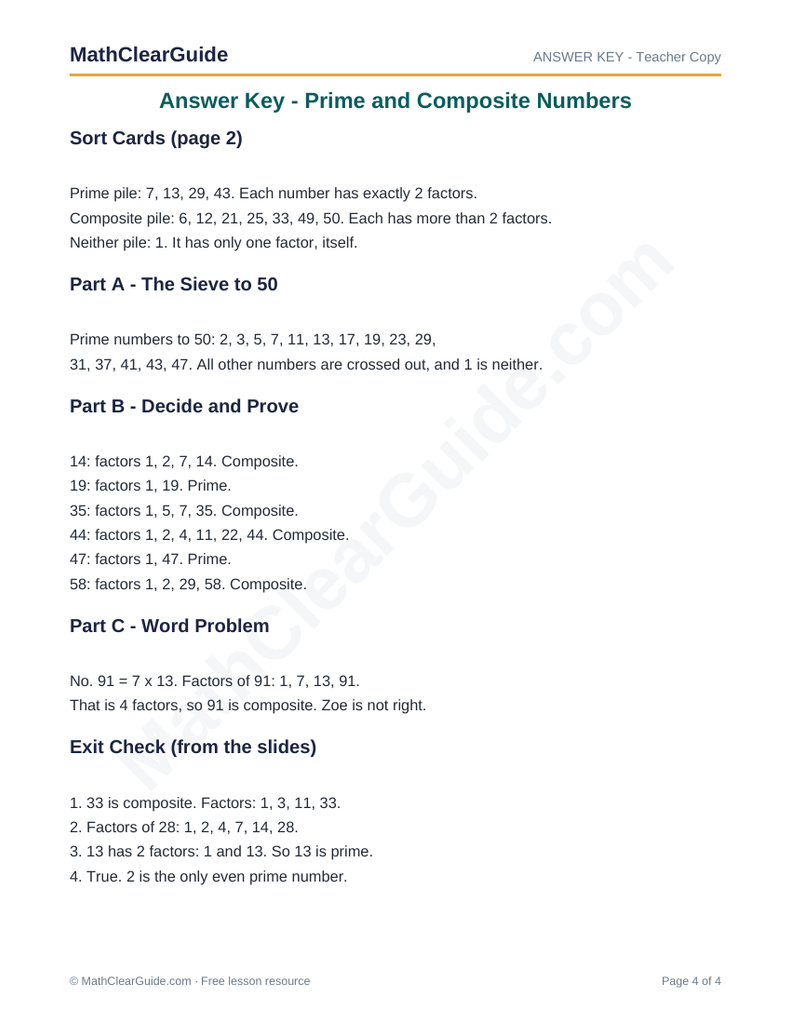
This lesson starts with the trap. Many pupils call 9 prime because it is odd. List its factors and the class sees 1, 3, and 9. That is three factors, so 9 is a composite number. The test never changes. A prime number has exactly two factors. A composite number has more than two. And 1 has only one factor, so 1 is neither prime nor composite. Pupils use a hundred chart sieve to cross out composites and circle the primes that are left. Looks do not decide the answer. The count does.
This is the free lesson. Get it here:
Prime is a count, not a look. Two factors, no more.
Patterns Built From Multiples
In this lesson, a pattern grows by adding the same number each time. Start with 4, 8, 12, and 16. Pupils say the rule in plain words first. The rule is add 4 each time. Then they predict the tenth term by multiplying, because ten groups of 4 make 40. They also hunt for the one term that breaks the rule in a ready made list. The questions use test style words, so this lesson works as the mixed review for the whole pack.
Download this lesson:
Factor or Multiple?
| Word | What it means | Example with 6 and 24 |
|---|---|---|
| Factor | Fits inside a number and divides it exactly | 6 is a factor of 24 because 6 x 4 = 24 |
| Multiple | What a number makes when it is multiplied | 24 is a multiple of 6 |
Factors and Multiples Grade 4: Which Lesson for Which Week
| Week | Lesson |
|---|---|
| Week 1 | Prime and Composite Numbers (free) |
| Week 2 | Finding Factors and Factor Pairs |
| Week 3 | Multiples and Skip Counting |
| Week 4 | Number Patterns with Factors and Multiples |
This clear split helps later, too. When pupils meet greatest common factor, they compare the factor lists of two numbers and look for the biggest match. That work is much easier when factor and multiple were never mixed up in the first place.
When a Pupil Gets Stuck
For a pupil who is stuck, keep the tools on the table. The practice page of the factor pairs lesson shows arrays next to the questions, and the factor rainbow sits at the top as a prompt. A child who cannot recall a pair can build the rectangle, count the sides, and write the pair down. Start with numbers that have clear pairs, like 12 and 18, before you move up.
For a pupil who is ready for more, use the Challenge page of the same lesson. The numbers go up to 100, the worked example box is removed, and one missing factor hides inside a word problem about rows of chairs. The pupil has to find the missing side, not just list pairs. If you need more practice at the same level, make a fresh sheet with the Worksheet Generator and keep the same number range.
List the pairs in order, and the number itself tells you when to stop.
Common Questions
What is the difference between a factor and a multiple? A factor fits inside a number and divides it exactly. A multiple is what a number makes when you multiply it. For example, 6 is a factor of 24, and 24 is a multiple of 6.
Is 1 prime or composite? Neither. It has only one factor, and that factor is 1 itself. Prime numbers need exactly two factors, so 1 does not fit either group.
How do you find every factor pair of a number? Work in pairs from 1, in order. Test each number, write down its pair, and stop when the pairs meet or cross.
What grade learns factors and multiples? Grade 4 in the US. In the UK, pupils meet the same work in Year 4.
Is the first lesson free? Yes. The Prime and Composite Numbers lesson is free with an email signup.
Is the answer key in? Yes. Every lesson in the pack has a filled in answer key.
Start with the free lesson. Get the Prime and Composite Numbers lesson by email, try the two factor test with your class, and watch the mix up start to clear. When you are ready for the full set, join to unlock the full pack with all four lessons, the practice pages, the challenge work, and the filled in answer keys.
Reading about it is one thing, practising it is another. Our free What Is Multiplication? lesson builds the idea step by step, with slides, a printable worksheet and a full answer key.
Members unlock every lesson in the library, including the full Fractions, Multiplication, Place Value, Addition & Subtraction, Time & Money and Geometry & Shapes units. See the full library


