
January is coming, and with it the middle of year testing window. Your district test will give you a score for every child. What it will not give you is a plan. A score says where a student landed. It does not say which skill broke down, or which lesson fixes it.
That is the job of a classroom mid-year math benchmark assessment: a short test you choose, sit and score yourself, built only from the skills your grade should have by now. Ours covers Grades 3, 4 and 5. The Grade 4 paper is free, with its full answer key and a reteach map, so you can see exactly how the pack works before you spend anything.
Get the free Grade 4 paper:
What Is a Mid-Year Math Benchmark?
A mid-year benchmark is a check given halfway through the school year. It tests the skills taught so far, in the form the end of year test will use, while there is still time to fix what is missing.
District tools like STAR Math, Acadience and i-Ready do this at scale, and they are useful. But they report in levels and percentiles. A printable benchmark reports in skills. When a child misses three fraction questions, you can see the three questions, see the method they used, and name the lesson that reteaches it. That is the difference between a score and a plan.
A benchmark is not a state test, and it is not graded for anyone else. It is a planning tool for the teacher who has to teach February.
When Are Mid-Year Benchmarks Given?
Most districts run their middle of year window in January. The published windows for the big testing programs look like this:
| Testing window | Dates for 2026-27 |
|---|---|
| STAR Math middle of year | January 4 to January 29, 2027 |
| Acadience middle of year | January 4 to January 29, 2027 |
| i-Ready middle of year | January 3 to February 11, 2027 |
| A classroom benchmark paper | Any week in December or January |
The smart move is to sit your own paper just before the district window opens. You find the gaps while you can still teach into them, and your class walks into the district test having already done the hard thinking once.
The district test tells me where my class stands. My own benchmark tells me what to teach on Monday.
A Grade 4 teacher, on January testing
What the January Window Covers in Each Grade
A fair mid-year test only covers what has been taught. Here is the mid-year scope our papers use, grade by grade:
| Grade | What the paper covers |
|---|---|
| Grade 3 | Multiplication and division facts and word problems, adding and subtracting 3-digit numbers, fractions on a number line, comparing fractions |
| Grade 4 | Place value and rounding, multi-digit multiplication and division, factors and prime numbers, fraction equivalence and ordering, adding and subtracting fractions |
| Grade 5 | Multi-digit whole number work, decimals to hundredths, adding, subtracting, multiplying and dividing fractions, volume as an introduction |
Each paper follows its grade’s Common Core scope to the middle of the year. Nothing from the spring units appears, because testing untaught content tells you nothing.
The Grade 3 Paper: Facts, 3-Digit Numbers and First Fractions
Grade 3 is the year fractions arrive, and the paper treats them gently but honestly: unit fractions, fractions on a number line, fractions past one whole, and comparing fractions with the same numerator or the same denominator. The rest checks the year’s core work: times tables and division facts in and out of word problems, and adding and subtracting 3-digit numbers with regrouping.
The paper holds 20 questions for 36 points and takes about 40 minutes. It sits inside the full pack with its filled in answer key.
Get the Grade 3 paper in the full pack:
The Grade 4 Paper: Free to Download
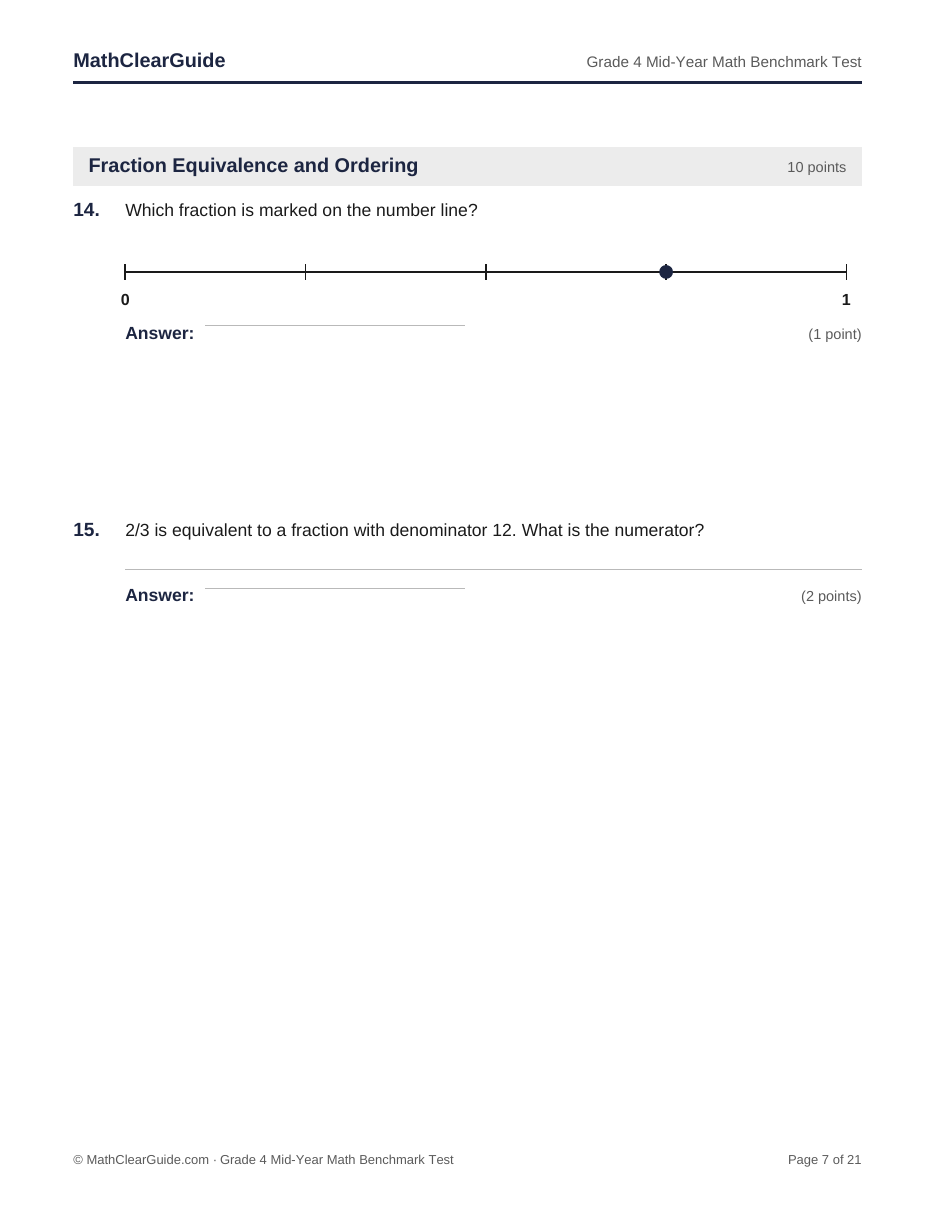
Grade 4 is the free paper, because it is the grade most teachers ask us about. It holds 24 questions for 40 points, in four sections: place value and rounding, multiplication and division, fraction equivalence and ordering, and adding and subtracting fractions. Your class needs about 45 minutes and no calculators.
The same file holds the full answer key, written as a filled in copy of the paper with worked steps, and a reteach map that links every question to its skill and to the lesson that fixes it. Enter your email on the resource page and the file is yours.
Download the free Grade 4 paper:
The Grade 5 Paper: Decimals, Fraction Operations and Volume
Grade 5 steps up. The paper checks multi-digit multiplication and division, decimal place value and rounding to hundredths, and the year’s big load: adding, subtracting, multiplying and dividing fractions, including area with fractional side lengths. Volume closes the paper as an introduction, with unit cubes, layers and the length times width times height method.
The paper holds 21 questions for 40 points and takes about 45 minutes. Like the others, it sits in the full pack with a filled in answer key.
Get the Grade 5 paper in the full pack:
Reading the Results: Scores Are Not the Point
Here is where a benchmark earns its keep. Score the paper, then stop looking at totals. A total of 28 out of 40 can hide two very different students: one who is nearly there everywhere, and one who is strong everywhere except fractions. Same score, different February.
The pack’s reteach tracker works at skill level. You record each student’s points question by question on a class grid. A skill summary then counts how many students are secure in each skill, and a reteach map names the lesson that reteaches it. When the tracker shows that half your Grade 4 class is weak on fraction equivalence, the next step is already written down: teach the Equivalent Fractions lesson, then recheck with the same questions a week later.
I stopped sorting my class by score. I sort by skill now, and reteach groups plan themselves.
A Grade 5 teacher, on using a reteach tracker
The three papers also borrow across grades, which is where differentiation gets easy. The same skills run through all three tests at three levels. A Grade 4 student with a number line gap can warm up on the Grade 3 paper’s number line questions before the Grade 4 reteach. A strong Grade 3 student can sit the Grade 4 paper as a stretch check. No new printing, no new planning: the series is the differentiation.
The Answer Keys Do the Marking With You
Every key in this pack is a filled in copy of its paper. The answers sit on the page in the same place as your students’ work, in bold dark red, with worked steps for the longer questions. You are not matching a list of bare answers to a page of student working. You are comparing two pages that look alike, which is why a class set scores inside one planning period.
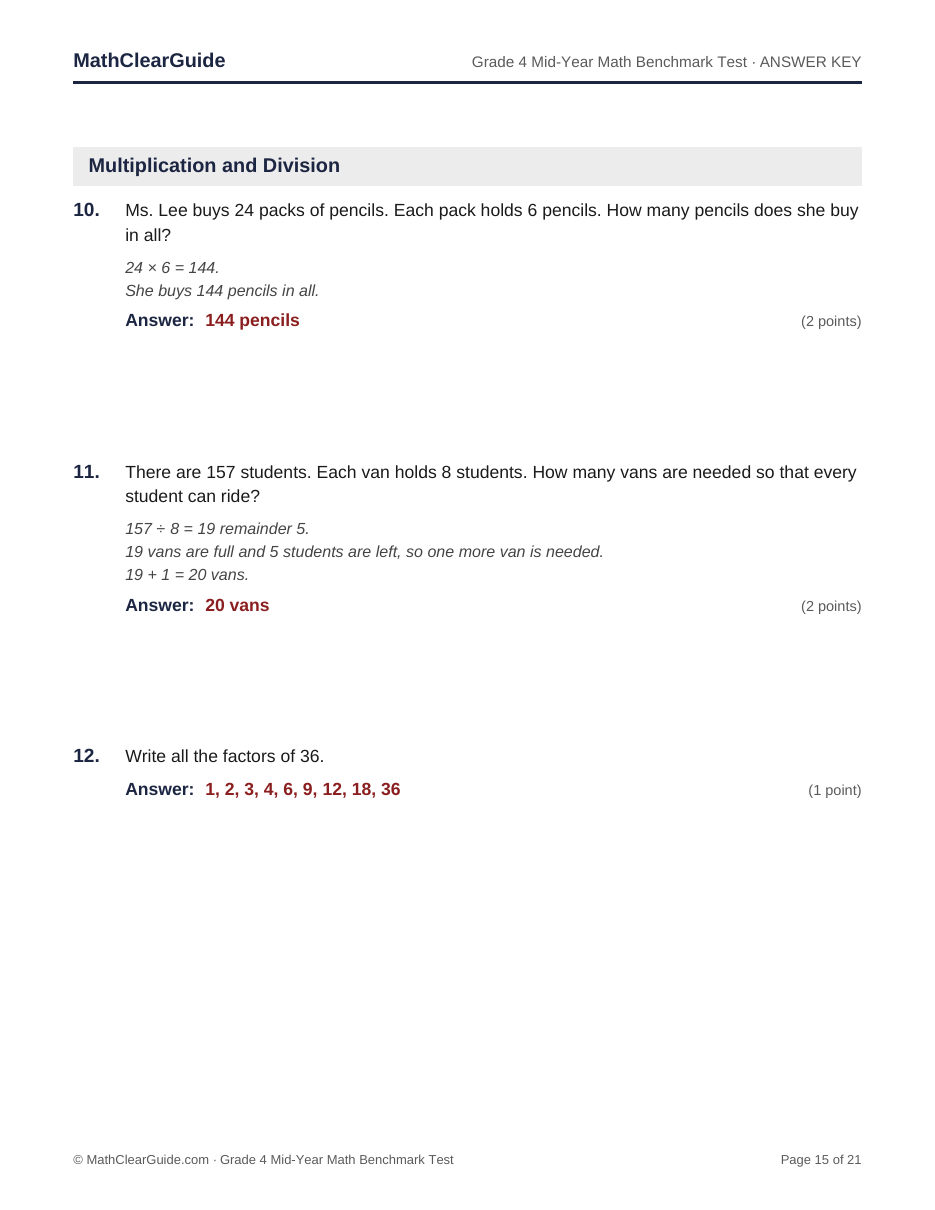
The keys also name the answers that are also acceptable, in plain words, where a question allows more than one form, and the map at the back of the free paper shows the pattern: question, skill, points, lesson.
Where Our Own Tools Fit
A benchmark finds the gap. These free tools on this site help you work on it between lessons:
- The Math Placement Test gives a quick level check across a whole grade, useful at the start of the year or for a new student.
- The Fraction Visual Model lets students build fractions on a number line and see equivalence, which is the exact skill the Grade 3 and Grade 4 papers test.
- The Long Division Calculator shows every step of the standard method, so students can check where their own working broke down.
- The Fraction Calculator checks fraction operations step by step, a good mirror for the Grade 5 paper’s fraction sections.
And when a whole skill needs reteaching, the library lessons line up with the tracker: Multi-Step Multiply and Divide for fact and method gaps, Place Value: Thousands and Beyond for number work, and the Grade 5 fractions lessons for the oldest group.
Frequently Asked Questions
When are mid-year benchmarks given?
Most districts run the middle of year window in January. STAR Math and Acadience run January 4 to 29, 2027, and the i-Ready window runs January 3 to February 11, 2027. A classroom paper can be sat any week in December or January, ideally just before your district window.
What does each grade paper test?
Grade 3 tests facts, 3-digit addition and subtraction, and first fractions. Grade 4 tests place value, multi-digit multiplication and division, and fraction equivalence and operations with like denominators. Grade 5 tests decimals, all four fraction operations, and an introduction to volume. Each paper covers only its grade’s mid-year Common Core scope.
Is the Grade 4 paper really free?
Yes. The Grade 4 paper, its full answer key and its reteach map are free. Enter your email on the resource page and the file unlocks. No card and no trial.
Is the answer key in?
Yes, for every paper. Each key is a filled in copy of the paper with worked steps for the longer questions, not a list of bare answers.
How do I use the reteach tracker?
Write each student’s points into the class grid as you score, one row per student. The skill summary counts how many students are secure in each skill, and the reteach map names the library lesson for every question. A printable PDF and an editable spreadsheet are both in the pack.
What do I do after a low score?
Do not retest the whole paper. Find the weakest skill on the tracker, teach the lesson the reteach map names for it, and recheck with just that section a week later. Small, named gaps close fast. A low total with no skill breakdown is the only result that helps no one.
Start With the Free Paper
You do not need a new system for January. You need one honest test, a key that scores fast, and a map from every missed question to the lesson that fixes it. Start with the free Grade 4 paper and see the pattern working on your own class. When you want the Grade 3 and Grade 5 papers, every key and the full tracker, join MathClearGuide and unlock the pack.
Download the free Grade 4 paper:
See the full pack:
Every topic clicks faster with practice. Our Resource Library has free lesson packs with slides, printable worksheets and full answer keys, ready to download and teach.
Members unlock every lesson in the library, including the full Fractions, Multiplication, Place Value, Addition & Subtraction, Time & Money and Geometry & Shapes units. See the full library


2 thoughts on “Mid-Year Math Benchmarks: A Grades 3-5 Guide for Teachers”