
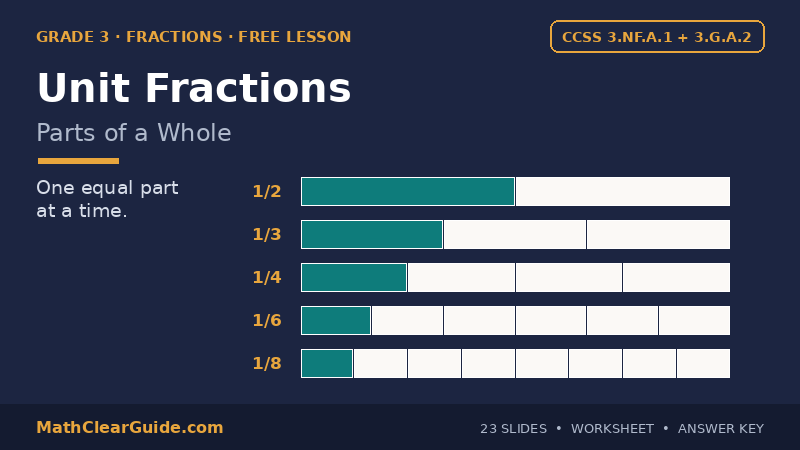
Fractions are the first topic where a child who was fine in math can suddenly feel lost. Whole numbers counted things. Now one whole is cut into parts, and the parts have names of their own. A child can read 3/4 and still not know what it means.
The test in January asks for the number line skill by name. Pupils must place a fraction at a point, not just shade a shape. This pack builds that skill step by step, in five short lessons.
Start free. The first lesson, Unit Fractions and Parts of a Whole, is free. Get it here: If the idea of a fraction is still new at home, read What Is a Fraction? first.
It Starts With One Equal Part
Cut one whole into equal parts and name just one part. That one part is a unit fraction. One part of four is 1/4. One part of two is 1/2. Pupils fold strips, check the parts match, shade one part and write its name. Thirds come the same way. Cut it into three equal parts. One part is 1/3. Each fraction is a count of these parts.
This is the free lesson. Get it here:
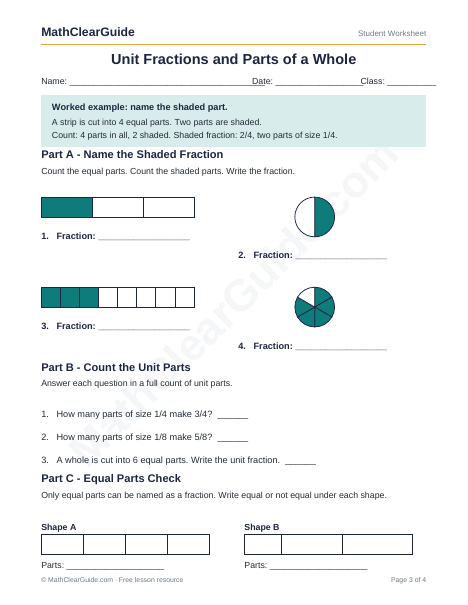
First check the parts are equal. Then count one part.
Fractions Live on a Number Line
A fraction is a number, so it lives at one point on a line. Split the line from 0 to 1 into equal parts. Count the parts from 0 and mark the point. Pupils walk a long desk line first, then mark points on the page for halves, thirds, fourths and sixths. Try the same work on screen with the Fraction Number Line tool and let pupils check each point at once.
Download this lesson:
January test coming up? Mid-Year Math Benchmark Assessment Pack checks these same skills on paper.

When a Fraction Is a Whole Number
Count unit parts past one whole and the parts fill the whole. Four parts of size 1/4 fill one whole, so 4/4 is 1. Eight parts of size 1/4 fill two wholes, so 8/4 is 2. Pupils build each count with strips, then write the fraction name and the whole number name side by side. When pupils check their own work, the Fraction Calculator shows the count in a clear form they can compare with their page.
Download this lesson:
Same Denominator: More Parts Wins
Now the parts are the same size and only the count changes. The bottom number, the denominator, says how many parts fill the whole. The top number, the numerator, says how many parts you have. With fourths, 3/4 has more parts than 2/4, so 3/4 is bigger. Pupils shade both fractions on strips of the same length, then write the sign that fits. Same size parts means the bigger count wins.
Download this lesson:
Same size parts. Just count them. More parts wins.
Same Numerator: Bigger Parts Win
This time the count stays the same and the size of the parts changes. One whole cut into 4 parts gives big parts. The same whole cut into 6 parts gives small parts, the sixths from the first lesson. So 1/4 is bigger than 1/6, and 2/4 is bigger than 2/6. Pupils fold two strips, lay one on the other, and see the size gap with their own eyes before they write a sign.
Download this lesson:
Support and Challenge in the Same Lesson
In the same numerator lesson, the support level keeps the fraction strips on the page. A pupil who needs help can shade, fold and point to the bigger part. The Challenge page takes the strips away. It asks for the sign and then asks for the reason in one sentence. One short line of writing shows if the idea is firm or if the pupil just guessed the sign.
Do not ask which number is bigger. Ask which parts are bigger.
Which Lesson for Which Week
Teach one lesson each week. The order matters. Each lesson uses the one before it.
| Week | Lesson |
|---|---|
| Week 1 | Unit Fractions and Parts of a Whole (free) |
| Week 2 | Fractions on a Number Line |
| Week 3 | Whole Numbers as Fractions |
| Week 4 | Comparing Fractions with the Same Denominator |
| Week 5 | Comparing Fractions with the Same Numerator |
Grade 4 goes one step past each skill. This table shows the path.
| Skill | Grade 3 asks | Grade 4 asks next |
|---|---|---|
| Unit fractions | Name and count unit parts | Equivalence, two names for the same size |
| Number lines | Place a fraction at a point | Order fractions and add on lines |
| Comparing | Same numerator or same denominator | Compare with unlike parts |
| Whole numbers as fractions | Write a whole number as a fraction | Mixed numbers |
In the UK, Year 3 meets this work in the spring Fractions A block. The scope matches this pack. The lessons carry US standard codes, and the tasks fit the same class work.
Common Questions
When do third graders learn fractions? In Grade 3, most often in the second half of the school year. The work starts with equal parts and unit fractions, then moves to number lines and simple comparing.
What is a unit fraction? One equal part of a whole. If a whole is cut into 4 equal parts, one part is 1/4. Every fraction is a count of unit fractions.
Why is one fourth bigger than one sixth when 6 is bigger than 4? Because the whole is cut into more parts, so each part is smaller. Six small parts fill the same whole as four big parts. More cuts means smaller parts.
Is the first lesson free? Yes. Unit Fractions and Parts of a Whole is free with an email signup.
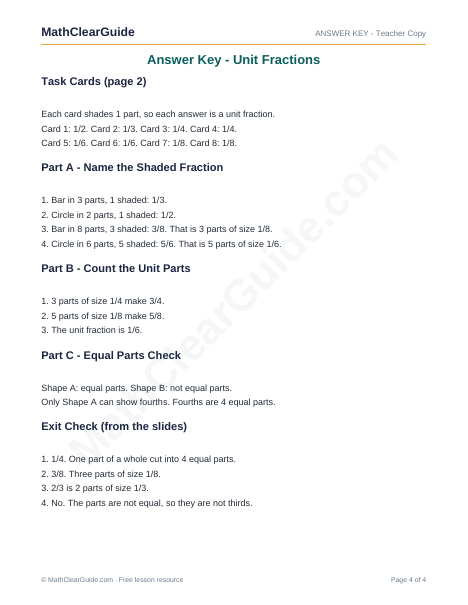
Is the answer key in? Yes. Every lesson has a filled in answer key. The key shows each answer on the page in the same place as the pupil work.
What comes after Grade 3 fractions? Grade 4 builds equivalence first, then comparing with unlike parts and mixed numbers. Each Grade 3 skill in this pack points at one of those next steps.
Start with the free lesson. Get Unit Fractions and Parts of a Whole by email, fold the strips with your class, and watch the first idea land. When you are ready, join to unlock the full pack of 5 lessons, with slides, task cards, practice pages, challenge pages and filled in answer keys. For the first Grade 4 step after this pack, try the free Equivalent Fractions lesson.
Reading about it is one thing, practising it is another. Our free What Is a Fraction? lesson builds the idea step by step, with slides, a printable worksheet and a full answer key.
Members unlock every lesson in the library, including the full Fractions, Multiplication, Place Value, Addition & Subtraction, Time & Money and Geometry & Shapes units. See the full library


1 thought on “Grade 3 Fractions: Unit Fractions, Number Lines and Comparing”