

The envelope comes home sometime between 20 January and 20 February, and this time the math line carries a letter. After a fall report with no grades at all, many Ontario parents open the Term 1 report card and land on the same questions. What does this grade really mean? Is a B good? What is an R? And what should we practise before Term 2? This post answers those questions in plain words. If you searched for ontario report card math comments because the words under the grade confused you, start with the free parent guide: Ontario Report Card: Maths Grades Explained for Parents. It walks through every grade on one page each, and it is free to print and share.
A grade tells you where your child stands. The comment underneath tells you what happens next.
What Is New This Term
The fall progress report used three levels: Progressing Very Well, Progressing Well, and Progressing With Difficulty. The Term 1 report card is different. For Grades 1 to 6, each subject now gets a letter grade, from A down to D, or the letter R. A short teacher comment sits beside the mathematics grade and explains it in words.
Kindergarten families get a different document, the Communication of Learning, which tells the learning story in words and pictures instead of letters.
The grade is not the mark from one test. Teachers build it from class tasks, short quizzes, math talks, and the work in your child’s folder across the whole term. The letter sums the term up. The comment shows the work behind it.
What Each Maths Grade Means
Ontario grades are tied to the provincial standard, which is Level 3, the B range. Read your child’s grade against that line, not against the top of the class.
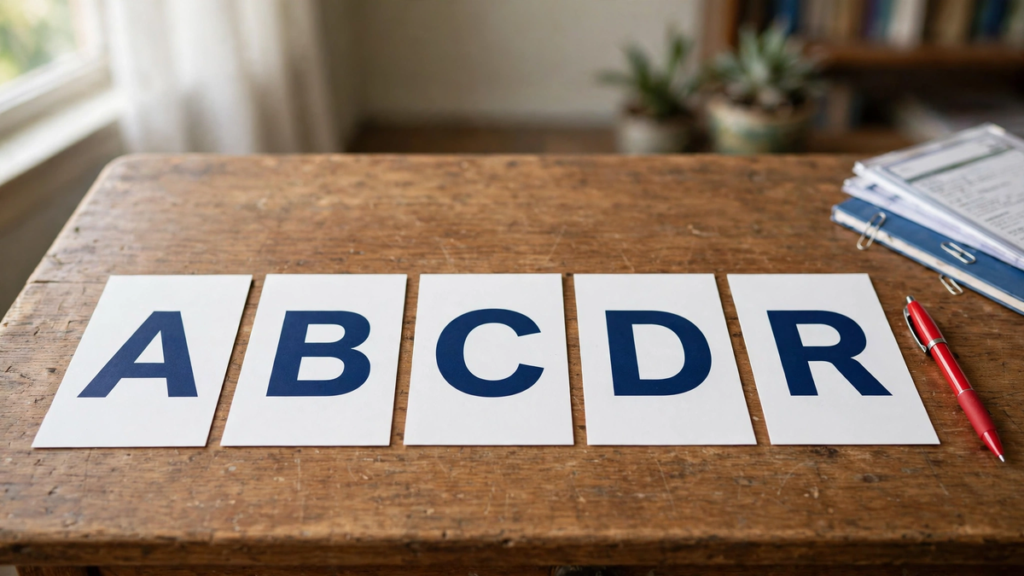
| Grade | What it means | What to do next |
|---|---|---|
| A | Above the provincial standard (Level 4). The work is strong and steady. | Keep the challenge coming with harder problems. |
| B | At the provincial standard (Level 3). This is the grade Ontario aims for. | Say well done, then read the comment for the small gap it names. |
| C | Approaching the standard (Level 2). Much of the learning is in place. | Practise the one or two ideas the comment names. |
| D | Below the standard (Level 1). Some key ideas are not yet secure. | Book the follow-up talk. Ask what support looks like. |
| R | The learning expected for this grade is not yet shown. A support plan is in place. | Meet the school early and often. Small steps, checked each week. |
Grades also carry a plus or a minus. B+ is the top of the B band, and B- is the lower edge. Read the letter first and the sign second.
Two worries are worth settling now. A C does not mean your child is failing. It means the standard is close, and the comment names the exact ideas to build. An R is not a final judgement either. It is a flag that starts a plan, and plans work best when home and school pull together early.
How to Read the Comment Under the Grade
A good math comment has two halves. The first half names a strength: something real your child can do, in plain words. The second half names a next step: the very next thing the learning needs.
Read the two halves against the grade. A comment that praises work above the standard should sit beside an A or a B. When the words and the letter tell the same story, you can trust both. When they seem to disagree, ask about it at the follow-up talk.
The comment usually points at one of five areas of math, called strands.
The Five Strands on the Report
Number covers counting, place value, the four operations, and fractions in the older grades. Algebra covers patterns and early equations with a missing number to find. Data covers collecting information, building graphs, and saying what the data shows. Spatial Sense covers shapes, solids, and measuring. Financial Literacy covers coins, bills, and first steps with budgets.
Mathematics gets one grade, but the comment usually leans on one strand. A comment about counting coins is a Financial Literacy comment, even when the grade beside it covers all five. Knowing the strand tells you what to practise. The free Worksheet Generator builds a short practice page on that exact skill in minutes.
For Parents: What to Practise Next
Start from the comment, not from the grade. Its next step is the teacher telling you, in one line, what would help most. Turn that line into one small habit:

- Number: five minutes of fact practice out loud, with objects before paper.
- Algebra: build a pattern with spoons or buttons, say the rule, and add three more terms.
- Data: chart one family question a week on the fridge and read it together.
- Spatial Sense: guess a length, measure it, and talk about how close the guess was.
- Financial Literacy: let your child pay for one small item and count the change into your hand.
If you are not sure which gap to check first, the free Math Placement Test shows where the holes are, grade by grade. The free parent guide prints these habits beside the grade pages.
Ten quiet minutes with coins, cubes or a tape measure teach more than one long worried hour on the weekend.
For Teachers: Writing These Comments
January is report season, and the math comment is the one parents read twice. The pattern that works is the one above: one strength, one next step, in plain words, matched to the grade beside it. The hard part is doing that thirty times without writing the same sentence for the whole class.

The Ontario Term 1 Report Card Maths Comment Bank holds 60 grade-anchored comments: five strands, three grade groups (Grades A and B, Grade C, Grades D and R), and two grade bands (Grades 1-2 and Grades 3-5), in colour, black and white, and editable text. If you are hunting for ontario report card math comments that already sit at the right grade, this is the set. Still on fall reports, or planning ahead? The November Ontario Progress Report Maths Comment Bank covers the progress levels, and its free parent guide explains those levels the same way.
Which One Do You Need
| If you are… | Start with | Why |
|---|---|---|
| A parent reading a Term 1 report | The free parent guide | Every grade explained in plain words, plus questions to ask |
| A parent planning home practice | The free parent guide, then the Placement Test | The habit for each strand, and a check of the real gaps |
| A teacher writing math comments | The paid comment bank | 60 comments already anchored to the grade, ready to personalise |
| A teacher handing something to parents | The free parent guide | Free to print and share with the whole class |
The Free Parent Guide
Ontario Report Card: Maths Grades Explained for Parents is a free seven-page guide. It explains what each grade means and what it does not mean, how to read the comment under the grade, five questions to ask the teacher, and one home habit per strand. It closes with a note for teachers and a links page, including the Parent Teacher Conference Kit for the follow-up talk. Ten minutes the evening the report comes home is enough to read it.
The Paid Comment Bank
The Ontario Term 1 Report Card Maths Comment Bank is the member companion. Where the guide explains the grades to parents, the bank writes the comments for teachers: 60 ready comments, each one a strength plus a next step, organised by strand, grade group, and grade band, so the wording always matches the letter it sits beside. It adds a teacher guide, a personalise page with five small edits that make a comment your own, and a next steps page to share with parents. It comes as a colour PDF, a black and white PDF for cheap printing, and an editable text file you can copy straight into your report software.
Common Questions
Is a B a good grade in Ontario?
Yes. B is the provincial standard, Level 3, and it is the grade Ontario aims for. An A means the work sits above that standard.
What does R mean on an Ontario report card?
R means the learning expected for the grade has not yet been shown, and a support plan is in place. It is a starting flag, not a final judgement. Meet the school early and check in often.
When do Term 1 report cards come home in 2027?
Schools send them between 20 January and 20 February 2027. The exact day changes by board and by school.
My child got a C in math. What should we do first?
Read the comment before anything else. It names the ideas that are not yet secure. Practise one of them in small daily steps.
Do kindergarten children get letter grades?
No. Kindergarten uses the Communication of Learning, which tells the learning story in words and pictures.
The best report comment is short, true, and easy to act on: one strength, one next step, in words a parent can use the same evening.
A Calm Way to Use This Report
A Term 1 grade is a snapshot from the middle of the year, with a full term still ahead. Read the letter, read the comment slowly, pick one next step, and let small practice do the rest. Parents can start tonight with the free parent guide and the Math Placement Test. Teachers can write truer comments faster with the comment bank, and plan the talk that follows with the Parent Teacher Conference Kit. One grade, one comment, one next step. That is enough to act on.
Every topic clicks faster with practice. Our Resource Library has free lesson packs with slides, printable worksheets and full answer keys, ready to download and teach.
Members unlock every lesson in the library, including the full Fractions, Multiplication, Place Value, Addition & Subtraction, Time & Money and Geometry & Shapes units. See the full library


