
Grade 6 percent is where math leaves the worksheet and walks into the shop. It is also where many classes stall, because percent asks pupils to hold three pieces in mind at once. Our Percent in Full unit teaches those three pieces slowly and in order, across five lessons, and it starts with a free one. The first lesson, What Percent Means, is a complete lesson with slides, task cards, a worksheet and a filled in key, free with an email signup: What Percent Means. This post walks through the whole unit, so you can see what your class gets and where to start.
What Percent Really Means
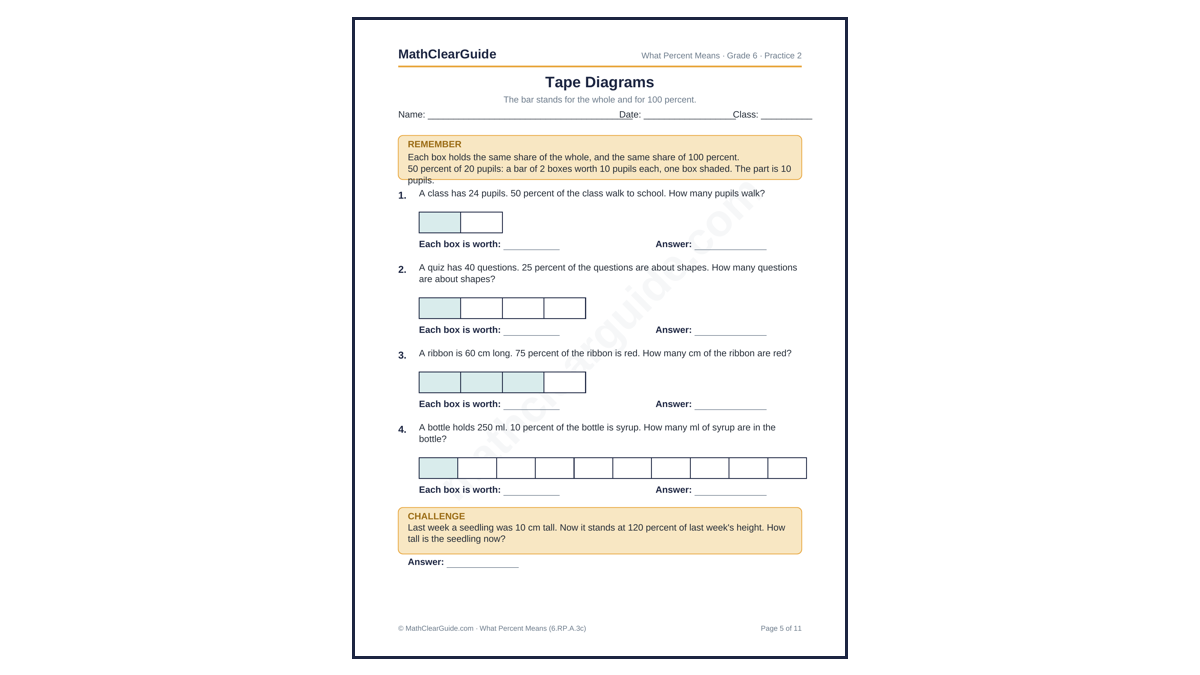
A percent is a rate per 100. That one sentence is the whole subject, and Lesson 1 does not rush past it. Pupils meet percent first as shaded squares on a hundred grid, then as a marked share on a tape diagram, then as a point on a double number line. Three models, one idea: the percent says how many out of every hundred, and the amount depends on the size of the whole. Fifty percent of 24 counters and fifty percent of 250 ml are both half, and the halves are not the same size. That contrast stops the classic error of treating the percent number itself as the answer. One page bridges back to the fraction and decimal work pupils already own, the ground our free Fraction Visual Model tool practises, and then the unit moves on to problem solving.
Percent is a fair share count: how many out of every hundred, so that any two amounts can be compared fairly.
The Unit at a Glance
Every lesson follows the same shape: 23 teaching slides, a printable worksheet with a teacher guide, task cards, practice pages, and a filled in answer key that shows the working, never a bare list. The first lesson is free. The other four are member lessons.
| Lesson | What it teaches | Standard |
|---|---|---|
| 1. What Percent Means (free) | Percent as a rate per 100, three models | 6.RP.A.3c |
| 2. Finding the Part | Percent of a number with tapes, tables and double number lines | 6.RP.A.3c |
| 3. Finding the Whole and the Percent | The two missing piece problems | 6.RP.A.3c, 6.RP.A.3 |
| 4. Percent in Real Life | Discounts, sales tax and tips, in the honest order | 6.RP.A.3c, 6.RP.A.3 |
| 5. Percent Word Problems | Every kind mixed, plus two step money problems | 6.RP.A.3, 6.RP.A.3c |
Start Free: What Percent Means
The free lesson teaches the meaning of percent in full, not a taster. Pupils hunt percents on the Percent Hunt cards, read and shade hundred grids, build percents on tape diagrams, and read double number lines both ways. A challenge strip ends the last page, where a seedling grows to 120 percent of its first height, so percent over 100 is met on day one, calmly. If your class can say what 35 percent of 200 ml means, they are ready for the rest of the unit: What Percent Means.
Finding the Part
Lesson 2 is the workhorse skill, finding a percent of a number, taught three ways. The tape diagram splits the whole into equal boxes. The ratio table scales across from 100 to the percent you need, which is how awkward percents like 35 percent of 240 fall out cleanly. The double number line reads the answer off a line built for that whole. Money amounts bring the rounding rule: answers land on cents, half up, and a benchmark check closes the lesson, because a part at 35 percent must sit between the 25 and 50 percent marks. The table facts lean on the free Multiplication Chart tool.

Members teach it here: Finding the Part.
Finding the Whole and the Percent
This is the lesson most percent units skip, and the one tests love. Given a part and a percent, can pupils grow the part back to the whole? Given a part and a whole, can they find the percent? Lesson 3 teaches both directions as one family, with the percent triangle as its picture: part at the top, whole and percent at the base, one corner covered. The Percent Detective cards make pupils name the missing piece and sort the cards into three piles before they solve. That habit is the spine of the whole unit.
A percent problem is one family with one missing piece. Name the piece first, and the problem is half solved.
Members teach it here: Finding the Whole and the Percent.
Percent in Real Life
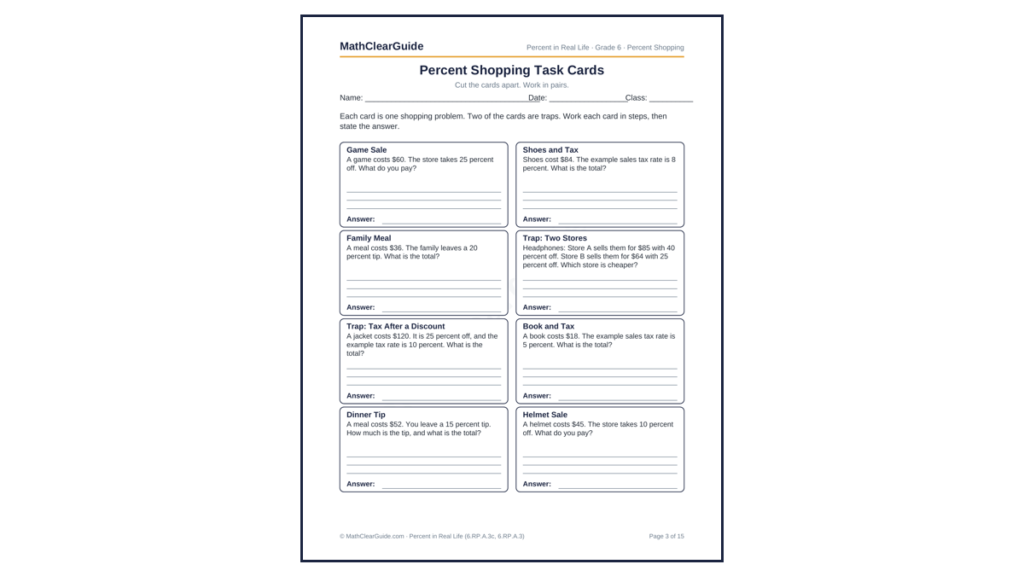
Lesson 4 spends percent the way shops do: discounts, sales tax and tips. Percent off is taught properly here, as the part taken away from the full price, and the lesson is strict about order. The discount comes off the full price first. Tax is then worked out on the sale price, never the full price. Two of the Percent Shopping cards are traps: the bigger percent off that is not the lower price, and the tax worked out in the wrong order. Every tax rate is labelled an example rate, because real rates change from place to place.
Members teach it here: Percent in Real Life.
Percent Word Problems
The closing lesson mixes everything. Part, whole and percent problems arrive in story form, real life problems take two steps, and a percent of a percent problem stretches the strongest pupils. One labelled extension strip takes a first look at percent increase, decrease and simple interest. Those are Grade 7 topics, the page says so plainly, and the strip skips cleanly.
Members teach it here: Percent Word Problems.
Start Where Your Class Stands
Not every class starts in the same place, so here is the honest ladder. If percent itself is brand new, start one step earlier with our Percentages and FDP pack. Its free first lesson, Percent Basics, teaches percent as parts out of 100, and the pack covers the swaps between fractions, decimals and percents, the ground our post on fractions, decimals and percentages explains in full and the full FDP pack teaches. This unit begins where that pack ends, and no page is sold twice.
If your class has just finished ratios, they hold the perfect warm up. Our Grade 6 ratios and rates unit ends where this one begins, and its free first lesson, Understanding Ratios, builds the tape diagrams and tables this unit leans on. Inside one lesson, the pages stretch three ways. Take a class of 40 at the school club, where 24 pupils belong. Support pupils find the part, with the tape printed. Core pupils find the whole: the club is 60 percent of the class, so how big is the class? Challenge pupils find the percent, then defend it with a check.
One Problem, Three Missing Pieces
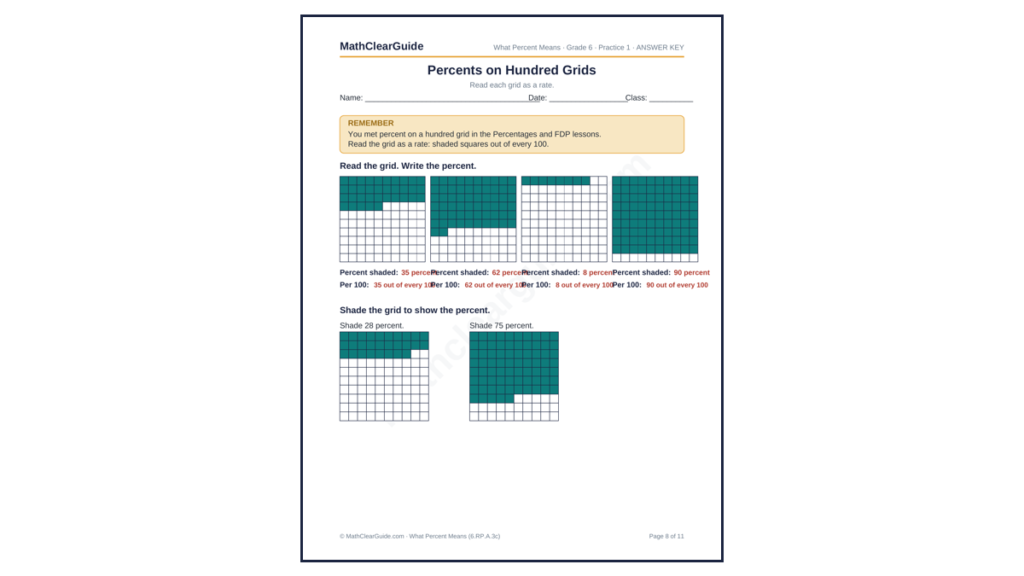
Here is the family in one small story. A class has 40 pupils, and 24 of them ride the bus. Ask for the part: 60 percent of 40 is 24 riders. Ask for the whole: 24 riders is 60 percent, so the class is 40 pupils. Ask for the percent: 24 out of 40 is 60 percent. Same story, same three numbers, three questions, each answered by covering a different corner of the triangle. The key page below is how every key in this unit looks: the model filled in, the working shown, the answer in a sentence.
Questions Teachers Ask
Is the first lesson really free? Yes. What Percent Means is a complete lesson, slides, cards, worksheet and key, free with an email signup. It is not a sample of the good pages. It is the good pages.
How is this unit different from the Percentages and FDP pack? The FDP pack teaches what percent is and how it swaps with fractions and decimals. This unit teaches percent problem solving: the part, the whole and the percent, and percent on prices, tax and tips. No page is repeated.
What if my class is not ready? Start with the FDP pack, or with the ratios unit, and come back.
Do I need all five lessons? No. Each lesson stands on its own. But the family only clicks when all three missing pieces are taught, so Lessons 2 and 3 are the pair we would never split.
What comes after percent? Integers and rational numbers, the next unit in our Grades 6 to 8 road.
Percent is the math of every shop, bill and receipt. A child who owns percent owns a piece of everyday life.
Start With the Free Lesson
Download the free lesson and teach it this week: What Percent Means. Members unlock the other four lessons and every other grade on the site, K to 8, on one plan with no per grade stacking. For fresh practice in the same skills, the free Worksheet Generator builds it. Ratios first, percent in full now, integers next: the road through Grade 6 is set.
Every topic clicks faster with practice. Our Resource Library has free lesson packs with slides, printable worksheets and full answer keys, ready to download and teach.
Members unlock every lesson in the library, including the full Fractions, Multiplication, Place Value, Addition & Subtraction, Time & Money and Geometry & Shapes units. See the full library


3 thoughts on “Grade 6 Percent: A Simple Guide for Teachers and Parents”