
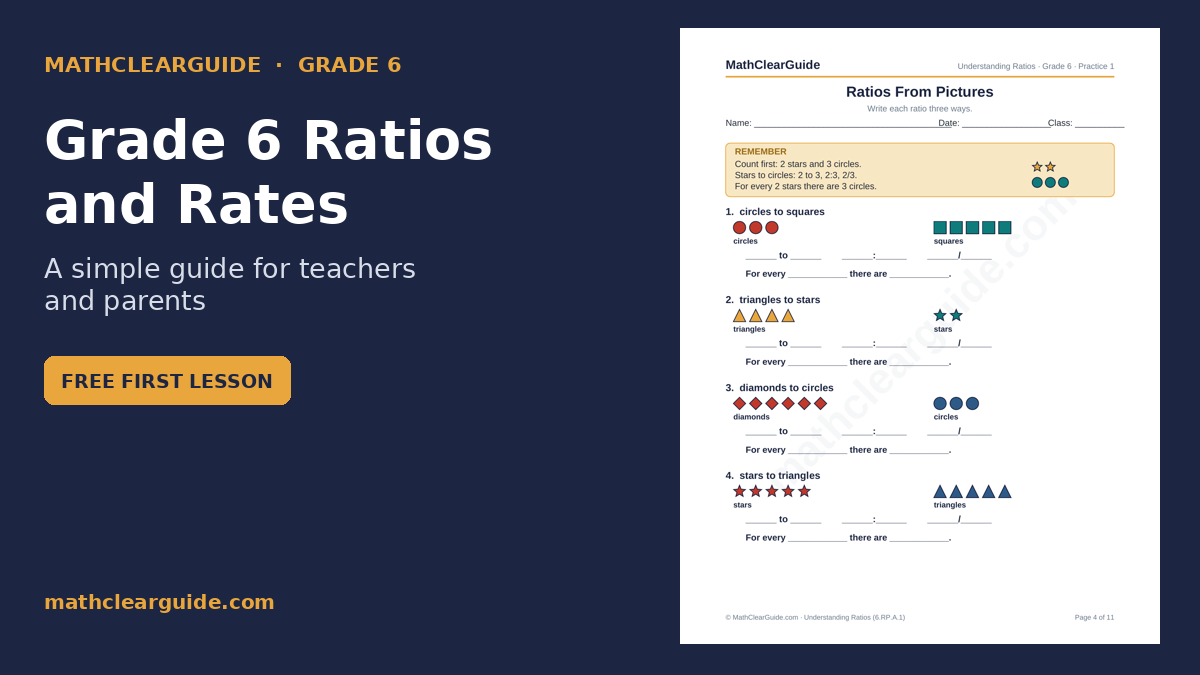
Grade 6 ratios are the first unit where math stops looking like Grade 5. Fractions put on a new name, word problems grow a second step, and a steady class can wobble. The fix is not more worksheets. It is building the idea slowly, one model at a time, in plain words. This unit does that in five lessons, each with teaching slides, a worksheet and a filled in key. The first lesson is free, and it is a full lesson, not a taster. Teach it, and let your class show you whether the style fits before you decide about the rest.
What Is a Ratio?
A ratio compares two amounts: how much of one thing there is next to another thing. A snack mix with 2 cups of raisins for every 3 cups of nuts has a ratio of 2 to 3, and the for every sentence is the heart of it. A ratio can be written three ways, as 2 to 3, as 2:3, and as 2/3, where the last way is read as a comparison, not as part of one whole. Order matters: 2 to 3 is not 3 to 2, because the first word names the first amount.
A ratio is a fair comparison. It keeps two amounts honest, side by side, so neither one can pretend to be the whole story.
The Unit at a Glance
| Lesson | Standard | What it teaches | Fits in |
|---|---|---|---|
| 1. Understanding Ratios (free) | 6.RP.A.1 | Ratio language, three ways to write a ratio, part to part and part to whole, tape diagrams | Week 1 |
| 2. Unit Rates | 6.RP.A.2 | The per one idea, finding a unit rate, rate language, comparing rates | Week 2 |
| 3. Ratio Tables and Equivalent Ratios | 6.RP.A.3a | Building tables, missing values, double number lines, plotting pairs | Week 3 |
| 4. Ratios in Real Life | 6.RP.A.3b, 6.RP.A.3d | Unit pricing and the better buy, constant speed, measurement conversions | Week 4 |
| 5. Ratio Word Problems | 6.RP.A.3 | Multi step problems with tape diagrams, tables and double number lines, a Grade 7 first look page | Week 5 |
The sequence is set: percent is the next unit, and integers come after that. Percent grows straight out of unit rate work, which is one more reason to teach this unit in order.
Start Free: Understanding Ratios
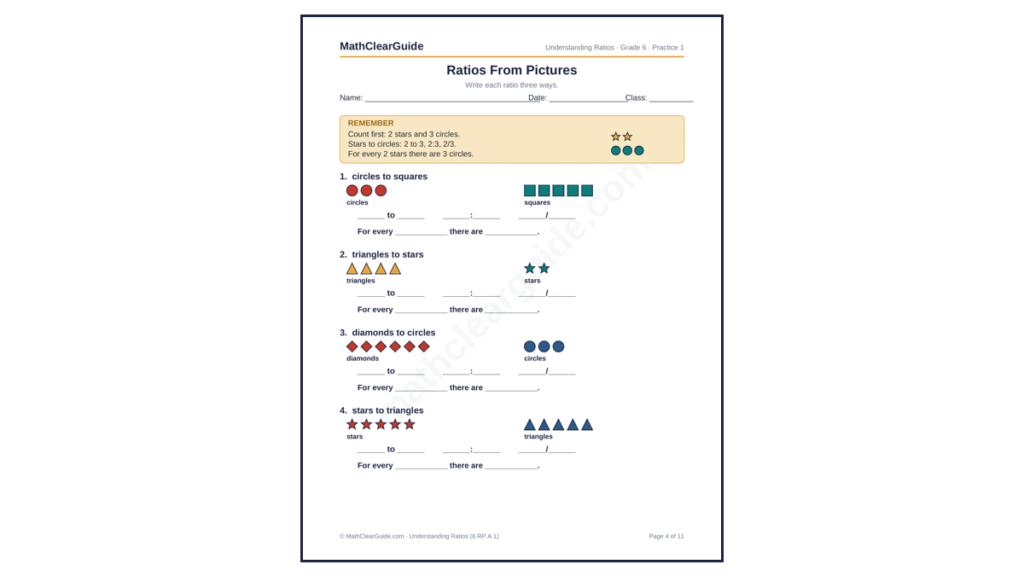
The free lesson teaches ratio language in full: 23 slides, eight Ratio Hunt task cards, three practice pages and a filled in key. Pupils write ratios three ways, say the for every sentence to a partner, and meet the tape diagram. The hardest working page reads the same picture two ways, part to part and part to whole. Part to whole ratios grow out of fraction models, so the free Fraction Visual Model tool is the warm up we use in class.
Get the free lesson here: Understanding Ratios
Unit Rates: The Per Idea
A unit rate is a ratio turned into a per one number: cups per bottle, dollars per hour, miles per hour. This lesson teaches pupils to find one by dividing, to say it in rate language three ways, and to compare two rates fairly by turning both into unit rates first. Every worked example shows each step, and the key shows the division working for every item, because at this level a skipped step is where a pupil gets lost.
Get the lesson here: Unit Rates
A unit rate is the number adults reach for without knowing its name. Price per ounce, miles per hour, pay per hour: it is all one idea.
Ratio Tables and Equivalent Ratios

A ratio table is the work tool of the whole strand. This lesson builds tables by multiplying and dividing both amounts, finds missing values (including the tricky missing middle value), and meets the double number line in depth. Each table row then becomes a point on the coordinate plane, and the points line up. The free Coordinate Plane Practice tool tops up the plotting pages, and the Multiplication Chart backs up the facts every table leans on.
Get the lesson here: Ratio Tables and Equivalent Ratios
Ratios in Real Life: Better Buys, Speed and Measuring
Pupils turn shelf prices into unit prices and crown the better buy with proof, not a guess, and two shelf cards punish guessing: the bigger pack is not always the better buy. The same rate thinking then runs constant speed problems in both directions, scales recipes up and down, and converts measurements with ratio tables, inches to feet and centimetres to metres. Sales here are dollars off only. Percent off waits for the percent unit, where it belongs.
Get the lesson here: Ratios in Real Life
Ratio Word Problems: Pulling It All Together
The last lesson teaches the habit that makes word problems manageable: sort before solving. Eight problem cards are sorted by the tool that fits, tape diagram, table, double number line or unit rate, before anyone solves. Then come sharing a total in a ratio, rate problems in context, and a multi step set whose key shows the full working step by step. A last page looks ahead to Grade 7, labelled plainly as a first look a teacher can skip whole.
Get the lesson here: Ratio Word Problems
One Table, Two Levels

One table can serve the whole class on the same morning. Take the lemonade table from Lesson 3. Support pupils fill the missing values with the unit rate given on the page, so their job is the pattern. Core pupils find the missing middle value unaided. Challenge pupils compare two mixes at a shared amount and defend which is stronger in one sentence. Same page, same lesson, three honest levels.
What Comes Next: Percent
Percent is not in this unit, on purpose. A percent is a rate per 100, so it grows out of the unit rate work in Lesson 2, and it gets a full unit of its own next: Unit 2, Percent in Full. Until then, the readiness path is our Percentages and FDP pack and its companion post on fractions, decimals and percentages. No ground is sold twice: this unit ends where percent begins. Unit 2 is now live, too: Percent in Full begins with a free first lesson, What Percent Means, and the FDP pack stays the readiness step to take before both units.
Questions Teachers Ask
Is the first lesson really free?
Yes. Understanding Ratios is a complete lesson, 23 slides, task cards, worksheets and a filled in key, free with email signup.
What standards does the unit teach?
The Grade 6 ratio strand: 6.RP.A.1, 6.RP.A.2, 6.RP.A.3a, 6.RP.A.3b and 6.RP.A.3d, pulled together under 6.RP.A.3 in the last lesson. Percent (6.RP.A.3c) is held for Unit 2, on purpose.
Is percent in this unit?
No. Percent is the next unit. The Percentages and FDP pack carries it at readiness level in the meantime.
What do I need to print?
Only the pages you teach from. Paid lessons come in color and in a black and white ink saving file, and the slides are editable PPTX.
Can a strong Grade 5 class start it?
Yes, with the free lesson. Ratio language grows out of part to whole fraction thinking, and Lesson 1 builds it from pictures.
Start With the Free Lesson
Teach ratios slowly now, and percent later will feel like an old friend coming back with a new name.
Download the free lesson with an email signup and teach it this week: Understanding Ratios. Members unlock the other four lessons and every other grade on the site with one plan, no per grade stacking. For fresh practice in the same skills, the free Worksheet Generator builds it in the same plain style. Ratios first, percent next, integers after that: the road is set.
Every topic clicks faster with practice. Our Resource Library has free lesson packs with slides, printable worksheets and full answer keys, ready to download and teach.
Members unlock every lesson in the library, including the full Fractions, Multiplication, Place Value, Addition & Subtraction, Time & Money and Geometry & Shapes units. See the full library


3 thoughts on “Grade 6 Ratios and Rates: A Simple Guide for Teachers and Parents”