
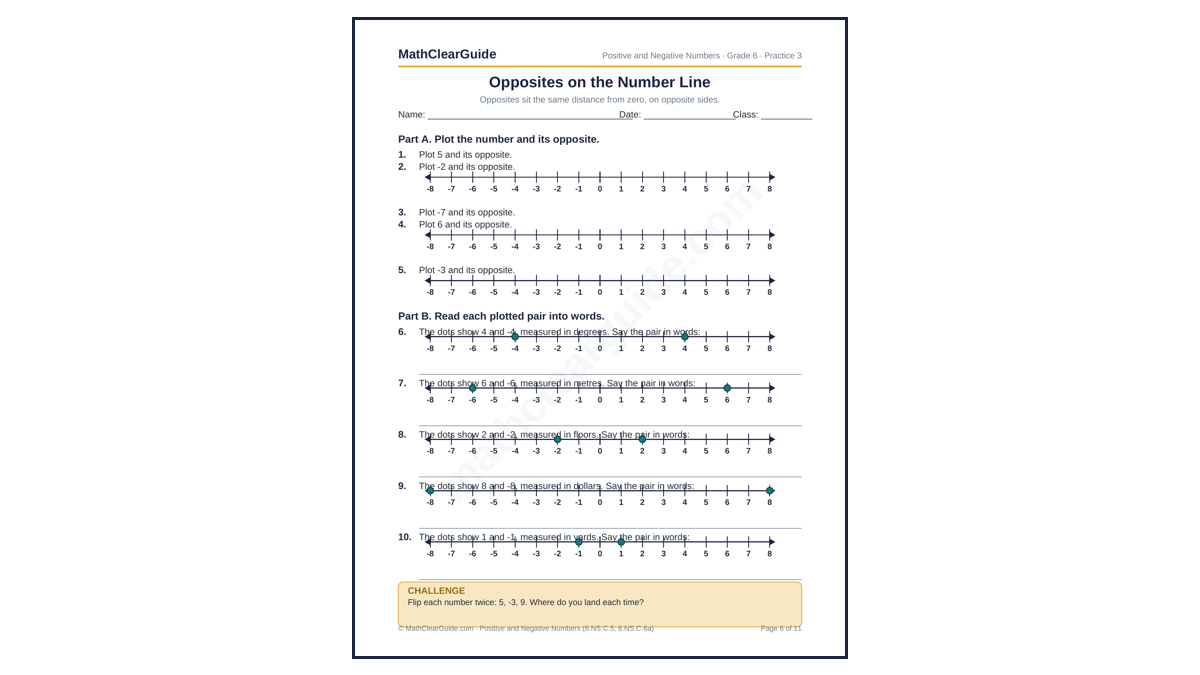
Integers are where the number line grows in both directions, and Grade 6 is where it happens. There is no earlier grade under this topic: below zero is new ground for every pupil in the room, all at once. Our Integers and Rational Numbers unit teaches that ground slowly and in order, across five lessons, and it starts with a free one. The first lesson, Positive and Negative Numbers, is a complete lesson with slides, task cards, a worksheet and a filled in key, free with an email signup: https://mathclearguide.com/resources/positive-and-negative-numbers/. The unit follows our percent unit on the Grade 6 road, and this post walks through all five lessons.
What Integers and Rational Numbers Really Mean
A signed number is a distance with a direction, measured from a zero the story chooses. Tell it three ways. A temperature of -5 degrees is 5 degrees of cold, below the zero that freezing sets. A depth of -5 metres is 5 metres down, below the zero at the surface. A balance of -5 dollars is 5 dollars owed, below the zero of an empty account. An integer is a whole number on that line, positive, negative or zero itself. A rational number is any number with one home on the line: every integer, every fraction and every decimal your class will meet this year.
Zero is the hardest working number in this unit. Every signed number is measured from it, so teach zero like it matters, because it does.
The Unit at a Glance
Every lesson follows the same shape: 23 teaching slides, a printable worksheet with a teacher guide, task cards, practice pages, and a filled in answer key that shows the working, never a bare list. The first lesson is free. The other four are member lessons. Ratios and percent came first on this road. Expressions and one-step equations come next.
| Lesson | What it teaches | Standard | Fits |
|---|---|---|---|
| 1. Positive and Negative Numbers (free) | Meaning, opposites, and what zero means in each story | 6.NS.C.5, 6.NS.C.6a | Week 1 |
| 2. Integers on the Number Line | Integers, fractions and decimals below zero and between integers | 6.NS.C.6, 6.NS.C.6c | Week 2 |
| 3. Comparing and Ordering Integers | Order by position, in symbols and in story words | 6.NS.C.7a, 6.NS.C.7b | Week 3 |
| 4. Absolute Value | Distance from zero, and how it can disagree with order | 6.NS.C.7c, 6.NS.C.7d | Week 4 |
| 5. Integers on the Coordinate Plane | Four quadrants, reflections, distances and polygons | 6.NS.C.6b, 6.NS.C.8, 6.G.A.3 | Week 5 |
Start Free: Positive and Negative Numbers
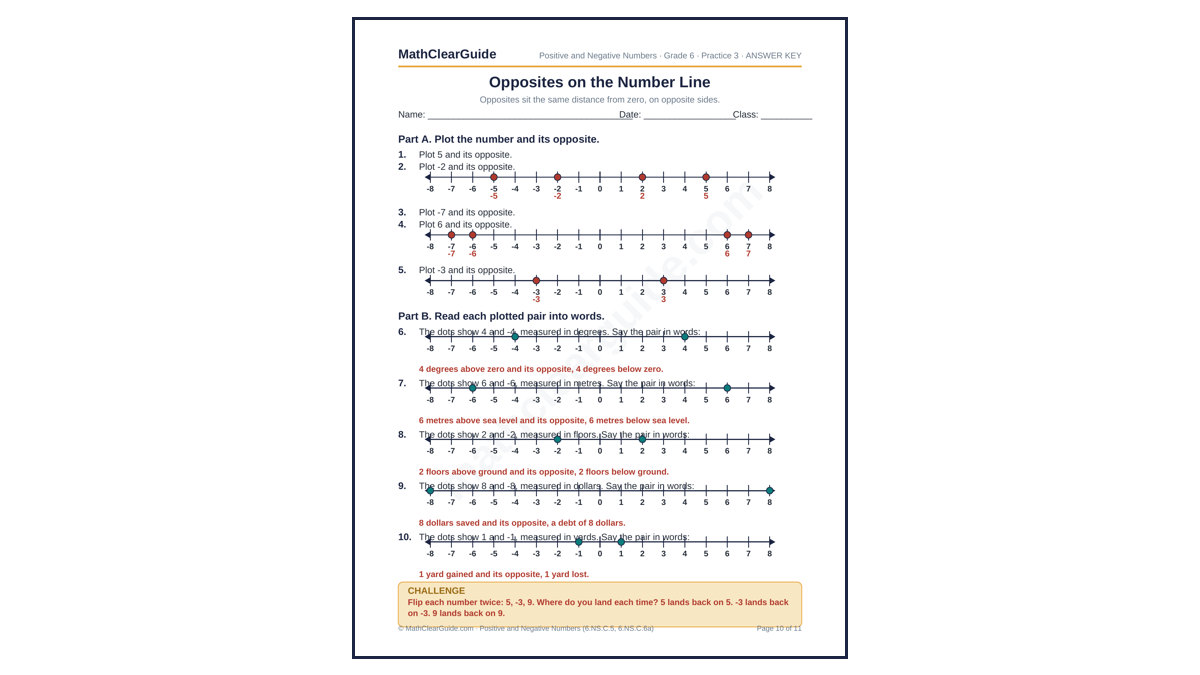
The free lesson teaches meaning before plotting, on purpose. Pupils write signed numbers for real stories first: temperatures, elevations, money, floors and games. Then they meet opposites, the pairs that stand the same distance from zero on either side. The Integer Hunt cards send pairs around the room reading a thermometer, a diver, a bank balance and a freezer. Teach it free here: https://mathclearguide.com/resources/positive-and-negative-numbers/. The line in this lesson is the fraction number line grown in both directions, the same line our free Fraction Visual Model tool practises.
Integers and Rational Numbers on the Number Line
Lesson 2 gives every rational number a home. Pupils place integers and their opposites first, then the harder ground: halves, quarters and tenths below zero and between negative integers, so -2.75 takes its place three quarters of the way from -2 toward -3. Lines stand up as well as lie down, on thermometers, a depth gauge and elevator scales. The Number Line Builder cards hand pupils a line with only 0 marked and make them choose the scale, place the value and defend the place in one sentence.

Members teach it here: https://mathclearguide.com/resources/integers-on-the-number-line/. For fresh placement practice in the same skill, the free Worksheet Generator builds it.
Comparing and Ordering Integers
Two towns wake at -2 and -9 degrees. Which town is colder? Half the class will say -2, because 2 is the smaller digit. Below zero, digit size lies: the number closer to zero is greater, and the colder town is the one further left. Lesson 3 teaches order as position and nothing else. Every inequality is a statement about where two numbers sit, every ordering set is read off a printed line, and the Order Up cards stage the traps on purpose: the bigger debt wearing the smaller balance, and the colder freezer wearing the smaller digit.
Ask the line. The line settles every argument about which negative number is greater, because position never lies.
Members teach it here: https://mathclearguide.com/resources/comparing-and-ordering-integers/.
Absolute Value: How Far From Zero
Order asks one question of a signed number. Absolute value asks a second: how far from zero does it sit? That distance is never negative, opposites share it, and it can honestly disagree with order. A balance of -40 dollars is the smaller balance and the greater debt, and both facts are true at once. Lesson 4 teaches that pair of ideas side by side until pupils can say which question they are answering. The Distance From Zero cards end in a pairing round, where every value finds the value at the same distance on the other side of zero.
Members teach it here: https://mathclearguide.com/resources/absolute-value/.
Integers on the Coordinate Plane
The capstone crosses two number lines at their zeros, and the whole unit stands up into four quadrants. Pupils plot and read points, learn that a point on an axis belongs to no quadrant, reflect points by flipping one sign, measure distances down shared columns and rows, and draw polygons from their vertices. One last page is labelled a first look at Grade 7, where signs start to move. The page says what it is, and it skips cleanly.
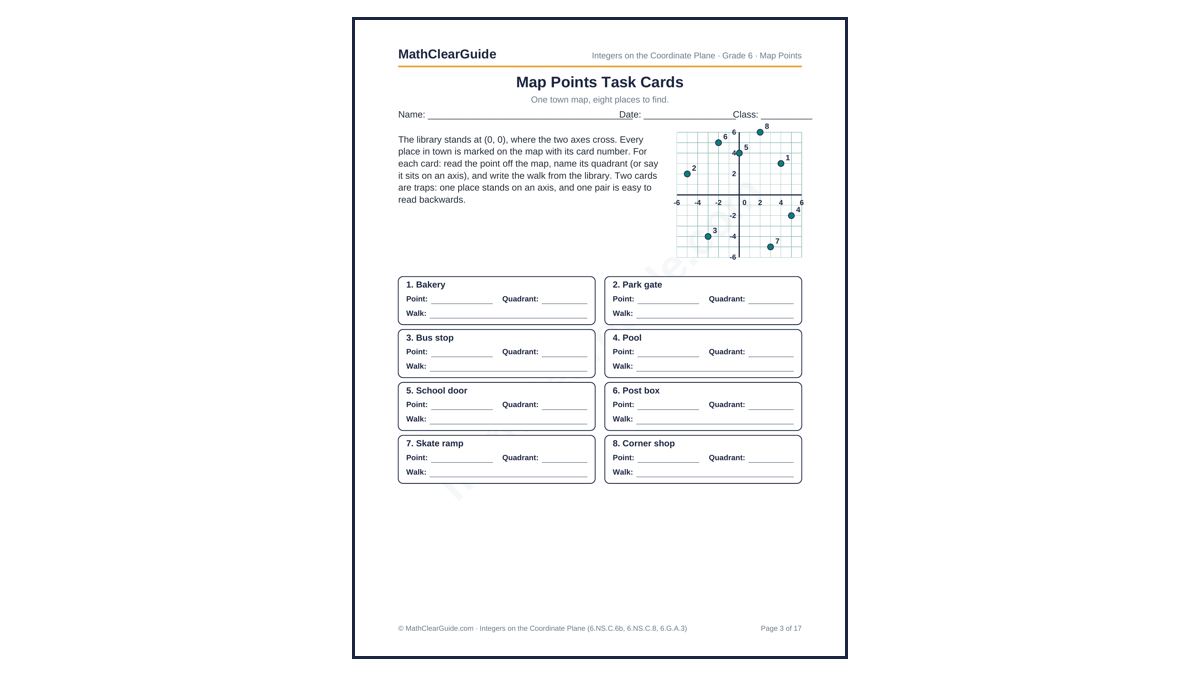
Members teach it here: https://mathclearguide.com/resources/integers-on-the-coordinate-plane/. The plotting pages pair with our free Coordinate Plane Practice tool, which drills the same skill.
Start Where Your Class Stands
Here is the honest ladder. A class shaky on fractions and decimals on a line starts one step lower, with the fraction line work: the Fraction Visual Model tool and our Grade 5 fractions lessons in the Resource Library. A class that ran the ratio unit and the percent unit is on the same Grade 6 road, and its step before this one is the percent unit free lesson, What Percent Means. Start that class at the free lesson above. And a class that finishes early should hear the plain truth: adding and subtracting integers is Grade 7 work, with its own unit coming. Expressions and one-step equations are the next Grade 6 step.
One Line, Three Questions
One printed number line can carry a whole class for one morning, at three honest levels. Support pupils place a value and its opposite, and say what zero means in the story. Core pupils order a set of five temperatures from coldest to warmest, reading the order off the line. Challenge pupils take two divers, at -18 metres and -12 metres, decide who is further from the surface, and defend the call with absolute value. Same line, same morning, three levels, and nobody is doing pretend work.
Questions Teachers Ask
Is the first lesson really free? Yes. Positive and Negative Numbers is a complete lesson, slides, cards, worksheet and key, free with an email signup. It is not a sample of the good pages. It is the good pages.
What standards does the unit teach? The 6.NS.C strand in full: 6.NS.C.5 and 6.NS.C.6a in Lesson 1, 6.NS.C.6 and 6.NS.C.6c in Lesson 2, 6.NS.C.7a and 6.NS.C.7b in Lesson 3, 6.NS.C.7c and 6.NS.C.7d in Lesson 4, and 6.NS.C.6b, 6.NS.C.8 and 6.G.A.3 in Lesson 5.
Does the unit teach adding and subtracting integers? No, and that is on purpose. This unit teaches what signed numbers mean, where they live and how they compare. Adding and subtracting integers is Grade 7 work and waits for its own unit. One labelled first look page in Lesson 5 walks a few small sums on the line for classes that are ready, and it skips cleanly for classes that are not.
What do I need to print? The task cards page and the practice pages you choose, per lesson. The slides open in PowerPoint or Google Slides.
When in the year does Grade 6 teach integers? It depends on the sequence your school follows. Many classes meet integers in the middle or second half of the year, after ratios and percent. This unit slots in whenever your sequence arrives there.
One line, drawn well, carries a child from the first negative number to every graph they will ever read.
Start With the Free Lesson
Download the free lesson and teach it this week: https://mathclearguide.com/resources/positive-and-negative-numbers/. Members unlock the other four lessons and every other grade on the site, K to 8, on one plan with no per grade stacking. Ratios first, percent in full, integers now: the road through Grade 6 is set.
Every topic clicks faster with practice. Our Resource Library has free lesson packs with slides, printable worksheets and full answer keys, ready to download and teach.
Members unlock every lesson in the library, including the full Fractions, Multiplication, Place Value, Addition & Subtraction, Time & Money and Geometry & Shapes units. See the full library


2 thoughts on “Grade 6 Integers and Rational Numbers: A Simple Guide for Teachers and Parents”