
What Is Width in Math?
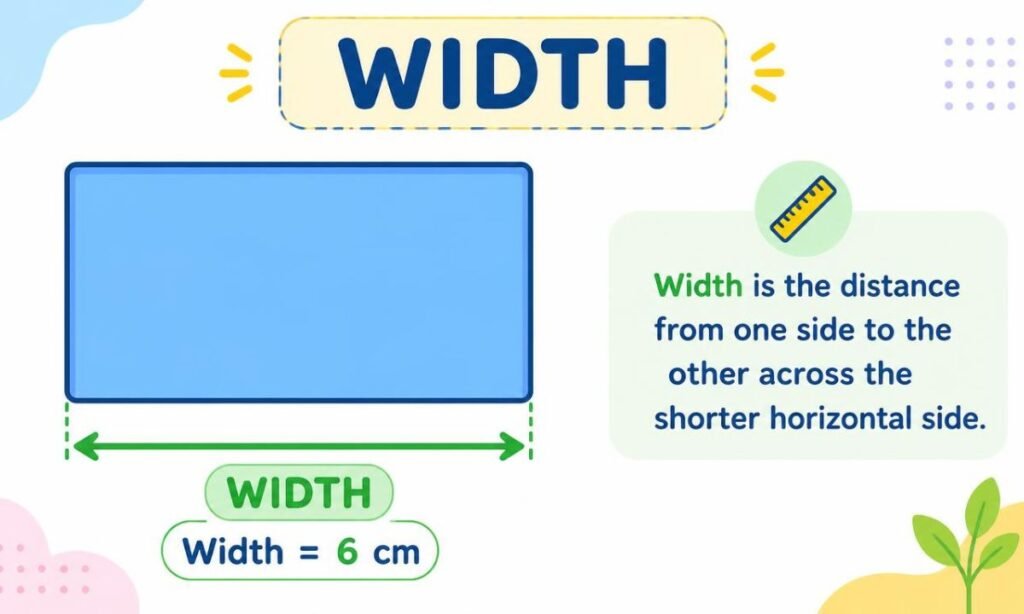
Width is the distance across an object from one side to the other. For example, you can measure the width of a book by measuring across its cover.
A width tells how wide something is. It is one way to describe an object’s size. You can measure width with equal-size objects, such as cubes, or with a ruler or measuring tape.
How Can You Tell Which Distance Is the Width?
The word width names a particular distance across an object. When a problem also gives a length, width usually refers to the other side-to-side dimension. People often use length for the longer side and width for the shorter side, but width is not always shorter.
Look at a rectangle that is 6 cubes long and 3 cubes wide. If you turn the rectangle on its side, the 6-cube length now looks vertical on the page, and the 3-cube width looks horizontal. The rectangle has not changed size. Its width is still 3 cubes. In other words, width does not always mean horizontal on the page.
A square is a helpful example, too. Its sides are equal, so its width can be the same as its length. When it is unclear which distance a question means, look for labels or words that explain the object’s dimensions. The terms length, width, and height describe different distances, depending on the object and the question.
How Do You Measure Width?
You can start with a classroom object and small cubes. Place the cubes in a straight line across the object, from one side to the other. Use cubes that are all the same size. Set them next to each other with no gaps or overlaps, then count them.
For example, if 5 cubes fit across a notebook cover, the notebook is 5 cubes wide. The cubes are nonstandard units because they are not official measurement units. They are useful for comparing objects, but another set of cubes may be a different size.
To measure with a ruler, line up one side of the object with the ruler’s zero mark. Keep the ruler straight across the width. Read the number at the other side and name the unit. If a book’s edge reaches 8 on the centimeter scale, its width is 8 centimeters. You can also measure width in inches. Starting at zero helps you measure the full distance.
How Width Helps Solve a Rectangle Problem
Width is a straight-line measurement, so it uses units such as centimeters, inches, or cubes. Area measures how much surface a shape covers, so it uses square units.
For example, a rectangle has an area of 12 square units and a length of 4 units. Imagine covering it with 12 square tiles arranged in 4 rows. Each row has 3 tiles, so the rectangle is 3 units wide. The width is 3 units, not 3 square units. This kind of missing-width problem builds on ideas students study after they begin comparing and measuring objects.
Try It: Find the Width
A rectangle is 7 paperclips long and 4 paperclips across. What is its width?
Answer: Its width is 4 paperclips. Width describes the distance across, so count the paperclips placed from one side to the other across the rectangle.
Frequently Asked Questions About Width
Is width always the shorter side?
No. Width is often the shorter side when it is paired with length, but that is not a rule. A square has equal side lengths, and an object can be turned so its width looks longer or shorter on the page.
Is width horizontal or vertical?
Width can appear horizontal or vertical, depending on how the object is turned and which distance is labeled. Follow the labels and the wording of the problem.
Can a square have a width?
Yes. A square has a width just like a rectangle does. Since every side of a square is equal, its width and length are equal.