
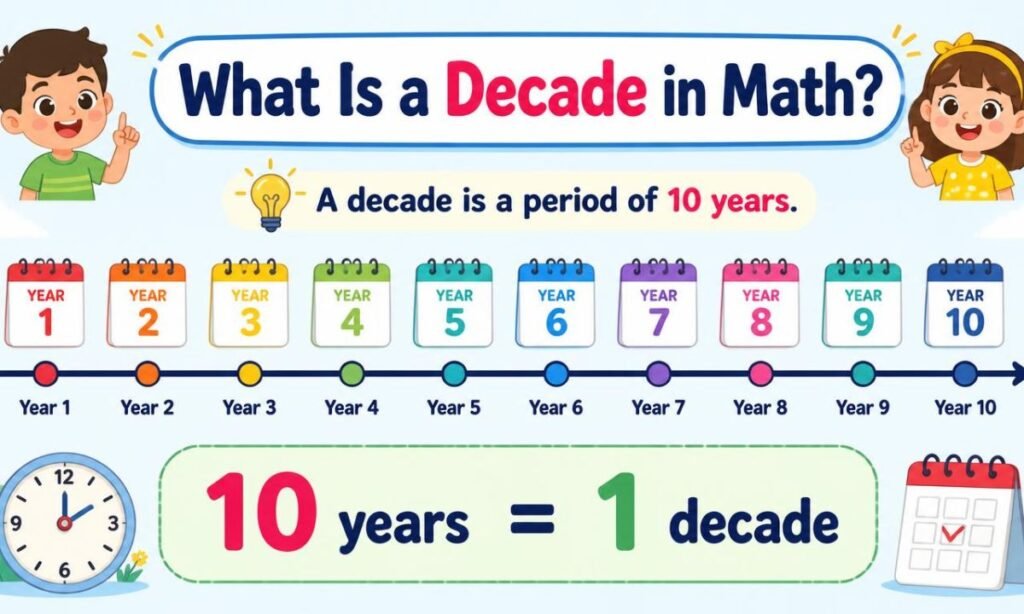
A decade is a period of 10 years in a row. For example, the years 2020 through 2029 make up one decade. When you see the word decade, think of ten calendar years grouped together.
See ten years on a timeline
Look at the years in the 2020s:
2020 → 2021 → 2022 → 2023 → 2024 → 2025 → 2026 → 2027 → 2028 → 2029
Count each year once. There are ten years, so this group is one decade. It begins on January 1, 2020, and ends on December 31, 2029.
A small counting detail can be confusing. If you subtract 2020 from 2029, the answer is 9. But the list has ten year labels because you count both 2020 and 2029:
2020 is year 1, 2021 is year 2, and 2029 is year 10.
This is like counting objects in a row. If a row has a first block and a tenth block, there are ten blocks altogether, even though there are nine spaces between them.
A decade can start in different years
A decade is any period of ten years. It does not always have to start in a year ending in 0. For example, 2015 through 2024 is also ten consecutive calendar years.
When a problem gives you a starting and ending year, list or count all the years it includes. Do not decide whether it is a decade just by checking whether the first year ends in zero. The key question is whether the period includes ten years.
How does a decade compare with a year and a century?
| Time unit | How long it is |
| 1 year | 1 year |
| 1 decade | 10 years |
| 1 century | 100 years |
Ten decades make one century. You can show this with multiplication: 10 decades × 10 years in each decade = 100 years. This connects time units with groups of ten.
You can also use division to count decades. If a history book covers 30 years, divide 30 by 10. The book covers 3 decades. If the number of years is not a multiple of ten, there may be extra years. For example, 25 years is 2 decades and 5 years.
Make a decade with year cards
Write the years 2030, 2031, 2032, 2033, 2034, 2035, 2036, 2037, 2038, and 2039 on ten cards. Mix them up, then put them in order. Point to each card and count from 1 to 10.
Ask: “How do you know these years make one decade?” A good answer is: “There are ten years in a row.” Try again with 2010 through 2019. The activity works with any set of ten consecutive calendar years.
Why do some people say a new decade started in 2021?
In everyday use, the 2020s means 2020 through 2029. People also group years such as 1990 through 1999 as “the 1990s.” This common naming pattern starts with a year ending in 0 and ends with a year ending in 9.
You may hear a different date when people talk about numbered centuries. The calendar has no year zero. The first century ran from year 1 through year 100, so the 21st century began in 2001. That is a different way of counting centuries. It does not change the usual meaning of “the 2020s.”