

A number line is the simplest tool in math class. It is one straight line, cut into equal steps, with a number on every step.
That plain line carries more teaching than almost any poster. Counting, adding, subtracting, rounding and fractions all live on it.
This post shows how the line works and seven activities that turn it into daily practice.
Every activity works with our free number line printable, with lines from 0 to 10, 0 to 20, 0 to 100 and fractions from 0 to 1.
What is a number line?
A number line shows numbers in order, spaced out evenly. Zero sits at the left, and the numbers grow by the same step at every tick.
Equal steps are the whole point. When each step is the same size, distance on the line means something real.
A jump of 5 covers the same ground anywhere on the line. That one fact is what makes the line honest.
Children who trust the spacing stop guessing. They can see that 8 sits closer to 10 than to 0, and they can prove it.
Adding with jumps
Adding on a number line is jumping forward. To add 7 + 5, start at 7 and make 5 jumps to the right.
You land on 12, and the jumps show the answer instead of hiding it. Nothing is carried, borrowed or memorized.
Bigger sums use bigger jumps first. For 28 + 13, jump 10 to 38, then jump 3 to 41.
That habit grows into mental math. Children who jump on a line start jumping in their heads.
On a number line, adding is just jumping forward. The answer is the tick you land on.
Subtracting with jumps back
Subtraction is the same picture in reverse. Start at the bigger number and jump back.
For 15 – 6, start at 15 and make 6 jumps to the left. You land on 9.
The line also shows subtraction as a gap. The distance between 9 and 15 is 6, which is why the answer works.
Children who see both views stop mixing up the two operations. Direction on the line tells them which one they are doing.
Rounding on the line
Rounding confuses children when it is only a rule about digits. On the line, rounding is just finding the closer end.
To round 47 to the nearest 10, find 47 between 40 and 50. It sits closer to 50, so 47 rounds to 50.
The halfway point does the deciding. Numbers past halfway round up, and numbers before it round down, and the line shows halfway clearly.
Once a child can see rounding, the digit rule starts to make sense. The rule becomes a shortcut for what the line already proved.
Rounding is not a trick with digits. It is a question the line answers: which end is closer?
Fraction number lines

A fraction number line runs from 0 to 1. The whole line is one whole, cut into equal parts.
On the halves line, 1/2 sits at the middle tick. On the fourths line, 2/4 lands on the very same point.
That matching point teaches equivalence without a rule. Two names, one spot on the line, one amount.
Our Fraction Number Line tool lets children place fractions on a line on screen and check each try at once.
For a wall version of the same idea, the free fraction wall printable shows the matching rows stacked together.
Seven number line activities
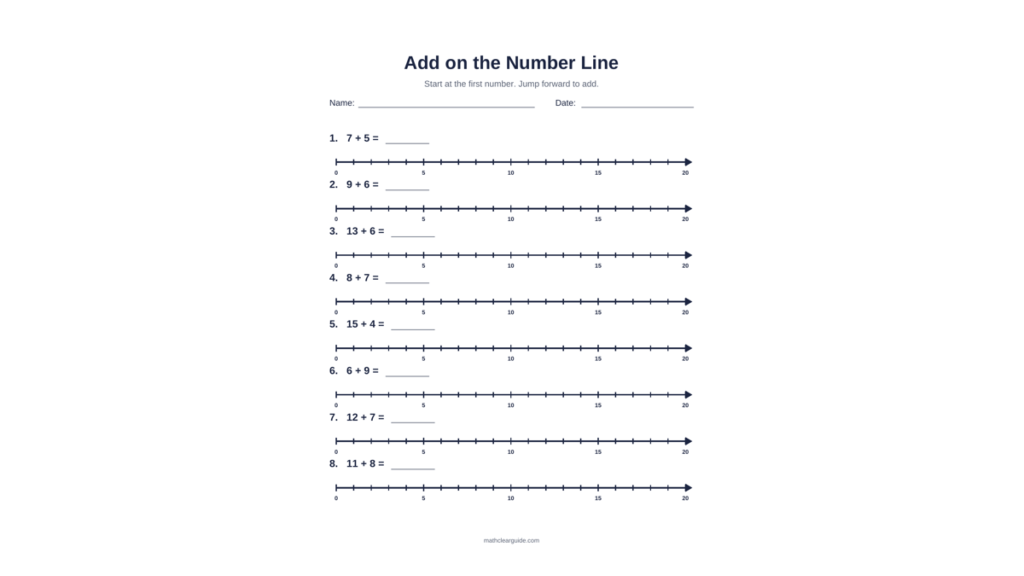
Print one line for the table and a blank copy for each child. Most of these activities take ten minutes and a pencil.
1. Fill the Blank Line. Hand over the blank 0 to 20 line. Your child writes the missing numbers under the ticks, then checks against the labelled line.
2. Jump and Land. Call out a start and a jump, like start at 6, jump forward 7. Your child draws the jumps and says the landing number.
3. Jump Back. The same game in reverse. Start at 18, jump back 9, and land on 9.
4. Halfway Hunt. Name two numbers, like 30 and 40. Your child finds the number that sits exactly halfway between them.
5. Round and Reason. Pick a number like 83. Your child finds it on the 0 to 100 line, names the two tens around it, and says which one is closer.
6. Counting Jumps. Ask how many jumps of 2 it takes to get from 0 to 14. Your child jumps and counts: 7 jumps.
7. Fraction Match. On the fraction lines, your child finds 1/2, then finds every fraction on the other lines that lands on the same point.
Worksheets with lines to 50 and 120, rounding practice and task cards sit in our Number Line Pack for members, with a full answer key.
Common mistakes to watch for
Counting the starting tick. A child adding 7 + 5 counts the 7 as the first jump and lands on 11. Teach the rule: start on the number, count the jumps, not the ticks.
Uneven steps on hand drawn lines. A line a child draws with uneven spacing gives wrong answers. Start with printed lines, where every step is exact, and let drawing come later.
Rounding by the wrong digit. Children sometimes round 47 by looking at the 4. The line fixes this: find the number first, then look at the two ends around it.
Start on the number, count the jumps. That one habit fixes most number line mistakes.
Questions teachers and parents ask
What is a number line? It is a straight line with numbers placed in order at equal steps. It shows counting, adding, subtracting, rounding and fractions as distances and jumps.
What age is a number line for? Children meet simple lines in first and second grade, counting and adding to 20 and 100. The same tool carries rounding in third grade and fractions after that.
How do I teach addition on a number line? Start at the first number and jump forward by the second number. The tick you land on is the answer, and the jumps show the working.
Why does my child land one short when adding? Most children count the starting tick as a jump. Have them say the start number, then count only the jumps they make.
Where can I get free printable number lines? In our Resource Library. Our free number line printable holds lines to 10, 20 and 100 plus fraction lines, each with a blank copy.
A number line costs one sheet of paper.
Used a little each week, it turns adding, subtracting and rounding from rules to memorize into moves a child can see.
Print the free lines, grab a pencil, and try Jump and Land today.
Reading about it is one thing, practising it is another. Our free What Is Place Value? lesson builds the idea step by step, with slides, a printable worksheet and a full answer key.
Members unlock every lesson in the library, including the full Fractions, Multiplication, Place Value, Addition & Subtraction, Time & Money and Geometry & Shapes units. See the full library


