
Multiplication flashcards are the oldest fact practice tool there is, and they still work. A card asks one question, and the answer waits on the back.
What makes them work is not the card. It is the game you wrap around it.
This post shares seven multiplication flashcard games that turn a plain deck into practice children ask for. Every game works with one printed deck and a few minutes.
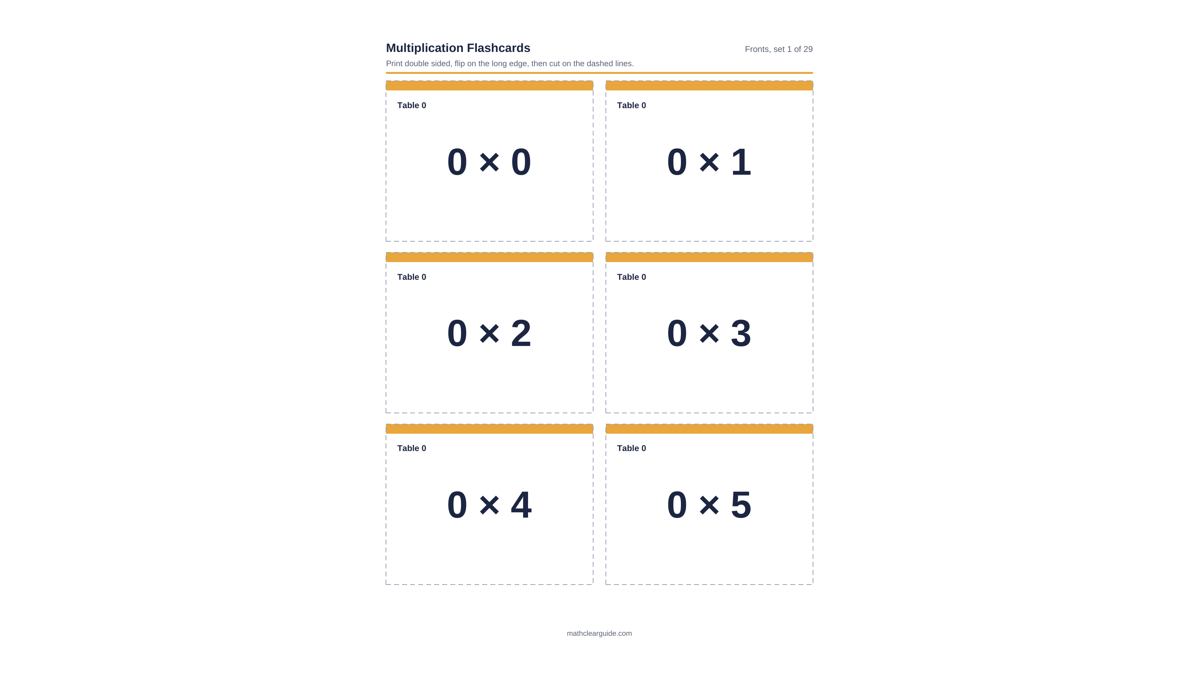
Our free multiplication flashcards printable holds every fact from 0 × 0 to 12 × 12, with the answer on the back of each card.
What makes flashcards work
A flashcard gives one fact at a time. There is nothing else on the card to hide behind, so the child either knows it or learns it on the spot.
The answer sits on the back, so checking takes one flip. Fast feedback is what turns a guess into a memory.
Short rounds beat long ones. Five minutes a day with a small pile of cards does more than one long session on the weekend.
Flashcards also show their work. A pile of cards a child can answer fast is proof of progress that the child can hold in one hand.
A flashcard is a tiny test with the answer key built in. The flip is where the learning happens.
Print the deck once, play all year
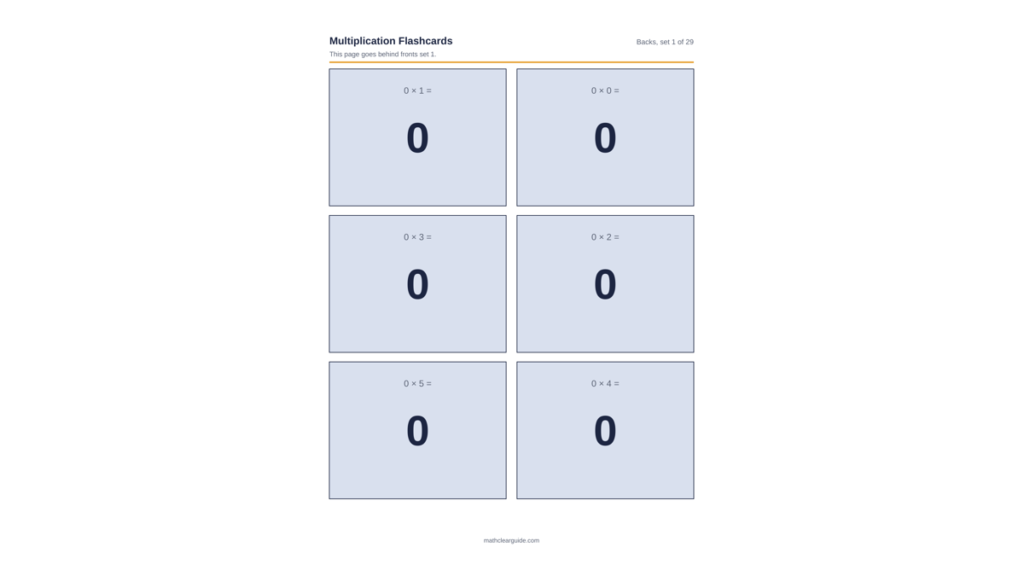
Print the front and back pages double sided, and flip on the long edge. Every answer then lands right behind its fact.
Cut on the dashed lines and keep the deck in a zip bag or a small box. A deck that lives in the math folder gets used all year.
Pair the deck with a chart on the wall for the facts that are still new. Our multiplication chart printable prints the full 1 to 12 chart in color and black and white.
Start with one table at a time. The deck is ordered by table, so the 7s are easy to pull out on their own.
A rubber band around one table keeps a working set together between rounds, so a child can pick up exactly where they left off.
Seven multiplication flashcard games
Print one deck per child if you can. Most of these games take five to ten minutes, a table and a pencil.
1. Flip and Say. Hold up a card. Your child says the whole fact out loud, seven times eight is fifty six, then flips to check. Saying the full fact builds a stronger memory than the answer alone.
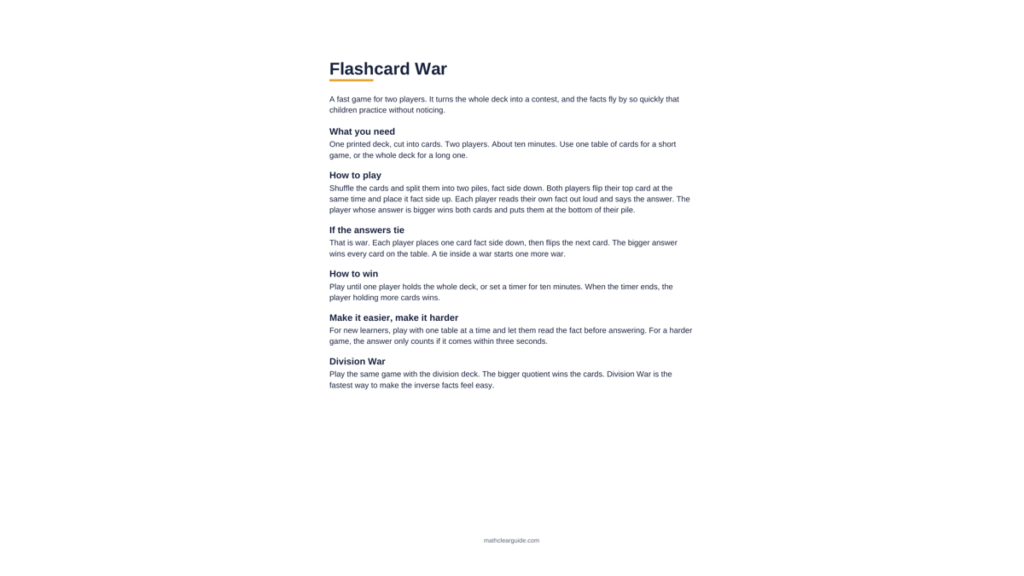
2. Flashcard War. Two players split the deck and flip one card each. The bigger answer wins both cards, and a tie starts a war. The full rules, a division version and record sheets sit in our Multiplication Flashcards Pack for members.
Children will drill fifty facts in a game of War and call it playing. That is the whole trick.
3. Beat the Clock. Set a timer for one minute and flip cards as fast as your child can answer. Count the right answers, write the score down, and try to beat it next time.
4. Sort the Facts. Work through one table and make two piles, fast facts and practice facts. Play only with the practice pile until it shrinks, then sort again. The shrinking pile shows progress better than any score.
5. Fact Family Flip. Pick a card, like 6 × 7 = 42. Your child says the turn around fact, 7 × 6, and the matching division fact, 42 ÷ 7. One card teaches three facts at once.
6. Race the Chart. Call out a product, like 56. Your child finds a card that makes it, then checks the fact on the chart. Our free Multiplication Chart tool shows each fact as groups and arrays.
7. Cover a Number. Cover one number on a card with your thumb. Your child works out the missing number from the answer, like the missing 8 in a card that shows a covered number times 8 equals 56.
Between games, our Math Fact Practice tool gives timed practice on screen when there is no partner around.
Common mistakes to watch for
Drilling the whole deck at once. One hundred sixty nine cards is a wall, not a pile. Start with one table, master it, then mix in one more table at a time.
Only ever asking in order. Children can chant the 7s in order and still freeze on 7 × 8 alone. Shuffle the table before you play, so every fact has to stand on its own.
Skipping the facts a child already knows. Fast cards feel good and build speed. Keep a few known facts in every round so the practice pile never feels like punishment.
Shuffle the deck. A fact a child can only say in order is a song, not a skill.
Questions teachers and parents ask
What age are multiplication flashcards for? Most children start in second grade with the easy tables and use the full deck through third and fourth grade, while times tables become memory work.
How many facts are in a full deck? Facts from 0 × 0 to 12 × 12 make 169 cards. Start with the table your child is learning now, and add tables one at a time.
How do I print the backs in the right place? Print double sided and choose flip on the long edge in your printer settings. The back pages are mirrored, so each answer lands behind its own fact.
What if my child hates flashcards? Skip the plain drill and go straight to the games. War and Beat the Clock hide the practice inside a contest, and most children forget they are drilling.
Where can I get a free deck? In our Resource Library. Our free multiplication flashcards printable holds the color deck for facts 0 to 12, with answers on the back and cut guides on every page.
A deck of flashcards costs a few sheets of paper and ten minutes with the scissors.
Played a little each week, it turns times tables from a chant into facts a child owns.
Print the free deck, start with one table, and play a round of War today.
Reading about it is one thing, practising it is another. Our free What Is Multiplication? lesson builds the idea step by step, with slides, a printable worksheet and a full answer key.
Members unlock every lesson in the library, including the full Fractions, Multiplication, Place Value, Addition & Subtraction, Time & Money and Geometry & Shapes units. See the full library


