

The numerator is the top number of a fraction. It counts how many equal parts you have.
New to fractions? Our free What Is a Fraction? lesson builds the idea of numerators and denominators from the very start, with slides, a printable worksheet and a full answer key.
See numerators in action with our free fraction calculator — enter any fraction and watch each step.
What Is a Numerator?
Every fraction has two numbers with a line between them, and each number has a name and a job. The top number is called the numerator. Its job is counting: it tells how many parts are being talked about, shaded, eaten, or counted.
Picture a pizza cut into 8 equal slices. You eat 3 slices. The fraction for your dinner is 3/8. The numerator is 3, because 3 is the number of slices you took. The pizza math stays honest because the top number only ever counts parts.
The word itself is a hint. Numerator comes from an old Latin word meaning “to count.” If you squish the words “number” and “numerator” together, you get a memory trick teachers love: the number-ator tells the number of parts. Say it once and it sticks.
How Do You Find the Numerator in a Fraction?
Finding the numerator takes two seconds. Look at the fraction, find the line in the middle, and read the number sitting on top of it. That is the numerator. In 5/6, the numerator is 5. In 1/2, the numerator is 1. In 7/10, the numerator is 7.
Fractions do not always sit neatly on top of each other. Sometimes they are written with a slash, like 3/4. The rule still holds: the first number, the one before the slash, is the numerator. Top of the stack or left of the slash, it is the same number doing the same job.
Try it like a classroom warm-up. The teacher flashes fraction cards and the class shouts only the numerator. She holds up 4/9 and the room calls out “Four!” She holds up 2/5 and they call “Two!” After a dozen cards, nobody hesitates. The numerator is always the top number, and now their eyes find it on their own.
What Does the Numerator Tell You?
The numerator answers the question “how many?” Imagine a chocolate bar split into 6 equal rectangles. The picture shows 6 parts total, but the story is about how many you get. If you take 1 rectangle, the numerator is 1. If you take 4 rectangles, the numerator is 4. The bottom number never moves. Only the numerator changes as the story changes.
This is why the numerator matters so much in comparing fractions. Look at 2/8 and 6/8. Both fractions talk about eighths, so the piece size is identical. The only difference is the numerator: 2 pieces versus 6 pieces. More pieces of the same size means more altogether, so 6/8 is bigger than 2/8. When the bottom numbers match, the top number does all the talking.
The numerator also tells a story about sharing. Four friends share 3 pizzas equally. Each friend gets 3/4 of a pizza. Read the numerator and you hear the story: 3 pizzas being shared. Read the bottom number and you hear the rest: among 4 friends. The numerator always carries the “how many” part of the tale.
Numerator vs Denominator: What Is the Difference?
Common Mistake: mixing up which number is which. Students learn fractions and promptly swap the two numbers in their heads. The fix is a pair of memory tricks. The numerator is the number on top, and it counts the parts you have. The denominator is down below, and it names the total number of equal parts in the whole.
Line them up side by side. In the fraction 3/4, the numerator 3 says “we have 3 parts” and the denominator 4 says “the whole is cut into 4 equal parts.” One counts, the other names. If you remember that the numerator is the counter and the denominator is the namer, the two never get tangled.
Here is one more way to keep them straight. The denominator is like a last name shared by a family of fractions. All the fourths, 1/4, 2/4, 3/4, belong to the same family because their pieces are the same size. The numerator is the first name that tells the fractions apart. Same family, different first names.
Try It: The Numerator Scavenger Hunt
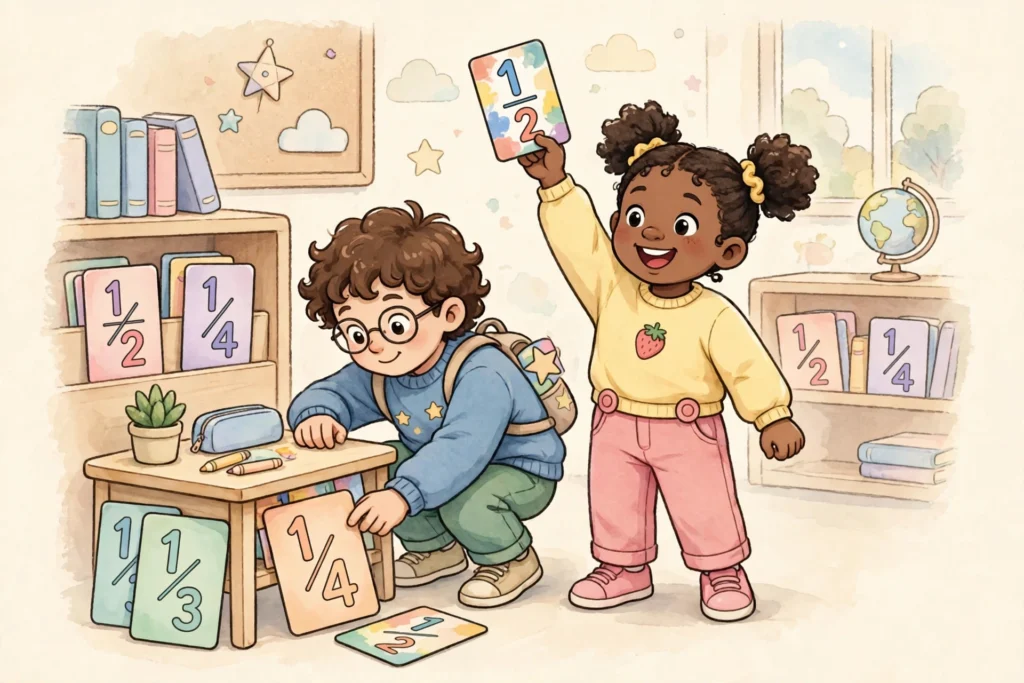
Write 12 fractions on index cards with big, clear numbers: 1/2, 3/4, 2/3, 5/8, 1/4, 4/5, 2/8, 3/5, 1/3, 6/8, 4/6, 2/4. Hide the cards around the classroom. Each student gets a recording sheet with two columns: “Fraction” and “Numerator.”
Round 1: Hunt. Students search the room, and each time they find a card, they copy the fraction onto their sheet and write its numerator beside it. Remind them: top number only. Speed counts, but accuracy counts more.
Round 2: Sort. Back at their desks, students sort their found fractions into groups by numerator. All the cards with a numerator of 1 go together, all the 2s together, and so on. Ask: “Which numerator showed up the most? Which showed up the least?”
Round 3: Story time. Each student picks one card and tells the story of its numerator. For 5/8, the story might be: “A pizza cut into 8 slices, and I ate 5 of them. The 5 is the numerator because it counts my slices.” The class votes on the most creative story.
Round 4: Switch. Now cover the numerators with sticky notes and quiz a partner: “The fraction is 3/4. What is the numerator?” Partners take turns until every card has been quizzed both ways.
Quick Practice
Question: In the fraction 5/8, what is the numerator, and what does it tell you?
Worked answer: The numerator is 5, the top number. It tells you that 5 of the 8 equal parts are being counted, for example 5 slices out of a pizza cut into 8 slices.
Related Terms
- Equivalent Fractions – different fractions with different numerators that name the same amount.
- Improper Fraction – a fraction whose numerator is bigger than its denominator.
- Mixed Number – a whole number paired with a fraction, like 1 and 3/4.
- Quotient – the answer to a division problem, which a fraction can also show.
- Quarter – one of four equal parts, as in the fraction 1/4.
Our Subtracting Fractions with Like Denominators lesson shows why only the numerators change when the denominators match.
Frequently Asked Questions
Where does the word numerator come from?
It comes from a Latin word meaning “to count.” That is fitting, because the numerator’s whole job is counting how many parts of the whole are being talked about.
Can the numerator be bigger than the denominator?
Yes. A fraction like 5/4 has a numerator of 5 and a denominator of 4. It names more than one whole, which makes it an improper fraction. Picture one whole pizza plus one extra slice from a second pizza.
Can the numerator be zero?
Yes. In the fraction 0/5, the numerator is 0, which means none of the parts are being counted. Zero fifths is just another way of writing zero.
How do you remember which number is the numerator?
Think “number-ator”: the numerator is the number on top, and it counts the number of parts you have. For the bottom number, think “down-nominator”: the denominator sits down below.
Reading about it is one thing, practising it is another. Our free What Is a Fraction? lesson builds the idea step by step, with slides, a printable worksheet and a full answer key.
Members unlock every lesson in the library, including the full Fractions, Multiplication, Place Value, Addition & Subtraction, Time & Money and Geometry & Shapes units. See the full library


