
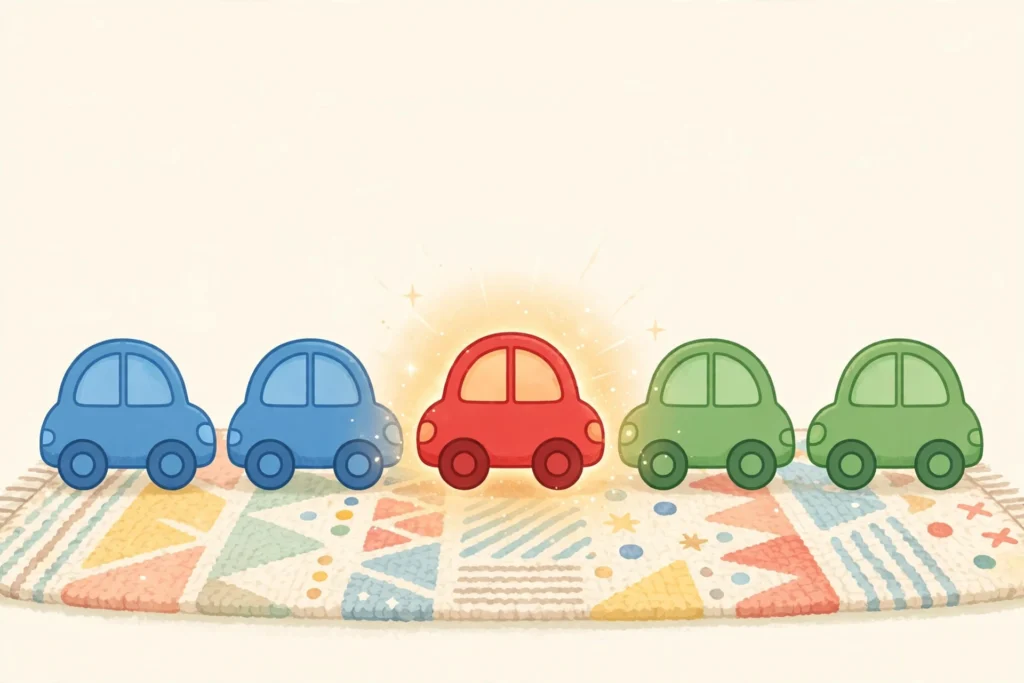
In math, “between” means in the middle of two things. A number is between two numbers when it is greater than the smaller one and less than the larger one.
What Does “Between” Mean in Math?
The word “between” shows up long before fractions or multiplication. In kindergarten, children use it as a position word: the green block sits between the red block and the yellow block. It tells where something is, right in the middle of two other things.
By first grade, “between” stretches onto the number line. A number that sits between two other numbers is larger than the smaller number and smaller than the larger number. The number 5 sits between 3 and 8, because 5 is greater than 3 and less than 8. The number 25 sits between 20 and 30. The idea is the same in both cases: find the middle.
Here is a simple test. To check whether a number is between two numbers, ask two questions. Is it greater than the smaller one? Is it less than the larger one? If both answers are yes, the number is between them. Is 6 between 4 and 9? Yes: 6 is greater than 4 and less than 9.
What Does “Between” Mean for Position?
Position words help children describe the world, and “between” is one of the busiest. Teachers pair it with above, below, and next to during spatial-awareness lessons. “Between” answers the question “where?” by pointing to the middle of two landmarks.
Try it at circle time. Line up three students. Ask the class who is standing between the other two. Every eye finds the middle student. Move the line to four students and ask again: who is between the first and last student? Now two students stand between them. That second question sneaks in early counting and comparing, which is exactly what teachers want.
Picture books and classroom games build the same skill. A bear hides between two trees. A marble rests between two cups. Each time, children scan left and right, locate the two ends, and settle on the middle. That scanning habit later helps them read number lines and graphs.
How Do You Find a Number Between Two Numbers?
Finding a number between two numbers is a first-grade superpower. Start with numbers close together, like 4 and 6. Count from 4: 5, 6. The number 5 comes after 4 and before 6, so 5 is between 4 and 6. Counting is the whole strategy.
For numbers farther apart, a number line does the heavy lifting. Mark 10 and 20 on a line. Point to the space in the middle. The number 15 sits right there, between 10 and 20. Any number from 11 to 19 works too. There is no single right answer when the gap is wide, and that freedom delights young mathematicians.
Did You Know: The word “between” helps you order numbers from least to greatest. When you sort 7, 3, and 9, you place 7 between 3 and 9. Ordering is just repeated “between” thinking: each number finds its spot in the middle of its neighbors.
Watch for one tricky case: a number cannot be between itself and another number. Is 8 between 8 and 12? No. It is equal to one of the ends, not greater than it. The test from earlier catches this: 8 is not greater than 8, so it fails the check.
What Does “Between” Look Like on a Number Line?
A number line turns “between” into a picture. Draw a line and mark 0 through 10. The number 7 sits between 5 and 10 because its dot lands in the stretch from 5 to 10. Children can see the middle instead of only imagining it.
Teachers often circle the two end numbers and shade the space between them. Then they ask: which numbers live in the shaded part? For ends 2 and 6, the answer is 3, 4, and 5. This shading game prepares students for intervals and inequalities years later, though nobody needs those big words yet.
The number line also shows that “between” works in both directions. Whether you travel left to right or right to left, 4 still sits between 2 and 6. Position on the line is what matters, not the direction of your eyes.
Try It: The Number Sandwich

You need painter’s tape, index cards, and markers. This activity takes about 15 minutes and gets the whole class moving.
Tape a long number line on the floor, marked 0 through 20. Write numbers on index cards. Circle two end numbers on the line with tape, for example 5 and 15. Hand a student a number card, such as 11, and ask: does it fit between the circled numbers? The student walks the line, checks both ends, and places the card.
Play several rounds. Start with easy cards that clearly fit, like 10 between 5 and 15. Then try edge cards: 5 itself, or 16. The class votes thumbs up or thumbs down. Each vote must come with a reason: “16 is not less than 15, so it is not between.” Reasons are the real lesson.
Finish with the sandwich twist. Two students stand on the circled end numbers, holding them like bread slices. A third student stands on a middle number, the filling. The class names the sandwich: “11 is the filling between 5 and 15.” Then the filling picks the next two slices of bread.
Quick Practice
Which number is between 30 and 40: 25, 35, or 45?
The answer is 35. It is greater than 30 and less than 40, so it passes the two-question test. The number 25 is less than 30, and 45 is greater than 40, so neither is between 30 and 40.
Related Terms
Frequently Asked Questions
What does “between” mean in math?
“Between” means in the middle of two things. A number is between two numbers when it is greater than the smaller number and less than the larger number.
What number is between 4 and 6?
The number 5 is between 4 and 6. Count from 4: 5 comes next, and 5 comes before 6.
How do you know if a number is between two numbers?
Ask two questions: is it greater than the smaller number, and is it less than the larger number? If both answers are yes, the number is between them.
Is 8 between 8 and 12?
No. The number 8 is equal to one of the ends, not greater than it. A number must be strictly greater than the smaller end and strictly less than the larger end to be between them.
Every topic clicks faster with practice. Our Resource Library has free lesson packs with slides, printable worksheets and full answer keys, ready to download and teach.
Members unlock every lesson in the library, including the full Fractions, Multiplication, Place Value, Addition & Subtraction, Time & Money and Geometry & Shapes units. See the full library


