
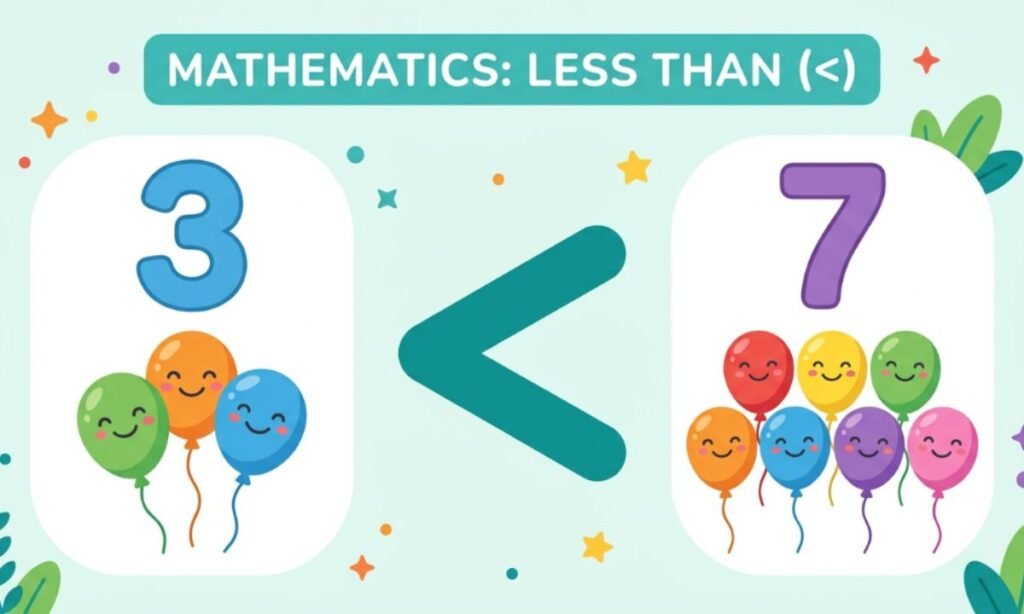
Less Than in Math
Less than tells us that one number or amount is smaller than another. The symbol for less than is <.
For example:
3 < 8
Read this comparison as “three is less than eight.” The number 3 is smaller than the number 8.
See Less Than With Real Objects
A child can understand less than by comparing two groups of objects. Imagine 3 blue cubes in one group and 8 yellow cubes in another group.
The blue group has fewer cubes. The yellow group has more cubes. Since 3 is a smaller number than 8, we can write:
3 < 8
One way to check is to match the cubes one at a time. After all 3 blue cubes have a partner, 5 yellow cubes remain. That tells us the blue group has less than the yellow group.
Counting also helps. Count the first group, count the second group, and compare the numbers. This gives children a clear path from real objects to written math.
How to Read the Less-Than Symbol
The symbol < has a narrow point and a wide, open side. When it is used correctly, the point faces the smaller number and the open side faces the larger number.
Look at this example:
4 < 9
The point faces 4 because 4 is the smaller number. The open side faces 9 because 9 is the larger number.
Always compare the numbers first. Then choose the symbol. This is more reliable than guessing from the shape alone.
Use a Number Line to Find the Smaller Number
A number line is another helpful model. On a number line with positive whole numbers, numbers farther to the left are smaller.
For example, 2 is to the left of 7:
0 1 2 3 4 5 6 7 8
Because 2 is farther left, 2 is less than 7.
2 < 7
The distance between the numbers does not change the meaning. Whether the numbers are close, such as 6 and 7, or farther apart, such as 1 and 9, the number farther left is less.
Teaching Strategies for Less Than
Start with objects before asking students to use the symbol. Give a child two groups of counters and ask, “Which group has fewer?” After the child counts or matches the groups, write the comparison together.
Next, use a number line. Ask the child to point to both numbers and name the one farther left. Then have the child say the full sentence before choosing <.
For students who reverse the symbol, cover the numbers and have them trace the point and open side with a finger. Uncover the numbers, decide which is smaller, and place the point toward that number. This keeps the focus on comparing values instead of memorizing an animal-shaped trick.
Short oral practice also helps. Say two numbers, such as 5 and 9, and ask the student to answer in three ways: “5 is less than 9,” “5 is smaller than 9,” and 5 < 9.
Turn the Comparison Around
The same two numbers can show the relationship from the other direction:
3 < 8
and
8 > 3
Both statements tell us that 3 is smaller than 8. The first statement starts with the smaller number. The second statement starts with the larger number and uses the greater-than symbol.
Read every comparison from left to right. In 3 < 8, the statement says “3 is less than 8,” not “8 is less than 3.”
Less Than, Fewer Than, and Smaller Than
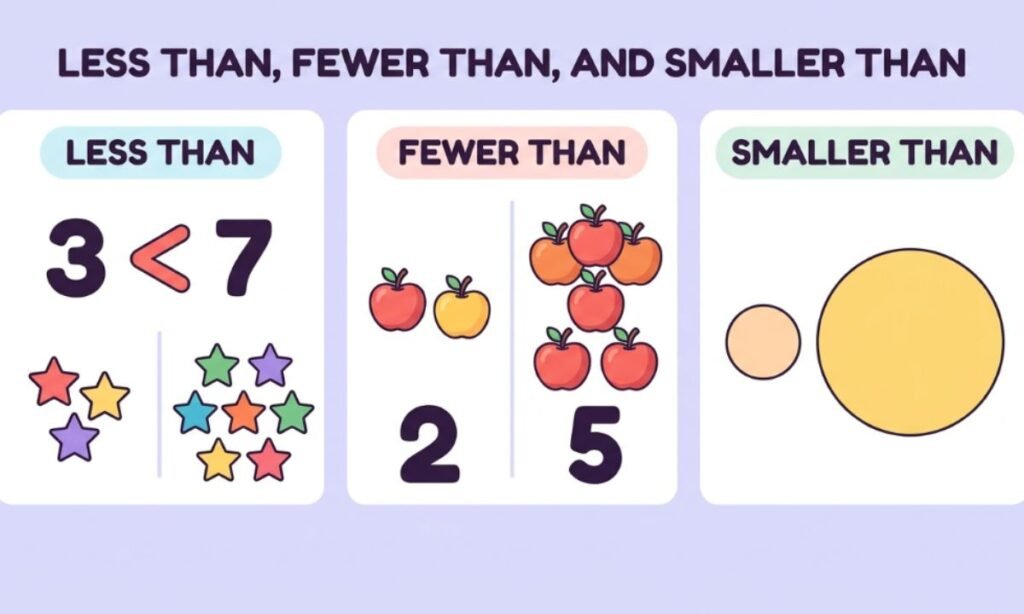
These phrases are related, but they are used in slightly different ways.
•Less than is common in mathematical comparisons, such as 5 < 10.
•Fewer than usually describes a smaller number of countable objects, such as “6 birds are fewer than 9 birds.”
•Smaller than describes a number with a lower value or an object with a smaller size.
For early math, children may hear “fewer” when comparing groups of objects and “less than” when writing a number sentence. Both ideas point to a comparison between a smaller amount and a larger amount.
A Quick Way to Check Your Answer
Use these three steps:
1.Look at the two numbers or groups.
2.Decide which one has the smaller amount or value.
3.Write < with its point facing the smaller number.
Try the comparison 7 __ 12.
Seven is smaller than twelve, so the completed statement is:
7 < 12
Read it aloud: “Seven is less than twelve.”
Less Than 7, 50, and 100
The same symbol works with any number. To say that an unknown number is less than 7, write:
n < 7
This means that n can be any number smaller than 7, such as 0, 2, or 6. The symbol for “less than 7” is not a special new sign. It is still <, placed before 7 in a comparison.
The same pattern works for larger numbers:
•n < 50 means n is less than 50.
•n < 100 means n is less than 100.
If you already know the number, write it on the left. For example, 46 < 50 means 46 is less than 50, and 72 < 100 means 72 is less than 100.
Common Mistake: Reversing the Symbol
A frequent mistake is to write the symbol in the wrong direction. For example:
9 < 4
This statement is false because 9 is not less than 4. Nine is greater than 4. The correct comparison is:
4 < 9
A good check is to name the smaller number before writing the symbol. The point of < must face that smaller number.
Try It Yourself
Complete each comparison.
1.2 __ 6
2.9 __ 5
3.“7 is ___ than 10.”
4.Draw one group with fewer objects than a second group. Write a number sentence to show your comparison.
Answers:
1.2 < 6
2.9 > 5 because 9 is greater than 5.
3.“7 is less than 10.”
4.Answers will vary. For example, 3 buttons and 6 buttons can be shown as 3 < 6.
Related Comparison Symbols
| Symbol | Meaning | Example |
| < | Less than | 3 < 8 |
| > | Greater than | 8 > 3 |
| = | Equal to | 5 = 5 |
These symbols record how two numbers or amounts relate. The numbers stay the same. The symbol simply describes the comparison between them.
Frequently Asked Questions
What does less than mean in math?
Less than means that one number or amount is smaller than another. For example, 4 < 9 means 4 is less than 9.
What is the less-than sign?
The less-than sign is <. Its point faces the smaller number, and its open side faces the larger number.
Which number is less in 6 < 10?
6 is less because 6 has a smaller value than 10.
Is less than the same as fewer than?
They express a similar comparison. Fewer than is often used for countable objects, while less than is common in mathematical number sentences.
Does the point face the smaller number?
Yes. In a correct less-than comparison, the point of < faces the smaller number.
When you compare two numbers, find the smaller value first. Then point the narrow side of < toward it. That simple habit helps you read and write less-than statements accurately.
Related Term:
Standard Form
Quarter
Not Equal
Pyramid