
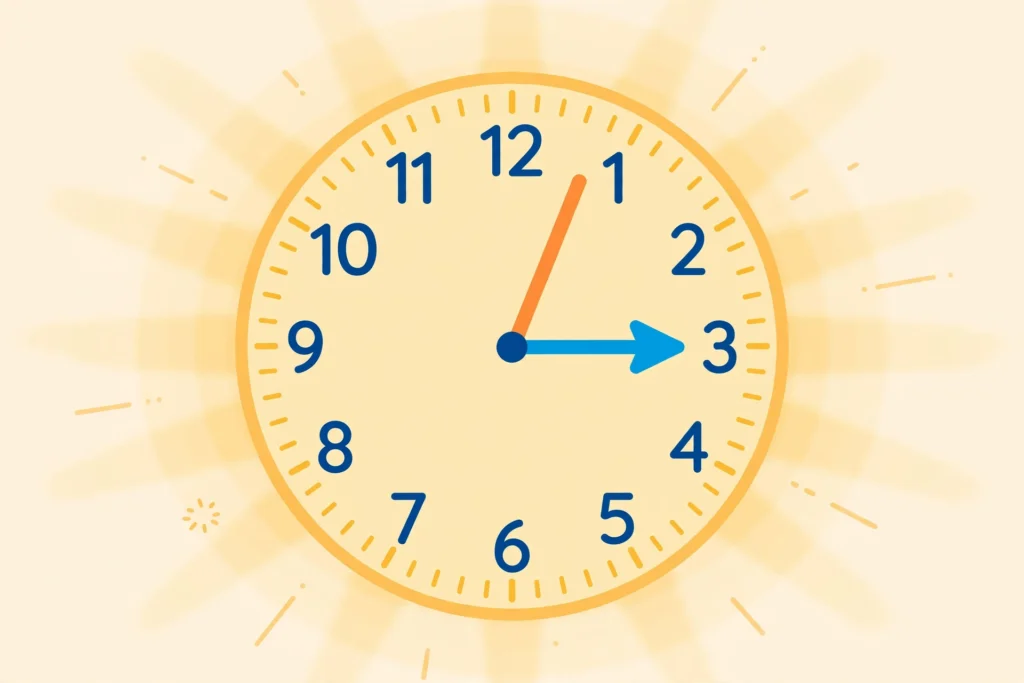
A minute is a unit of time equal to 60 seconds.
What Is a Minute?
A minute is one of the building blocks of time. Sixty seconds fit inside a single minute, and sixty minutes fit inside an hour. When someone says “give me a minute,” they are asking for a short stretch of time, about as long as it takes to sing “Happy Birthday” once through at a normal pace.
In a classroom, a minute feels longer than it sounds. I once watched a second grade teacher start her math block with a one-minute challenge. She put a timer on the board and asked her students to write as many addition facts as they managed before the timer buzzed. The room went silent, pencils flew, and when the buzzer sounded the kids groaned. “That was only a minute?” one boy asked. Sixty seconds of hard thinking can feel like forever, and sixty seconds of recess can feel like a blink. Time moves at the same speed. What we do with it changes how it feels.
How Many Seconds Are in a Minute?
There are exactly 60 seconds in one minute. Seconds tick by fast. You can count them out loud: one Mississippi, two Mississippi, all the way to sixty Mississippi, and one full minute has passed.
Kids love testing what fits inside a minute. Most second graders can write their first name about 8 to 10 times in one minute. They can do around 15 to 20 jumping jacks. They can tie one shoe if they are quick. These little experiments build number sense with time. When a child knows what a minute feels like in her body, reading minutes on a clock stops being abstract.
How Do You Read Minutes on a Clock?
On an analog clock, the long hand is the minute hand. It makes one full trip around the clock face every 60 minutes. The short hand is the hour hand, and it moves much more slowly.
The big numbers on a clock do double duty. The 1 does not just mean 1 o’clock. For the minute hand, the 1 means 5 minutes. The 2 means 10 minutes. The 3 means 15 minutes, the 4 means 20 minutes, and so on, all the way to the 12, which means 60 minutes, or the start of a new hour.
Between the big numbers sit small lines. Each small line is one minute. So when the minute hand points at the 2, that is 10 minutes past the hour. When it points one small line past the 2, that is 11 minutes past the hour. Learning to read minutes means learning to skip count by fives and then count on by ones for the lines in between.
How Long Is a Minute in Real Life?
A minute is short, but it is not empty. Brushing teeth takes about two minutes. A traffic light usually stays green for less than a minute. Tying your shoes takes about a minute. Waiting for the microwave to heat soup takes around two minutes.
Estimating minutes is a skill worth practicing. Ask a child to guess how long it will take to clean up the blocks, then time it. Was the guess close? This game trains an inner clock. Over time, kids get better at judging whether an activity needs a few minutes or half an hour, and that judgment helps them manage homework, chores, and bedtime routines.
How Many Minutes Are in an Hour?
There are 60 minutes in one hour. That is why the minute hand returns to the 12 after one full trip. Half an hour is 30 minutes, and a quarter of an hour is 15 minutes. These chunks show up everywhere: a TV show runs about 30 minutes, a soccer half runs about 45 minutes, and a school lunch period is often around 30 minutes.
The bigger picture helps too. There are 24 hours in a day, so a full day holds 1,440 minutes. That sounds like a lot until you subtract sleep, school, and meals. Minutes are the small change of the day. Spending them well is a habit that starts in elementary school.
Quick Answer: one minute equals 60 seconds. Sixty minutes equal one hour. The minute hand on a clock shows how many minutes have passed since the hour began.
Try It: Count Minutes on a Paper Clock

You need: a paper plate, a brass fastener, two strips of cardboard for hands, and a marker. Write the numbers 1 through 12 around the plate like a clock. Make the minute hand long and the hour hand short. Push the fastener through the center so the hands can spin.
Now spin the minute hand to the 4. Start at the 12 and skip count by fives as you touch each number: 5, 10, 15, 20. The clock shows 20 minutes past the hour. Move the hand to the 7 and try again: 5, 10, 15, 20, 25, 30, 35. That is 35 minutes.
For a challenge, move the hand a few small lines past a number and count on by ones. Two lines past the 6 means 32 minutes. Play with a partner: one person spins the hand, the other reads the minutes. See who can read ten times correctly first.
Quick Practice
Question: The minute hand on a clock points to the 9. How many minutes past the hour is it?
Worked answer: 45 minutes. Each number on the clock stands for 5 minutes, and 9 times 5 equals 45. So the clock reads 45 minutes past the hour, which is also called a quarter to the next hour.
Related Terms
Frequently Asked Questions
What is the difference between a minute and a second?
A second is the smaller unit. It takes 60 seconds to make one minute. You can feel a second by clapping once at a steady beat. A minute is long enough to do a small task, like writing your name several times. A second is barely long enough to say one word.
How long is one minute exactly?
One minute is exactly 60 seconds, no more and no less. Scientists measure it with atomic clocks, but for elementary math, 60 seconds is the whole story. Every minute in every hour of every day is the same length.
Why does a clock use 60 minutes instead of 100?
The 60-minute hour comes from ancient Babylonian mathematicians, who counted in base 60 thousands of years ago. We kept their system for time. The number 60 is handy because it splits neatly into halves, thirds, quarters, fifths, and sixths, which makes scheduling easy.
How can kids practice reading minutes at home?
Point to a wall clock or a watch several times a day and ask for the minutes. Start with the big numbers, where the answer is a multiple of five, then work up to the small lines between numbers. A homemade paper plate clock, like the one in the activity above, turns practice into a game.
Reading about it is one thing, practising it is another. Our free Telling Time to the Hour and Half Hour lesson builds the idea step by step, with slides, a printable worksheet and a full answer key.
Members unlock every lesson in the library, including the full Fractions, Multiplication, Place Value, Addition & Subtraction, Time & Money and Geometry & Shapes units. See the full library


