
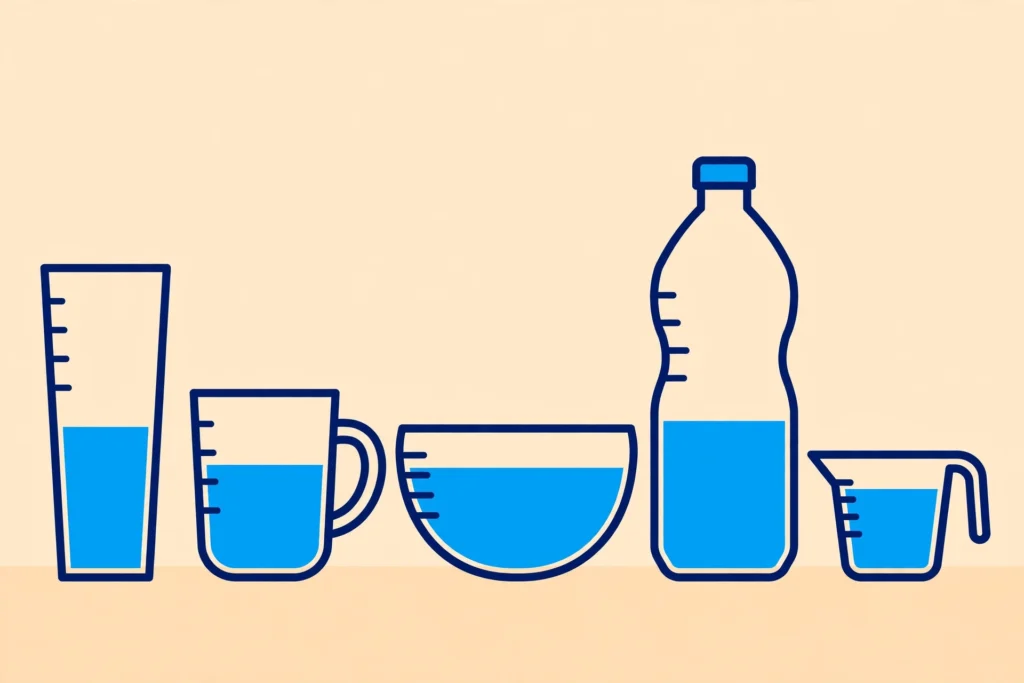
Capacity is the amount of liquid or material a container can hold, measured in units like liters, milliliters, cups, pints, quarts, and gallons.
What Is Capacity?
Fill a bathtub and you are thinking about capacity. Pour juice into a lunchbox cup and you are thinking about capacity. Capacity is a how-much-can-it-hold question. It belongs to containers: bottles, buckets, bowls, tanks, and tubs.
The classic classroom surprise goes like this. The teacher holds up a tall skinny glass and a short wide mug. “Which holds more?” Hands vote for the tall glass. Then the teacher pours the glass into the mug, and the mug overflows. Eyes go wide. Tall does not always mean holds more. That moment is why we measure instead of guessing.
What Units Measure Capacity?
Metric units start with the liter. A liter is about the size of a large water bottle. A milliliter is tiny, about 20 drops of water. One thousand milliliters make one liter, so milliliters suit medicine cups and liters suit milk jugs.
| Unit | Size | Good for |
| Milliliter (mL) | 1/1000 of a liter | medicine, perfume, a spoonful of vanilla |
| Liter (L) | 1000 milliliters | water bottles, soda, milk |
| Cup (c) | 8 fluid ounces | recipes, a mug of cocoa |
| Pint (pt) | 2 cups | small milk cartons, berries |
| Quart (qt) | 2 pints, 4 cups | soup, motor oil |
| Gallon (gal) | 4 quarts, 8 pints, 16 cups | milk jugs, paint, aquariums |
The customary units stack like a ladder. Two cups make a pint. Two pints make a quart. Four quarts make a gallon. Students love chanting the chain: cup, pint, quart, gallon. Each step doubles until the last leap, where the gallon quadruples the quart.
Picking the right unit is a judgment call. You would not measure a swimming pool in milliliters or cough syrup in gallons. Match the unit to the job, and the numbers stay friendly.
What Is the Difference Between Capacity and Volume?
These twins confuse everyone, so here is the clean split. Capacity is how much a container CAN hold. Volume is how much space something takes up, or how much is actually inside.
Picture a fish tank that can hold 20 gallons. Its capacity is 20 gallons. Now fill it halfway with water. The volume of the water is 10 gallons. Same tank, two different numbers, two different ideas.
Here is the memory hook students keep: capacity is about the container, volume is about the contents. Ask “how much can it hold” for capacity. Ask “how much is in it, or how much space does it take” for volume.
Is a Liter Bigger Than a Quart?
Yes, but only a little. One liter equals about 1.06 quarts, so a liter bottle holds a splash more than a quart bottle. This is the rare case where the metric unit wins the size contest against its customary cousin.
Teachers turn this into a pouring race. Fill a quart container with water and pour it into an empty liter bottle. It fits, with room to spare. Then fill the liter bottle and try to pour it back into the quart container. It overflows. Nobody forgets that demo.
Common Mistake: “The Taller Container Holds More”
Common Mistake: taller does not mean bigger capacity. A tall thin vase can hold less than a short wide pot. Your eyes measure height, but capacity measures all three dimensions at once. When it matters, pour or measure instead of trusting the shape.
The second trap is mixing up capacity and volume on tests. Read the question twice. “How much water is in the bucket” asks for volume. “How much water can the bucket hold” asks for capacity. One word changes the whole answer.
Try It: Order the Containers
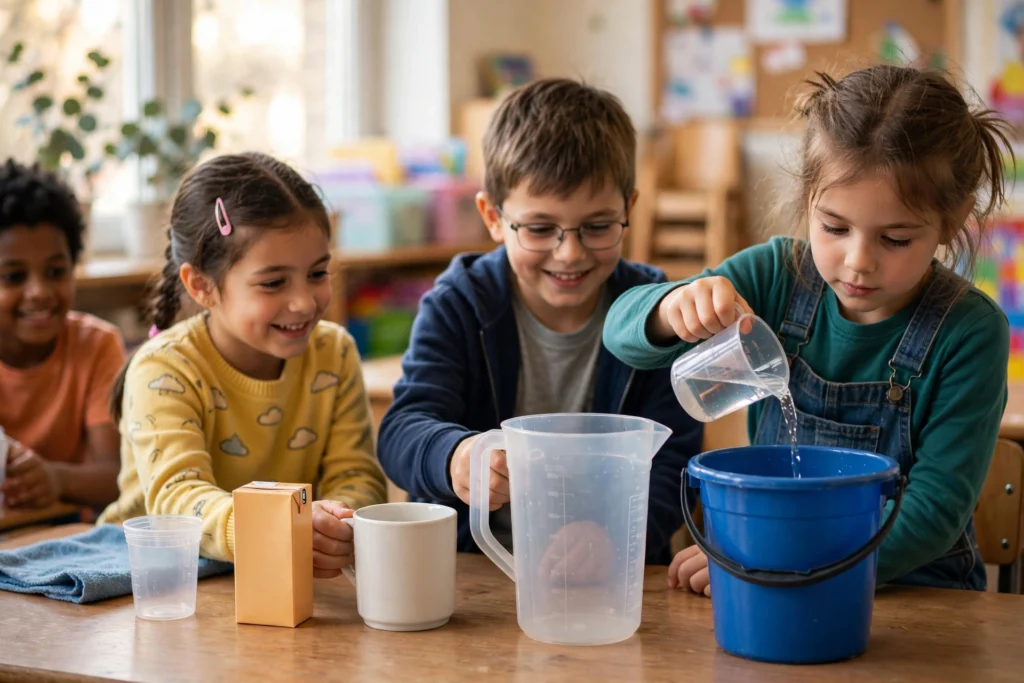
Gather five containers: a medicine cup, a juice box, a mug, a plastic pitcher, and a bucket. Line them up and have students order them from smallest to largest capacity just by looking. Record every prediction on the board.
Now check. Use a small measuring cup as your unit and count how many cupfuls each container takes to fill. Pour carefully. The order almost always changes, and the debate about which container fooled everyone is the best part of the lesson.
For a finale, pick the best unit for each container. Medicine cup: milliliters. Juice box: milliliters. Mug: cups or milliliters. Pitcher: liters or quarts. Bucket: gallons. Naming the right unit is a skill all its own.
Quick Practice
A recipe needs 2 liters of water, but your measuring cup only shows milliliters. How many milliliters do you need? And which container would you reach for to carry it home from the store: a 500 mL bottle or a 1-gallon jug?
Answer: 2 liters equals 2000 milliliters, because 1 liter = 1000 milliliters. Reach for the 1-gallon jug. A 500 mL bottle is far too small, and a gallon holds about 3.8 liters, so it fits the 2 liters with room to spare.
Related Terms
Explore length and word problems.
Frequently Asked Questions
How many milliliters are in a liter?
1000. The prefix milli means one-thousandth, so a milliliter is one-thousandth of a liter. Move the decimal three places and you have your answer.
What unit would you use for a swimming pool?
Gallons in the customary system, or liters in metric. A backyard pool can hold tens of thousands of gallons. Milliliters would give you a silly huge number, which is exactly why we choose bigger units for bigger jobs.
What does capacity mean for a car or a stadium?
The same idea, stretched wider. A car’s capacity might mean how many people it seats. A stadium’s capacity is how many fans it holds. Capacity always answers “how much can it hold,” whatever “it” happens to be.
Next time you pour a drink, look at the container first. You are holding a capacity question in your hand, and now you know the units to answer it.
Every topic clicks faster with practice. Our Resource Library has free lesson packs with slides, printable worksheets and full answer keys, ready to download and teach.
Members unlock every lesson in the library, including the full Fractions, Multiplication, Place Value, Addition & Subtraction, Time & Money and Geometry & Shapes units. See the full library


