
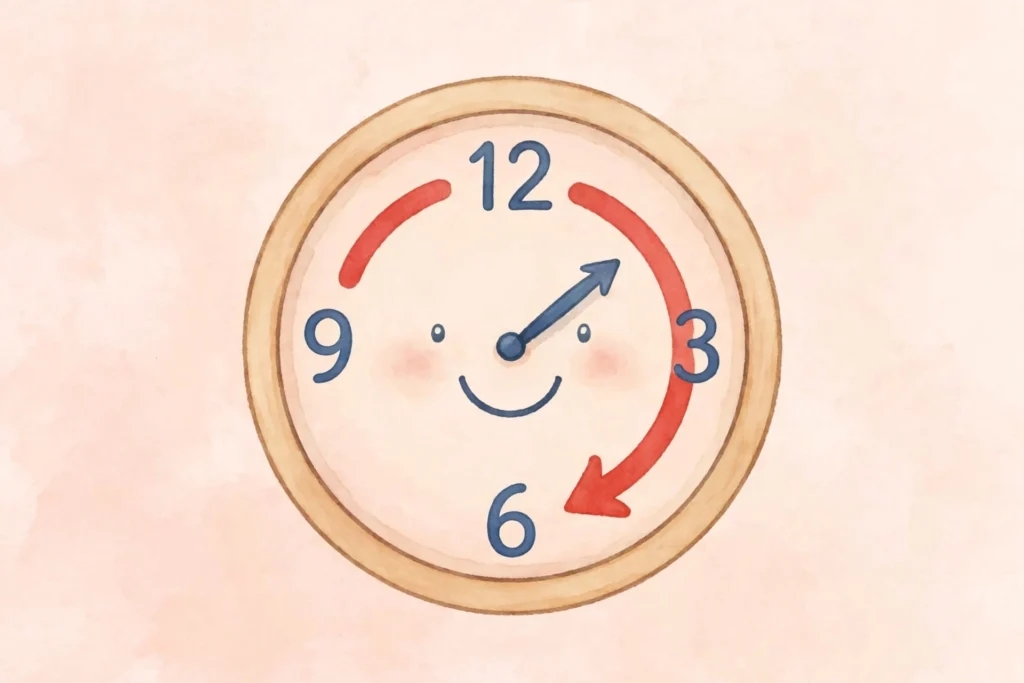
Clockwise is the direction a clock’s hands move when they tell time. When something turns clockwise, it spins the same way the hands of an analog clock spin.
What Is Clockwise?
Take a look at a wall clock with hands. The minute hand starts at the top, swings down the right side, sweeps across the bottom, and comes back up the left side. That loop is the clockwise direction, and it never changes.
Quick Answer: Clockwise means turning the same way clock hands turn: from the top toward the right, then down, then toward the left, then back up to the top.
The word itself gives you the memory hook. Clock plus wise, where wise means manner or way. So clockwise means “in the manner of a clock.” Kids who can read an analog clock already know this motion by sight, even before anyone gives it a name.
In math, clockwise and its opposite, counterclockwise, describe rotation. A rotation is a turn around a fixed point, like a pin holding the center of a paper spinner.
Which Way Is Clockwise?
This is the question kids ask most, and it deserves a hands-on answer. Hold your right hand in front of you and draw a circle in the air. Start at the top, curve to the right, come down, and sweep back up. Congratulations, your hand just traced the clockwise direction.
A second trick uses the clock itself. Picture the numbers 12, 3, 6, and 9 on a clock face. Clockwise travels from 12 to 3 to 6 to 9 and back to 12. Say those numbers out loud in order and trace the path with your finger. You will feel the loop: right, down, left, up.
Teachers sometimes shorten the two directions to CW for clockwise and CCW for counterclockwise. You will see those letters in puzzles, board games, and science instructions. Now you know exactly what they stand for.
What Is the Difference Between Clockwise and Counterclockwise?
Counterclockwise is the mirror image. It travels from the top toward the left, then down, then toward the right, and back up. In British English, people often say anticlockwise instead of counterclockwise. Both words mean the exact same thing.
Here is a simple table to keep them straight:
| Direction | Path on the clock | Other name |
|---|---|---|
| Clockwise | 12 to 3 to 6 to 9 | CW |
| Counterclockwise | 12 to 9 to 6 to 3 | CCW, anticlockwise |
Picture a merry-go-round. If you stand in front of it and the horses move from the top toward the right side, the ride is turning clockwise. If they move toward the left side instead, it is turning counterclockwise. Same ride, opposite spin.
One thing to watch: the direction depends on which side you are looking from. A wheel can look clockwise from one side and counterclockwise from the other. In a classroom, everyone should agree on the viewing side before calling out the direction.
Why Does a Clock Go Clockwise?
This is one of the best questions in all of math history. The answer starts with sundials, the oldest clocks people ever built. A sundial tells time with a shadow cast by a stick called a gnomon.
In the northern hemisphere, where the first mechanical clocks were invented, the sun crosses the sky from east to west. That makes the shadow on a sundial sweep from the top toward the right. When clockmakers built the first mechanical clocks about a thousand years ago, they simply copied the motion they saw on sundials.
If clocks had been invented in the southern hemisphere first, where shadows sweep the opposite way, your classroom clock might spin counterclockwise instead. The direction is a convention, a choice people agreed on long ago, not a law of nature.
Where Do We See Clockwise in Real Life?
Once you know the word, you start spotting clockwise everywhere. Try these examples with your family:
- Screws and lids: turning a screwdriver or a jar lid to the right tightens it. The old saying goes “righty-tighty, lefty-loosey,” and righty-tighty is clockwise.
- Turning a key: most door locks turn clockwise to lock.
- Sports: runners on a track usually race counterclockwise, which means they face the opposite of clock hands.
- Spinning tops: flick one and watch which way it spins. Name the direction out loud.
- Board games: many games pass the turn to the player on the left or right, which is another way of saying clockwise or counterclockwise around the table.
Scientists and engineers use these directions too. A ceiling fan spins one way in summer and the other way in winter to move air differently.
Try It: The Spinning Arrow Challenge
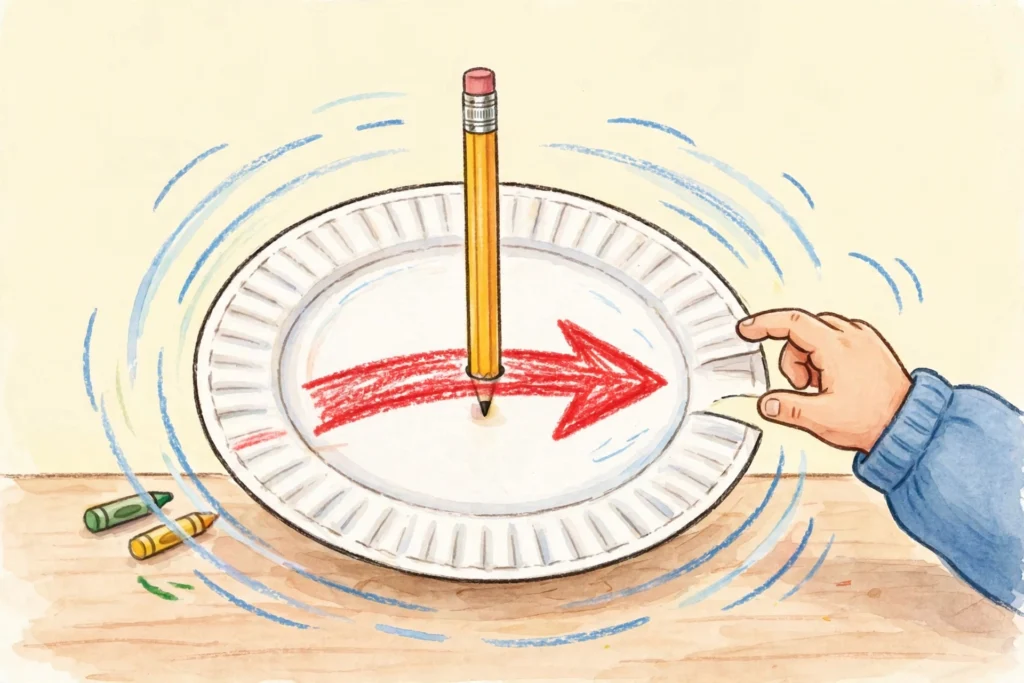
You will need a paper plate or a circle of cardboard, a paper clip, a pencil, and a marker. This one is perfect for a partner.
Draw a bold arrow on the paper plate pointing from the center toward the edge. Push the pencil through the middle so the plate spins freely, and straighten the paper clip on top to make a pointer. Your spinner is ready.
Player one gives the plate a flick while player two watches. Before the spinner stops, player two must shout “clockwise” or “counterclockwise.” Then check: did the arrow travel from the top toward the right? That is clockwise. Toward the left? Counterclockwise.
Take turns and keep score for ten spins. For a harder round, the watcher must call out the direction within two seconds of the flick.
Finish by drawing two big circles on paper. Label one with a curved arrow going clockwise and the other counterclockwise. Hang them on the wall. From now on, when anyone asks which way something spins, point to your chart.
Quick Practice
Question: You are tightening a screw into a piece of wood. Which direction should you turn the screwdriver, clockwise or counterclockwise?
Worked answer: Tightening means turning to the right, and righty-tighty is the memory trick. Turning to the right around the circle follows the same path as clock hands. So turn the screwdriver clockwise.
Related Terms
Turns and angles go hand in hand. Keep exploring with Acute Angle and Obtuse Angle.
Frequently Asked Questions
Is clockwise to the right?
Yes, at the top of the circle. The motion starts at the top and heads toward the right, which is why kids remember it as the turn-to-the-right direction. It is a circle that simply begins by going right.
What does counterclockwise mean?
It is the opposite of clockwise: from the top toward the left, then down, then toward the right, then back up. In British English it is usually called anticlockwise. Same direction, different name.
Do screws always turn clockwise to tighten?
Almost always. Standard screws, bolts, jar lids, and many valves tighten clockwise and loosen counterclockwise. A few specialty fasteners break this rule, so engineers check the instructions on unusual jobs.
Why do we need the words clockwise and counterclockwise?
Because “turn it” is not enough. If a science experiment or a game says to rotate something, the result changes with the direction. These two words remove all doubt, so everyone in the room turns the same way.
Can something move clockwise and counterclockwise at the same time?
No. At any moment, a spinning object turns one way or the other. It can switch directions, like a washing machine that reverses, but it never does both at once.
Reading about it is one thing, practising it is another. Our free Telling Time to the Hour and Half Hour lesson builds the idea step by step, with slides, a printable worksheet and a full answer key.
Members unlock every lesson in the library, including the full Fractions, Multiplication, Place Value, Addition & Subtraction, Time & Money and Geometry & Shapes units. See the full library


