
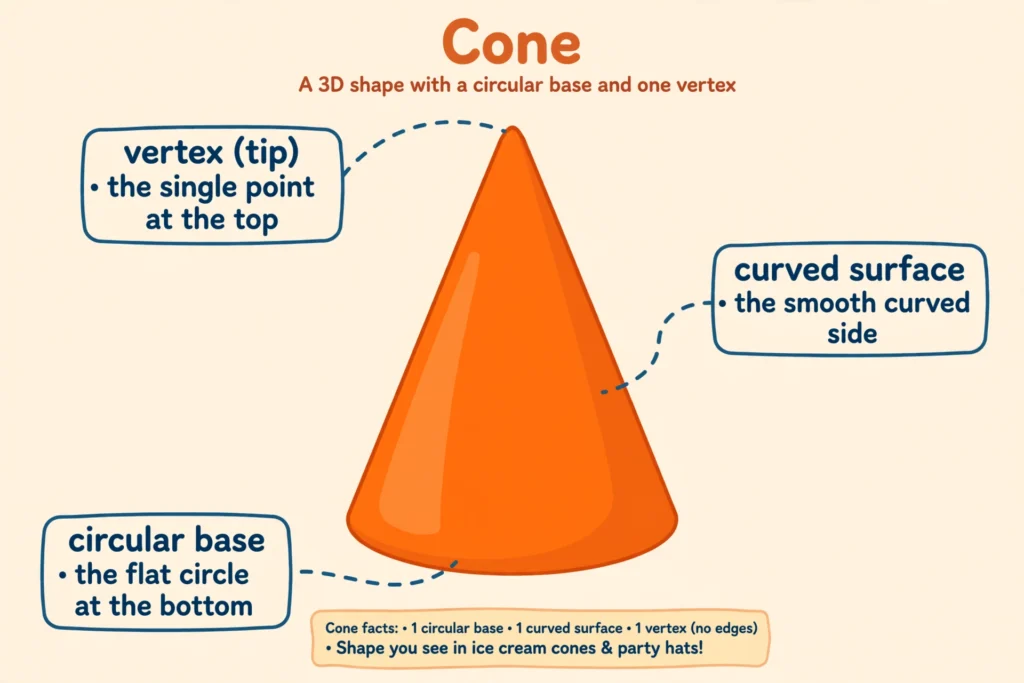
A cone is a three-dimensional shape with a flat circular base that tapers smoothly up to a single point. That point is called the vertex, or the apex.
What Are the Parts of a Cone?
A cone has three main parts. The base is the flat circle at the bottom. The lateral surface, which is just the math name for the curved side, wraps around from the base up to the top. The vertex is the sharp point where the curved surface comes together.
Two measurements describe a cone’s size. The radius is the distance from the center of the circular base to its edge. The height is the straight-line distance from the vertex down to the center of the base. There is also a third measurement called the slant height, which runs from the vertex down along the curved surface to the edge of the base.
Picture an ice cream cone in your hand. The crunchy wafer bottom you hold is near the vertex, the round opening at the top is the base, and the smooth outside of the wafer is the lateral surface. Once you see it in your hand, the parts are easy to name.
How Many Faces, Edges, and Vertices Does a Cone Have?
A cone has one flat face, which is its circular base. It has one vertex, which is the point at the top. And it has zero edges, because an edge is where two flat faces meet, and the cone only has one flat face.
This is a favorite test question, so here is how students usually talk it through. Faces: 1. Edges: 0. Vertices: 1. The curved surface wraps around the side, but it does not count as a flat face, and the circle where the curved surface meets the base does not count as an edge.
Did You Know: the word cone comes from the Greek word konos, which means a wedge or a peak. People have been naming this shape for thousands of years, and the idea is the same: something wide at the bottom that rises to a point.
What Is the Difference Between a Cone and a Pyramid?
A cone and a pyramid are close cousins. Both have a single vertex at the top and a flat base at the bottom. The difference is the base. A cone has a circular base and one smooth curved surface. A pyramid has a polygon base, like a square or triangle, and flat triangle faces for sides.
Here is a memory trick students love. A cone is like a pyramid that spun around until its flat sides blurred into one curve. The great pyramids of Egypt are true pyramids with square bases and four flat triangle sides. A traffic cone on the road is a true cone with a circular base and no flat sides at all.
What Is the Volume of a Cone?
The volume of a cone tells you how much it can hold. The formula is V = 1/3 x pi x r^2 x h, where r is the radius of the base and h is the height. In words: find the area of the circular base, multiply by the height, then take one third of the result.
The one third part has a neat reason behind it. If you had a cylinder with the same base and the same height as your cone, the cone would fill exactly one third of that cylinder. Three cones of sand would fill one matching cylinder. That picture helps many students remember the formula long after the lesson ends.
Where Do You See Cones in Real Life?
Cones are everywhere once you start looking. Ice cream cones, traffic cones, and birthday party hats are the classic three. Volcanoes form cone shapes as lava piles up around the opening. Teepees rise to a point like giant cones. The nose cones of rockets use the shape to cut through the air.
Try a spotting game on your next car ride. Count how many cones you see: traffic cones near road work, the pointed tops of pine trees in the distance, a megaphone at a game, a funnel in the garage. Most kids find five or six before the ride is over.
Try It: Go on a Cone Hunt Around Your Home

Grab a notebook and walk through your home like a shape detective. Look in the kitchen, the bathroom, the garage, and the toy box. Every time you find a cone, sketch it and label its base, its curved surface, and its vertex.
Good hiding spots include a funnel in the kitchen drawer, a party hat left over from a birthday, the tip of a crayon worn down to a point, and the paper cup from a water cooler. For each find, ask yourself: does it have a circular base and a single point? If yes, you found a cone.
Bring your notebook back and share your best find with the class. The strangest cone usually wins the biggest laugh, and everyone learns where cones hide in real life.
Quick Practice
Question: A traffic cone is standing on the road. How many flat faces, edges, and vertices does it have?
Answer: It has 1 flat face (the circular base), 0 edges (because there is only one flat face, so no place for an edge to form), and 1 vertex (the point at the top).
Related Terms
- Pyramid: A pyramid also rises to a single vertex, but its base is a polygon and its sides are flat triangles.
- Rectangular Prism: A box-shaped solid with flat rectangular faces, a good contrast to the cone’s single curved surface.
Frequently Asked Questions
What is the point of a cone called?
The point is called the vertex, and some books call it the apex. Both words mean the same thing: the single point at the top of the cone, opposite the base.
Can a cone roll?
Yes. If you lay a cone on its side and push it, it rolls around in a circle. The vertex stays near the center of the circle while the base edge traces the round path. This is different from a ball, which rolls straight.
Is a party hat a cone?
Yes. A party hat is a hollow cone. It has the circular opening at the bottom for a base and the point at the top for a vertex, even though there is no solid inside.
What is the difference between a cone and a cylinder?
A cylinder has two circular bases, one on the top and one on the bottom. A cone has only one circular base, and the other end tapers to a point. If you cut the point off a cone with a straight slice, the top piece is a smaller cone and the bottom piece is called a frustum.
Reading about it is one thing, practising it is another. Our free What Are 2D Shapes? lesson builds the idea step by step, with slides, a printable worksheet and a full answer key.
Members unlock every lesson in the library, including the full Fractions, Multiplication, Place Value, Addition & Subtraction, Time & Money and Geometry & Shapes units. See the full library


