
What Is a Pyramid in Math?
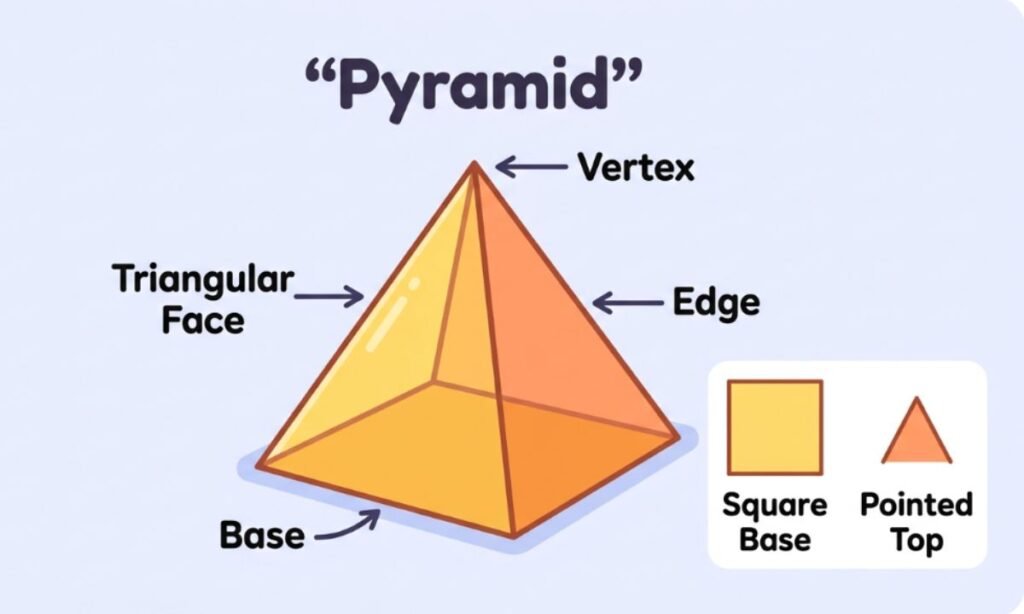
A pyramid is a solid, three-dimensional shape with one polygon-shaped base and triangular faces that meet at one point. That point is called the apex.
A square pyramid is a familiar example. It has one square base and four triangular faces that slope up to the apex. A pyramid does not have to have a square base, though. Its base can be a triangle, pentagon, hexagon, or another polygon.
How Can You Tell If a Shape Is a Pyramid?
Use this checklist when you look at a model or drawing:
1.It is a solid, or 3D, shape.
2.It has one polygon base.
3.Its other faces are triangles.
4.The triangular faces meet at one apex.
The base is one flat face of the solid. The other faces are called triangular faces because each one is a triangle. The line segments where two faces meet are edges. The corners are vertices. The apex is the vertex at which the triangular faces meet.
A picture can be turned in different directions and still show a pyramid. The base does not have to appear at the bottom of the picture. What matters is the shape’s structure.
Pyramid in Math Examples
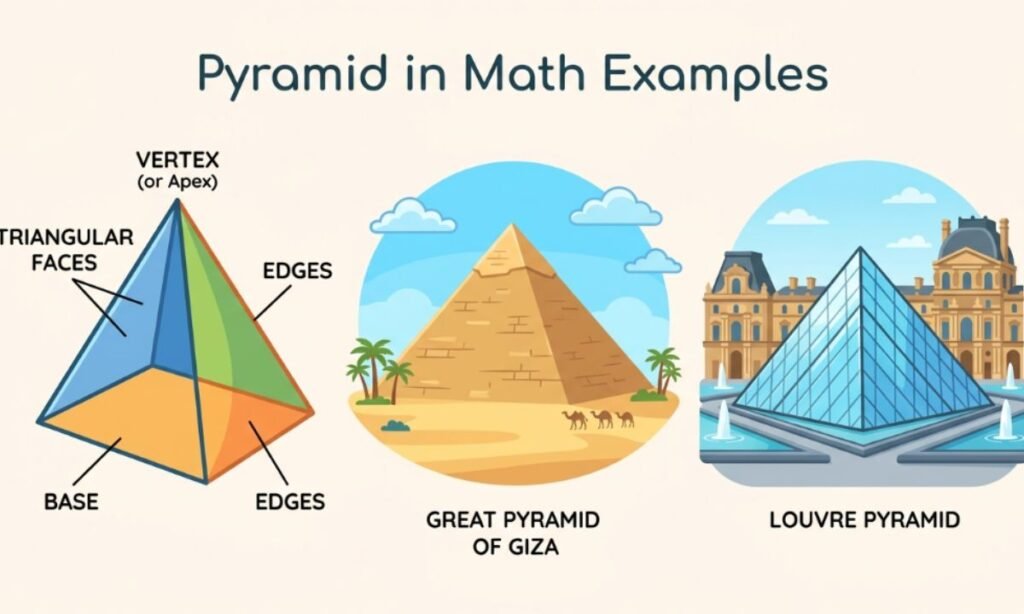
A triangular pyramid has a triangle as its base and three triangular side faces. A square pyramid has a square base and four triangular side faces. A pentagonal pyramid has a pentagon as its base and five triangular side faces.
For example, if a solid has one hexagon-shaped base and six triangular faces that meet at one point, it is a hexagonal pyramid. The base shape gives the pyramid its name.
Square Pyramid in Math
A square pyramid has one square base, four triangular faces, eight edges, and five vertices. Its four triangular faces meet at the apex.
To count its faces, count the square base and the four triangles:
1 square face + 4 triangular faces = 5 faces
The Great Pyramid of Giza has a square base, but a classroom square pyramid does not need to be large or made of stone. A paper model, block, or small toy can show the same geometric structure.
How Are Pyramids Named?
A pyramid gets its name from the shape of its base. For example, a pyramid with a pentagon as its base is a pentagonal pyramid. It has five triangular side faces because a pentagon has five sides.
A triangular pyramid is also called a tetrahedron when all four of its faces are triangles. The name tetrahedron means “four faces.”
Pyramid Shape Name
The name of a pyramid comes from the polygon at its base. A triangle base makes a triangular pyramid, a square base makes a square pyramid, and a pentagon base makes a pentagonal pyramid. This rule works even when the solid is turned.
Pyramid Shape Examples Names
Here are common pyramid shape names and the bases that create them:
| Pyramid name | Base shape |
| Triangular pyramid | Triangle |
| Square pyramid | Square |
| Rectangular pyramid | Rectangle |
| Pentagonal pyramid | Pentagon |
| Hexagonal pyramid | Hexagon |
A square is also a special type of rectangle, but a square pyramid and a rectangular pyramid are usually named separately so students can describe the exact base shape.
Parts of a Square Pyramid
A square pyramid is a useful model for learning geometry words.
•Base: The square face at the bottom or back of the model.
•Triangular faces: The four triangles that connect the base to the apex.
•Apex: The top point where the triangular faces meet.
•Edges: The line segments where two faces meet.
•Vertices: The corners of the solid. The apex is one of its vertices.
•Faces: All the flat surfaces, including the base and the triangular faces.
A square pyramid has:
| Part | Number |
| Faces | 5 |
| Edges | 8 |
| Vertices | 5 |
The five faces are one square and four triangles. The five vertices are the four corners of the square base plus the apex.
Pyramid or Prism?
Pyramids and prisms are both solid shapes with flat faces, but their structures are different.
| Feature | Pyramid | Prism |
| Number of bases | One | Two |
| Bases | One polygon | Two matching, parallel polygons |
| Side faces | Triangles | Usually rectangles or parallelograms |
| Point at the top | Has an apex | Does not have one single apex |
A box is shaped like a rectangular prism. It has a matching face at each end. A pyramid has one base, and its triangular faces come together at one point.
Try It: Sort and Build Shapes
Sort solid shapes
Gather models or pictures of a pyramid, prism, cone, cylinder, and sphere. Sort them by asking:
•How many bases does the shape have?
•Are its surfaces flat or curved?
•Are its side faces triangles?
•Do several faces meet at one point?
A pyramid should have one polygon base, flat triangular side faces, and one apex.
Build a paper pyramid
Cut out one square and four matching triangles. Tape one triangle to each side of the square, then bring the triangle tips together. The finished model has one square base, four triangular faces, and one apex.
As you build, label the base, faces, edges, vertices, and apex. This activity shows how flat 2D shapes can form a solid 3D shape.
Pyramid in Maths Formula
The volume of a pyramid is found with this formula:
V = 1/3 × B × h
In this formula, V means volume, B means the area of the base, and h means the perpendicular height from the base to the apex. The height is measured straight up from the base, not along a sloping triangular face.
For example, suppose a pyramid has a base area of 12 square centimeters and a height of 6 centimeters:
V = 1/3 × 12 × 6 = 24 cubic centimeters
Volume formulas are usually taught after students first learn to identify and describe pyramids. The important idea for younger students is that the base area and vertical height determine the amount of space inside the pyramid.
Pyramid Shape Examples
Pyramid shapes can appear in models, buildings, decorations, toys, and classroom materials. A mathematical pyramid must have a polygonal base and triangular faces that meet at an apex. An object only counts as a true pyramid when it has that structure.
Examples include a square pyramid block, a triangular tent model, a pyramid paperweight, a pyramid-shaped game piece, and a geometric solid in a math kit.
10 Examples of Pyramid Objects
Here are ten objects that may have a pyramid shape:
1.A pyramid building model
2.A pyramid-shaped paperweight
3.A pyramid block in a geometry set
4.A pyramid game piece
5.A pyramid gift box
6.A pyramid decoration
7.A pyramid candle
8.A pyramid tea bag package
9.A pyramid-shaped roof or roof model
10.A pyramid tent model
Some real objects only resemble pyramids. Check the base and side faces before calling an object a mathematical pyramid.
Example of Pyramid Shape at Home
Look for a pyramid-shaped decoration, toy block, gift box, or paper model at home. Sketch it from two sides and label the base, one triangular face, an edge, a vertex, and the apex.
If you cannot find a pyramid, make one by folding a square piece of paper with four triangles attached around its edges. Bring the triangle tips together and tape them. You now have a square pyramid model.
Teaching Strategies for Pyramids
Explore and compare solid shapes
Give students models or pictures of pyramids, prisms, cones, cylinders, and spheres. Before introducing vocabulary, let them handle, stack, slide, or roll the models. Ask questions such as:
•Which shapes have only flat faces?
•Which shapes can roll?
•Which shapes have one base?
•Which shape has triangular faces that meet at one point?
Have students record the number and type of faces, edges, and vertices they observe. This helps them classify shapes by properties rather than by appearance.
Investigate the base and triangular faces
Give students a triangular pyramid, square pyramid, and pentagonal pyramid. Ask them to trace each face on paper and sort the traced shapes into polygons and triangles. Then have them count the sides of each base and the number of triangular faces.
Guide students to notice the pattern: a pyramid with a four-sided base has four triangular side faces, while a pyramid with a five-sided base has five triangular side faces. Ask, “What do you predict about a pyramid with a six-sided base?”
Connect the model to its name
After students count and trace the bases, ask them to name each pyramid. A triangle base makes a triangular pyramid, a square base makes a square pyramid, and a pentagon base makes a pentagonal pyramid. This connects the naming rule to an observable feature instead of memorization.
Compare a pyramid and a prism
Place a square pyramid next to a rectangular prism. Ask students to identify the number of bases, compare the side faces, and explain what happens to the faces of the pyramid at the apex. Rotate both models so students see that orientation does not change the shape’s classification.
Use the sentence frame, “This solid is a pyramid because it has…” Students should complete it with one polygon base, triangular faces, and an apex.
Explore pyramid nets
Provide several paper nets, including a square with four triangles attached and examples that will not fold into a pyramid. Ask students to predict which nets will work before cutting or folding them.
After testing the nets, have students explain why a successful net needs one base and one triangular face for each side of that base. Students can design their own square-pyramid net, label its parts, and explain how the flat pieces form a solid.
Common Mistakes About Pyramids
Every pyramid has a square base.
Not quite. A pyramid can have a triangular, square, pentagonal, hexagonal, or another polygonal base. The base determines the pyramid’s name.
The base must be at the bottom.
Not always. In a drawing or model, a pyramid can be turned. The base is the polygon face that gives the pyramid its name, even when it is not shown at the bottom.
A cone is a pyramid.
No. A cone has one circular base and a curved surface. A pyramid has a polygonal base and flat triangular faces.
A pyramid and a prism are the same.
No. A pyramid has one base and an apex. A prism has two matching, parallel bases and no single apex.
Quick Practice
A solid has one pentagon-shaped base and five triangular faces that meet at one point.
1.What type of solid is it?
2.What is the name of the pyramid?
3.How many faces does it have altogether?
Answer: It is a pyramid, specifically a pentagonal pyramid. It has 6 faces altogether: 1 pentagonal base and 5 triangular faces.
Frequently Asked Questions
What is the top point of a pyramid called?
The top point is called the apex. It is also one of the pyramid’s vertices.
How many bases does a pyramid have?
A pyramid has one polygonal base. The base may be a triangle, square, pentagon, or another polygon.
What is the difference between a pyramid and a cone?
A pyramid has a polygonal base and flat triangular faces. A cone has a circular base and one curved surface.
How do you name a pyramid?
Look at its base. A triangle makes a triangular pyramid, a square makes a square pyramid, and a pentagon makes a pentagonal pyramid.
Can a pyramid be turned upside down?
Yes. Turning a model does not change its name or defining features. It is still a pyramid if it has one polygon base and triangular faces that meet at an apex.
A pyramid is a solid shape with one polygon base, triangular side faces, and one apex. To name it, look at the shape of its base.
Related Term: