
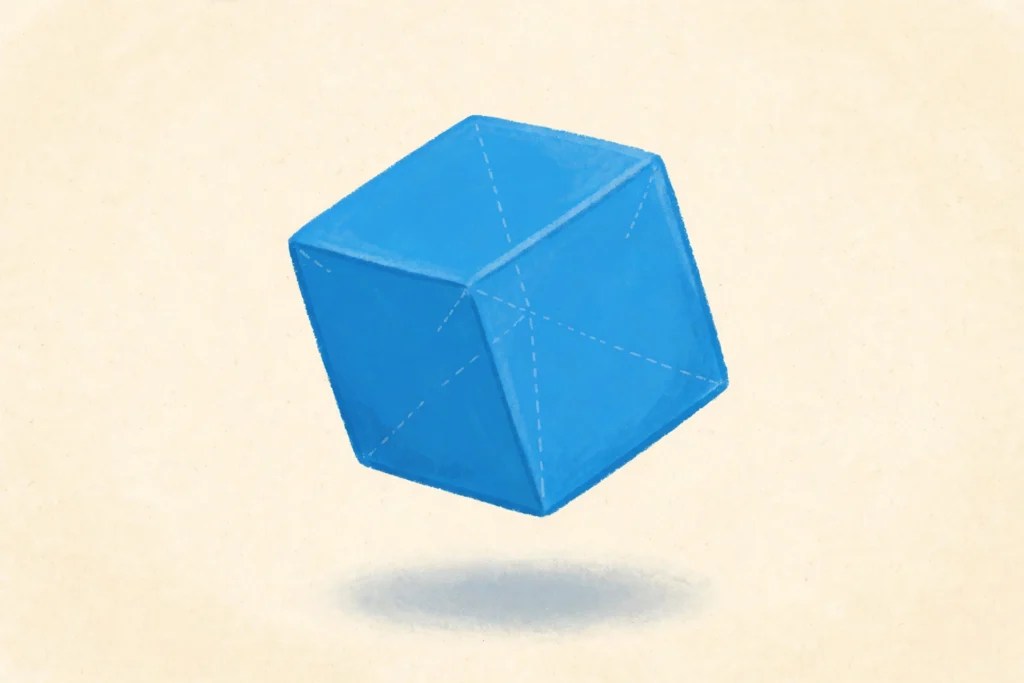
A cube is a solid shape that takes up space in three directions: length, width, and height. All six of its flat faces are squares, and every square is exactly the same size.
Grab a die from a board game and hold it in your hand. That little block is a cube. It feels the same from every side, and no matter how you turn it, you see the same shape. That perfect evenness is what makes a cube special among 3D shapes.
How Many Faces, Edges, and Vertices Does a Cube Have?
This is the question teachers ask most about the cube, and the answer is a tidy set of numbers that are easy to memorize: 6 faces, 12 edges, and 8 vertices.
- Faces are the flat surfaces. A cube has 6: top, bottom, front, back, left, and right. Each one is a square.
- Edges are the straight lines where two faces meet. A cube has 12 edges, and every edge is the same length.
- Vertices are the corner points where edges meet. A cube has 8 vertices, and at each corner three edges and three faces come together.
Here is a trick for counting the edges without missing any. Each square face has 4 edges, and there are 6 faces, which makes 24 edge pieces. But every edge is shared by 2 faces, so you divide by 2. Twenty-four divided by 2 is 12 edges.
| Part of the cube | What it is | How many |
|---|---|---|
| Faces | Flat square surfaces | 6 |
| Edges | Lines where faces meet | 12 |
| Vertices | Corners where edges meet | 8 |
In Mrs. Alvarez’s second grade class, counting the parts of a cube is a hands-on job. She hands each table group a big foam die and a sheet of round stickers. The job is simple: put one sticker on every face, then count the stickers. Six, every time. Then students trace each edge with a finger and press a tiny sticker on every corner. By the end, the die wears 8 corner stickers, and the numbers 6, 12, and 8 feel like old friends.
Did You Know: The cube belongs to a famous family of shapes called the Platonic solids. More than two thousand years ago, Greek thinkers admired the cube because every face matches, every edge matches, and the angle where two faces meet is a perfect right angle.
What Is the Difference Between a Cube and a Square?
Students mix these two up all the time, so let us settle it. A square is flat. It lives on paper, has 4 equal sides, and 4 corners. A cube is solid. It takes up space, with 6 square faces, 12 edges, and 8 corners.
Think of it this way: a square is like a single floor tile, and a cube is like a box built from six of those tiles. You can draw a square, but you can pick up a cube and turn it in your hand. Every face of a cube is a square, but a square on its own has no depth, so it can never be a cube.
A quick test helps. Ask, “Can I fill it with sand?” If the answer is yes, you are looking at a 3D shape like a cube. If it is flat like a drawing, it is 2D, like a square.
Where Do You See Cubes in Real Life?
Cubes hide in plain sight all around you. Dice, alphabet blocks, ice cubes, sugar cubes, and storage cubes all have six equal square faces. A Rubik’s Cube is a playful one: it is a big cube built from 26 smaller cubes that twist and turn.
Watch out for the look-alikes, though. A cereal box or a tissue box is shaped like a box, but its faces are rectangles of different sizes, not six matching squares. That shape has its own name: a rectangular prism. Every cube is a rectangular prism, but a rectangular prism is only a cube when all of its faces are equal squares.
Try It: The Block Corner Count

You need one cube-shaped block and 8 small stickers. A wooden alphabet block or a linking cube works well.
- Step 1: Hold the block and find one corner. Press a sticker right on the point.
- Step 2: Turn the block slowly and sticker every corner you find. Count out loud as you go.
- Step 3: When you think you are done, count the stickers. You should have exactly 8.
- Step 4: Now trace every edge with your finger, counting as you go. You should land on 12.
- Step 5: Press your palm flat against each face, one at a time. Six faces, six flat slaps.
If your edge count comes out wrong, the usual slip is counting a shared edge twice. Remember: each edge belongs to two faces at once, so touch it once and move on.
Quick Practice
Question: Jamal is holding a box with 6 faces. He says it must be a cube. Do you agree with him? Explain your thinking.
Answer: Not quite. Having 6 faces is not enough. A tissue box has 6 faces too, but it is a rectangular prism, not a cube. For the box to be a cube, all 6 faces must be squares of exactly the same size. If even one face is a longer rectangle, the shape is a rectangular prism instead.
Related Terms
- Rectangular Prism: a 3D shape with six rectangular faces. A cube is a special rectangular prism with all equal faces.
- Pyramid: another 3D shape with flat faces, but its faces are triangles that meet at a point on top.
Frequently Asked Questions
Is a cube a prism?
Yes. A prism is a 3D shape with two matching bases and rectangular sides, and a cube fits that rule. It is the most even prism of all, with every edge the same length.
What is a cube net?
A net is a flat pattern you can cut out and fold into a 3D shape. A cube net is made of six squares joined edge to edge. There are eleven different nets that all fold into a cube, and drawing them is a favorite classroom puzzle.
Can a cube roll?
No. Flat faces make a cube slide or tumble instead of rolling. Shapes that roll, like spheres and cylinders, have curved surfaces.
How is a cube different from a rectangular prism?
A cube has six square faces that are all the same size. A rectangular prism has six rectangular faces that can have different sizes. Every cube counts as a rectangular prism, but most rectangular prisms are not cubes.
Reading about it is one thing, practising it is another. Our free What Are 2D Shapes? lesson builds the idea step by step, with slides, a printable worksheet and a full answer key.
Members unlock every lesson in the library, including the full Fractions, Multiplication, Place Value, Addition & Subtraction, Time & Money and Geometry & Shapes units. See the full library


