
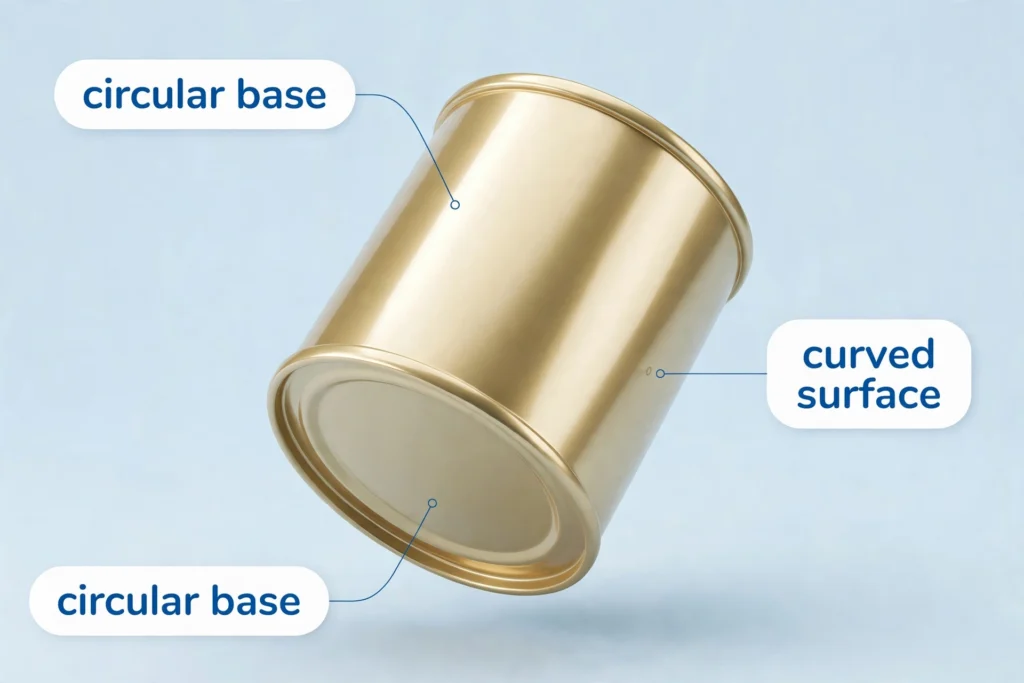
A cylinder is a 3D shape with two flat circular ends and one curved side, like a soup can.
What Is a Cylinder?
Pick up a soup can and turn it slowly in your hand. The top and bottom are flat circles. They match each other exactly in size, and they sit parallel, one above the other. Between them stretches one smooth curved side.
That is a cylinder. Two identical circular bases, joined by a single curved surface. It looks like a tube or a can.
Every cylinder has the same three parts. The flat circles are called bases. The smooth wrap-around side is the curved surface. The distance from one base to the other is the height. On a soup can, the height is how tall the can stands.
How Many Faces, Edges, and Vertices Does a Cylinder Have?
Mathematicians count three kinds of parts on a solid shape: faces, edges, and vertices.
Here is the count for a cylinder.
| Part | How many | What it looks like |
| Faces | 3 | 2 flat circles + 1 curved surface |
| Edges | 2 | the curved rims where a flat base meets the curved side |
| Vertices | 0 | no corners at all |
Run your finger around the rim of a can. That smooth circle is an edge. It is curved, not straight, but it still counts as an edge because it is where two faces meet.
Now hunt for a corner. There is none. A vertex is a point where edges meet, and on a cylinder the two rims never meet at a point. So a cylinder has zero vertices. Compare that with a cube, which has 8 sharp corners.
Cylinder Examples in Real Life
Once you know the shape, you start seeing cylinders everywhere. Open the kitchen cabinet and you will find a parade of them.
- soup can
- paper towel roll
- drinking glass
- candle
- battery
- water pipe
- drum
Some are short and wide, like a tuna can. Some are tall and thin, like a paper towel roll. The size changes, but the recipe stays the same: two circular bases and one curved surface.
Does a Cylinder Roll or Slide?
Both, and that is what makes it fun to test. Lay a can on its side and give it a push. It rolls across the table on its curved surface. Now stand it on one end and push. It slides, or it tips over, but it cannot roll. The flat base holds it still enough to stack: cans pile neatly in a pantry because those flat circles sit flush on each other.
Try the same test with a ball and a box. The ball only rolls. The box only slides. The cylinder is the shape that does both, depending on which face it rests on.
What Is the Difference Between a Cylinder and a Cone?
A cylinder and a cone are easy to mix up because both have a circular base and a
curved surface. The difference is in what happens at the top.
| Feature | Cylinder | Cone |
| Circular bases | 2 | 1 |
| Shape from base to top | stays the same width | tapers to a point |
| Vertices | 0 | 1 (the tip) |
| Looks like | soup can | ice cream cone |
Hold the two side by side. The cylinder keeps its width all the way up. The cone shrinks to a single point. If it has a pointy tip, it is a cone.
Is a Cylinder a Prism?
In elementary math, no. A prism is built entirely from flat faces, and its bases are polygons like triangles or rectangles. A cylinder breaks that rule with its curved surface, so we give it its own name.
Older students learn a neat connection: a cylinder behaves like a prism whose base is a circle instead of a polygon. That idea helps with volume later, but for now, keep them in separate boxes. Flat faces only means prism. Curved surface means cylinder.
What Does a Cylinder Look Like Unfolded?

Peel the label off a soup can and flatten it on the table. It makes a perfect rectangle. That rectangle was the curved surface all along, just rolled up.
A flattened cylinder, called its net, has exactly three pieces: two circles for the bases and one rectangle for the curved side. Tape a net like this together and it folds back into a can. Try drawing one: the rectangle’s long side must match the distance around the circle, which is why the label fits the can so neatly.
Common Mistake: “It Has Corners”
Common Mistake: pointing at the rim of a can and calling it a corner. It feels like a corner under your finger, but a vertex needs edges that meet at a single point. The rim of a cylinder is one smooth circle with no meeting point, so it is an edge, not a vertex. Zero vertices, every time.
Another mix-up: calling any tube a cylinder. A traffic cone is tube-shaped, but it tapers, so it is a cone. A box of pasta is long, but its faces are flat rectangles, so it is a rectangular prism. Check the bases: two matching circles means cylinder.
Try It: Roll, Stack, Slide
Gather three objects: an empty can, a ball, and a small box. Clear a table and test each one.
First, lay each object on its side and push gently. Which ones roll? Next, stand each one up and try to stack a book on top. Which ones hold still? Last, sort them into two groups: shapes with only flat faces and shapes with a curved surface.
Talk through what you see. The can rolls on its side and stacks on its end because it has both kinds of faces. That two-way behavior is the cylinder’s signature.
Quick Practice
Which of these is a cylinder: a soup can, an ice cream cone, or a dice?
Answer: the soup can. It has two circular bases and one curved surface. The ice cream cone tapers to a point, so it is a cone. The dice has six flat square faces, so it is a cube.
Bonus: how many vertices does the soup can have? Zero. No corners anywhere.
Related Terms
Explore rectangular prism and pyramid.
Frequently Asked Questions
Can a cylinder roll?
Yes, on its curved surface. Lay it on its side and it rolls like a wheel. Standing on its flat base, it slides or stacks instead.
Does a cylinder have any vertices?
No. Its two edges are smooth circles that never meet at a point, so there are zero vertices.
What 3D shape is a toilet paper roll?
A cylinder. It is hollow inside, but the shape still has two circular bases and one curved surface.
Is a circle a cylinder?
No. A circle is flat, with only length and width. A cylinder is solid, with length, width, and height. Trace the base of a can and you get a circle. The can itself is the cylinder.
The next time you open the pantry, look at the cans lined up on the shelf. Two circles, one curved side, zero corners. You are looking at cylinders standing at attention.
Reading about it is one thing, practising it is another. Our free What Are 2D Shapes? lesson builds the idea step by step, with slides, a printable worksheet and a full answer key.
Members unlock every lesson in the library, including the full Fractions, Multiplication, Place Value, Addition & Subtraction, Time & Money and Geometry & Shapes units. See the full library


