To divide means to split a number into equal parts or equal groups.
What Does It Mean to Divide?
Picture a Friday afternoon in Ms. Rivera’s third-grade classroom. She sets a bin of 24 colored pencils on her desk and points to the six table groups. “Each table gets the same number,” she says. A student deals the pencils out one by one, and when the bin is empty, every table has exactly 4 pencils. That student just divided: 24 pencils split into 6 equal groups gives 4 per group.
Divide is the verb form of division, one of the four basic operations in math. To divide is to take a larger number and break it into equal smaller parts. Every time, the key word is equal. If the groups come out uneven, you have not divided yet, you have just split things up.
What Are the Two Ways to Think About Division?
Division shows up in two different story shapes, and both count as dividing.
The first shape is fair sharing. You know the total and the number of groups, and you want the size of each group. “24 apples shared across 4 bags” asks how many apples land in each bag. The answer is 6 apples per bag. The question finds the size of each group.
The second shape is grouping, sometimes called “how many fit.” You know the total and the size of each group, and you want the number of groups. “24 apples packed 6 to a bag” asks how many bags you need. The division sentence looks the same, 24 ÷ 6 = 4, but this time the answer counts groups instead of apples per bag.
What Are the Parts of a Division Problem?
Every division problem has named parts. Here they are in the problem 20 ÷ 4 = 5.
| Part | What It Does | In 20 ÷ 4 = 5 |
|---|---|---|
| Dividend | The number being divided (the starting total) | 20 |
| Divisor | The number you divide by (groups, or size of each group) | 4 |
| Quotient | The answer to the division problem | 5 |
| Remainder | What is left over when the split is not exact | 0 |
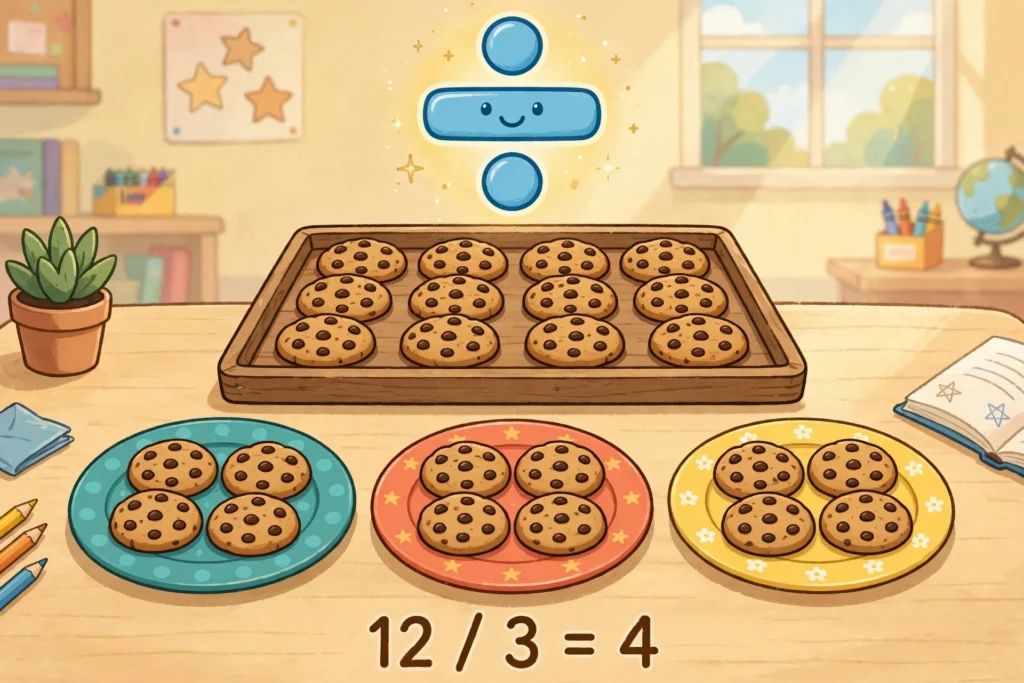
Division can be written in three common ways, and all of them say the same thing. The flat number sentence 12 ÷ 3 = 4 uses the division sign, which is called the obelus. The fraction form 12/3 = 4 uses a slash. And the long-division bracket puts the 12 inside and the 3 outside, with the answer going on top. Practice reading all three, because tests and textbooks switch between them.
What Is a Remainder in Division?
Sometimes the sharing does not come out even. Say the class bakes 14 cookies and 3 friends want to share them equally. Each friend gets 4 cookies, and 2 cookies sit on the plate with nobody to claim them. We write 14 ÷ 3 = 4 remainder 2, often shortened to 4 R 2. The remainder is the leftover, the part that cannot be shared fairly.
A remainder is always smaller than the divisor. In 14 ÷ 3 = 4 remainder 2, the leftover 2 is smaller than the divisor 3. That rule acts as a built-in check. If a student writes 14 ÷ 3 = 3 remainder 5, the remainder 5 is bigger than the divisor 3, which means one more full group of 3 was hiding in the leftovers.
Common Mistake: Students flip division problems around, writing 12 ÷ 3 when they mean 3 ÷ 12. Order matters here. Addition and multiplication work the same in any order, but division does not: 12 ÷ 3 = 4 while 3 ÷ 12 is a tiny fraction, not 4. Read the story first, then write the sentence.
How Are Divide and Multiply Connected?
Divide and multiply are inverse operations, which means each one undoes the other. That link gives students two powerful tools: a way to learn division facts and a way to check answers.
Start with a multiplication fact you know, like 3 × 4 = 12. From that one fact you get a whole fact family: 12 ÷ 3 = 4 and 12 ÷ 4 = 3. The product of the multiplication fact becomes the dividend of the division facts. Learn one multiplication fact and you get two division facts free.
The connection also creates a checking formula. After solving a division problem, multiply the answer back and add any remainder:
Dividend = (Divisor × Quotient) + Remainder
Try it on 17 ÷ 5 = 3 remainder 2. Check: (5 × 3) + 2 = 15 + 2 = 17. The dividend reappears, so the answer is right. This check catches most careless slips, and it turns every division problem into multiplication review at the same time.
Try It: The Fair-Sharing Challenge

You need 18 small objects (cubes, paper clips, or dry beans work fine) and 3 paper plates. Put all 18 objects in a pile in the middle of the table. Now deal them out like playing cards, placing one object on each plate as you go around the circle, round and round until the pile is gone. Count the objects on each plate. Every plate should hold 6. You just modeled 18 ÷ 3 = 6 with your own hands.
Now try the challenge round. Put 20 objects in the pile and deal them onto the same 3 plates. This time 2 objects stay in the middle when the plates stop filling evenly. Each plate holds 6, and the middle pile holds 2. You modeled 20 ÷ 3 = 6 remainder 2, and the leftover pile is the remainder you can see and touch.
Quick Practice
Question: A teacher has 18 stickers and wants to give an equal number to 3 students. Write the division sentence and find how many stickers each student gets.
Worked answer: The total being shared is 18, so 18 is the dividend and 3 is the divisor. The sentence is 18 ÷ 3 = ?. Since 3 × 6 = 18, the quotient is 6. Each student gets 6 stickers, with nothing left over. Quick check: 3 × 6 + 0 = 18. Correct.
Related Terms
- Quotient: the answer you get when you divide
- Fact Family: related multiplication and division facts that use the same numbers
Frequently Asked Questions
Is “divide” the same as “division”?
They mean the same operation, but divide is the action word and division is the noun. You divide 24 by 6. The operation you performed is called division. It is like the pair “add” and “addition.”
What is the answer to a divide problem called?
The quotient. In 20 ÷ 4 = 5, the quotient is 5. If something is left over, it gets its own name: the remainder.
Can you divide by zero?
There is no answer that works. Division asks what number times the divisor gives the dividend, so for 5 ÷ 0, the number times 0 would have to equal 5. But any number times 0 is 0, never 5. That is why calculators show an error.
Does dividing always make a number smaller?
With whole numbers, dividing by a number greater than 1 gives an answer smaller than the starting number. But dividing by 1 changes nothing: 7 ÷ 1 = 7. So the answer can stay the same, even though it cannot grow larger when you divide whole numbers.
Reading about it is one thing, practising it is another. Our free What Is Division? lesson builds the idea step by step, with slides, a printable worksheet and a full answer key.
Members unlock every lesson in the library, including the full Fractions, Multiplication, Place Value, Addition & Subtraction, Time & Money and Geometry & Shapes units. See the full library