
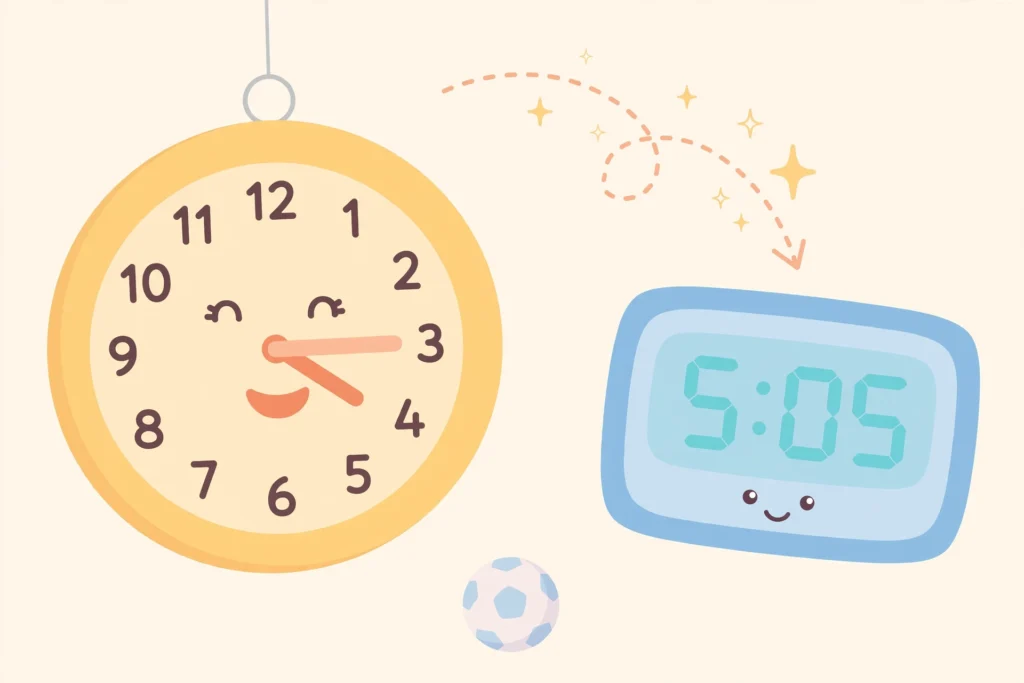
Elapsed time is the amount of time that passes from the start of an event to its finish. If soccer practice starts at 4:15 and ends at 5:05, the elapsed time is 50 minutes.
What Is Elapsed Time?
The word elapsed means “gone by.” So elapsed time is simply the time that has gone by between two moments. A cartoon episode that runs from 3:00 to 3:30 has an elapsed time of 30 minutes. A bike ride from 10:20 to 11:05 has an elapsed time of 45 minutes.
Kids meet elapsed time in word problems starting around third grade, and it shows up everywhere in real life. How long is the bus ride? How long until lunch? How many minutes of recess are left? Every one of those questions is asking for elapsed time.
How Do You Find Elapsed Time?
The basic rule is a subtraction sentence: elapsed time = end time – start time. For a movie that starts at 2:10 and ends at 3:40, subtract the start from the end. The hours give 1 hour, and the minutes give 30 minutes, so the elapsed time is 1 hour 30 minutes.
When the end minutes are smaller than the start minutes, borrow one hour as 60 minutes. A game starts at 6:45 and ends at 7:20. You cannot take 45 from 20, so borrow: 7:20 becomes 6:80. Now 80 – 45 = 35 minutes, and the hours cancel out. The elapsed time is 35 minutes. Borrowing in time math feels strange at first because 1 hour equals 60 minutes instead of 10, but the steps match the regrouping kids already know.
How Do You Find Elapsed Time on a Number Line?
Many teachers prefer the count-up method on an open number line, and most kids find it friendlier than borrowing. Draw a line, mark the start time on the left and the end time on the right, then hop forward in easy chunks.
Try the soccer practice example. Practice starts at 4:15 and ends at 5:05. Start at 4:15 and hop to the next friendly landmark, 5:00. That hop is 45 minutes. Then hop from 5:00 to 5:05, which is 5 minutes. Add the hops: 45 + 5 = 50 minutes. The elapsed time is 50 minutes.
The landmark trick is what makes this method shine. Always jump to the next hour first, then deal with the leftover minutes. For a library visit from 9:40 to 11:15, hop from 9:40 to 10:00 (20 minutes), then 10:00 to 11:00 (1 hour), then 11:00 to 11:15 (15 minutes). Add them up: 20 minutes + 1 hour + 15 minutes = 1 hour 35 minutes.
What Is the Difference Between Elapsed Time and Clock Time?
Clock time is a point on the clock, like 4:15. Elapsed time is a length of time, like 50 minutes. Kids sometimes mix them up and answer “5:05” when asked how long something lasted. A quick fix is to listen for the units in the question. “What time did it end?” wants a clock time. “How long did it take?” wants an elapsed time.
Another helper: elapsed time answers always name minutes, hours, or seconds. If your answer does not include one of those words, check whether you gave a clock time by mistake.
Why Is Elapsed Time Tricky?
Time does not work in base ten. Money and place value march in tens and hundreds, but an hour holds 60 minutes and a minute holds 60 seconds. That is why subtracting times feels different from subtracting plain numbers.
The clock face helps. Each number on the clock stands for 5 minutes, so counting around the dial is skip counting by fives. From the 3 to the 9 is six numbers times five minutes, which is 30 minutes. Kids who can hop by fives around a clock have a built-in calculator for elapsed time problems.
Quick Answer: To find elapsed time, subtract the start time from the end time. Or mark both times on a number line and count the jumps from start to finish. Both roads lead to the same answer.
Try It: The Number Line Time Walk

Tape a long strip of paper to the floor or draw a chalk line on the driveway. Write 4:15 at the left end and 5:05 at the right end. Mark 4:30, 4:45, and 5:00 in between, spacing them evenly like a timeline.
Stand at 4:15. Walk to 5:00 in big steps and count the minutes out loud as you go: 15 minutes to reach 4:30, 15 more to 4:45, 15 more to 5:00. That is 45 minutes of walking. Then take small steps from 5:00 to 5:05 and count five more minutes. You just walked 50 minutes of elapsed time with your feet.
Now invent your own. Pick a start time and an end time, mark them on the line, and walk the hops. Try one that crosses an hour, like 10:50 to 11:20, and watch how the hop to 11:00 makes the rest easy. Walking the line turns an abstract subtraction into something your body remembers.
Quick Practice
Reading time starts at 1:40 and ends at 2:25. What is the elapsed time?
Hop to the next hour first: 1:40 to 2:00 is 20 minutes. Then 2:00 to 2:25 is 25 minutes. Add the hops: 20 + 25 = 45 minutes. The elapsed time is 45 minutes.
Related Terms
Printable Practice
Practise elapsed time with this free printable worksheet. Read start and end clock pairs, use a number line to add a length of time to a start time, and solve time word problems, with a full answer key on the last page.
Download the Letter version
Download the A4 version
Frequently Asked Questions
What is elapsed time in simple words?
It is how much time passes between the start and the finish of something. Lunch from 12:00 to 12:45 has an elapsed time of 45 minutes.
Can elapsed time cross over an hour?
Yes. A game from 10:50 to 11:20 lasts 30 minutes. Hop from 10:50 to 11:00 (10 minutes), then 11:00 to 11:20 (20 minutes), and add: 10 + 20 = 30 minutes.
What does the word elapsed mean?
Elapsed means passed or gone by, as in “the time has elapsed.” When the minutes elapse, they slip by from the start of an event toward its end.
What grade learns about elapsed time?
Elapsed time appears in third grade math. The Common Core standard 3.MD.A.1 asks students to tell time to the nearest minute and solve word problems involving time intervals in minutes.
Reading about it is one thing, practising it is another. Our free Telling Time to the Hour and Half Hour lesson builds the idea step by step, with slides, a printable worksheet and a full answer key.
Members unlock every lesson in the library, including the full Fractions, Multiplication, Place Value, Addition & Subtraction, Time & Money and Geometry & Shapes units. See the full library


