
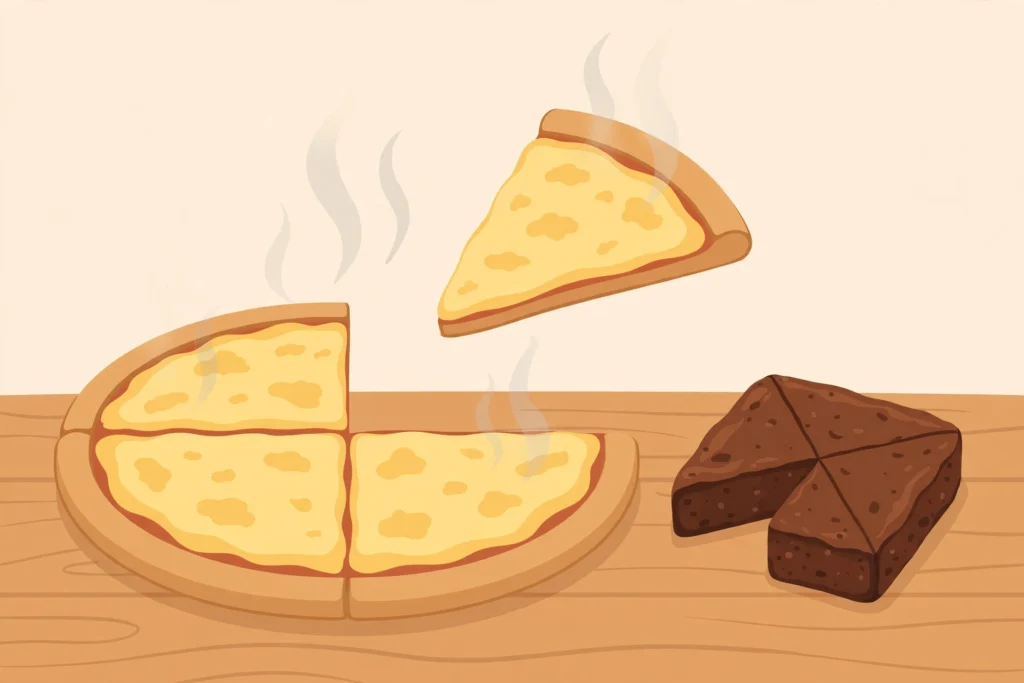
An equal share is one part of a whole that has been split so that every part is exactly the same size.
What Is an Equal Share?
Think about sharing a cookie with a friend. If you break it into two pieces and one piece is big while the other is tiny, your friend will complain. Fair sharing means the pieces match. When a whole is split into pieces that are all the same size, each piece is an equal share.
Equal shares show up long before fractions do. A preschooler who insists that both halves of a sandwich match already understands the idea. In math class, equal shares become the foundation of fractions. A half is simply one equal share of a whole split into two. A third is one equal share of a whole split into three. Without equal shares, fractions make no sense, because the pieces would have no agreed size.
I once watched a second grade teacher settle a cookie dispute the math way. She held up two paper cookies, one cut into two equal halves and one cut into one big and one small piece. “Which plate shows equal shares?” she asked. Every hand shot up for the first plate. Then she asked the harder question: “How do you know?” A quiet boy in the back said, “Fold them on top of each other and they would match.” That is the definition of equal shares, straight from a seven-year-old.
What Are Halves, Thirds, and Fourths?
Equal shares have special names based on how many there are. When a whole is split into 2 equal shares, each share is called a half. Two halves make one whole. When a whole is split into 3 equal shares, each share is called a third. Three thirds make one whole. When a whole is split into 4 equal shares, each share is called a fourth, which is also called a quarter. Four fourths make one whole.
Notice the pattern. The name tells you how many shares the whole was cut into, and that same number of shares rebuilds the whole. Five equal shares would be called fifths, six would be sixths, and eight would be eighths. In second grade, the focus stays on halves, thirds, and fourths, since those are the shares kids meet most in real life: half a sandwich, a third of a granola bar, a quarter of a pizza.
How Do You Know If Shares Are Equal?
Looking is a good start, but eyes can be fooled. The fold test is better. Cut a paper shape into pieces, then stack the pieces on top of each other. If the edges line up, the shares are equal. If one piece sticks out past the others, the shares are not equal.
For shapes on paper, tracing works too. Trace one piece onto tracing paper, then slide it over the other pieces. A perfect match means equal shares. Teachers also use balance scales with paper pieces. Equal shares weigh the same, because they are the same amount of paper. Three different tests, one idea: equal shares match in size.
Do Equal Shares Have to Look the Same?
No, and this surprises many students. Equal shares must be the same size, but they do not have to be the same shape. Take a square. Cut it straight down the middle and you get two rectangles. Cut it corner to corner and you get two triangles. Both cuts make halves. The rectangle half and the triangle half look different, but they cover exactly the same amount of space.
This idea matters because real life rarely cuts things into matching shapes. A brownie pan cut into zigzag pieces can still give every child an equal share. What counts is the size of each piece, not its outline. Mathematicians say that equal shares of identical wholes need not have the same shape, and second graders prove it with scissors and paper.
Common Mistake: thinking that more pieces means bigger shares. It is the opposite. The more equal shares you cut from one whole, the smaller each share becomes. A fourth of a pizza is smaller than a half of the same pizza, because four people are splitting what two people would have shared.
Try It: Cut the Shape into Equal Shares

You need: paper circles, squares, and rectangles, plus scissors and crayons. Start with a circle. Fold it in half so the edges line up, crease it hard, and open it. You just made two equal shares. Color one half and label it “half.”
Now take a square. Fold it in half, then fold it in half again. Open it up. You should see four equal shares. Color one fourth and label it “fourth.” Try folding the square a different way, corner to corner, and compare the triangle fourths to the rectangle fourths. Same size, different shape.
The rectangle is the tricky one. Can you fold it into three equal shares? Hint: fold one end in to make a flap, then fold the other end over it, and adjust until all three sections match. Label each part “third.” Which shape was hardest to split fairly, and why?
Quick Practice
Question: A pizza is cut into 4 equal shares. What is each share called? How many of these shares make the whole pizza?
Worked answer: Each share is called a fourth, which is also called a quarter. It takes all 4 fourths together to rebuild the whole pizza. If you eat 1 fourth, 3 fourths are left.
Related Terms
Frequently Asked Questions
What is the difference between equal shares and fractions?
Equal shares are the pieces. Fractions are the numbers we use to name those pieces. When you cut a shape into 4 equal shares, you have the shares in your hands. When you call one piece one fourth, you are using fraction language to describe it. Equal shares come first, and fraction names come second.
Can a group of objects have equal shares too?
Yes. Equal shares are not only for shapes. If 12 marbles are shared equally among 3 friends, each friend gets 4 marbles. Each group of 4 is an equal share of the whole set. The rule is the same: every share must be the same size, whether the whole is a pizza or a pile of marbles.
What do you call five equal shares?
Five equal shares are called fifths. Six are called sixths, eight are called eighths, and ten are called tenths. The pattern is simple: the name comes from the number of shares. Second grade focuses on halves, thirds, and fourths, and the bigger names arrive with fraction work in third grade.
Why do equal shares get smaller when you make more of them?
Because the whole stays the same size while the number of pieces grows. Imagine one pizza shared by 2 friends, then the same pizza shared by 8 friends. Each of the 8 friends gets a much smaller slice. More shares means the whole is divided into tinier portions.
Every topic clicks faster with practice. Our Resource Library has free lesson packs with slides, printable worksheets and full answer keys, ready to download and teach.
Members unlock every lesson in the library, including the full Fractions, Multiplication, Place Value, Addition & Subtraction, Time & Money and Geometry & Shapes units. See the full library


