
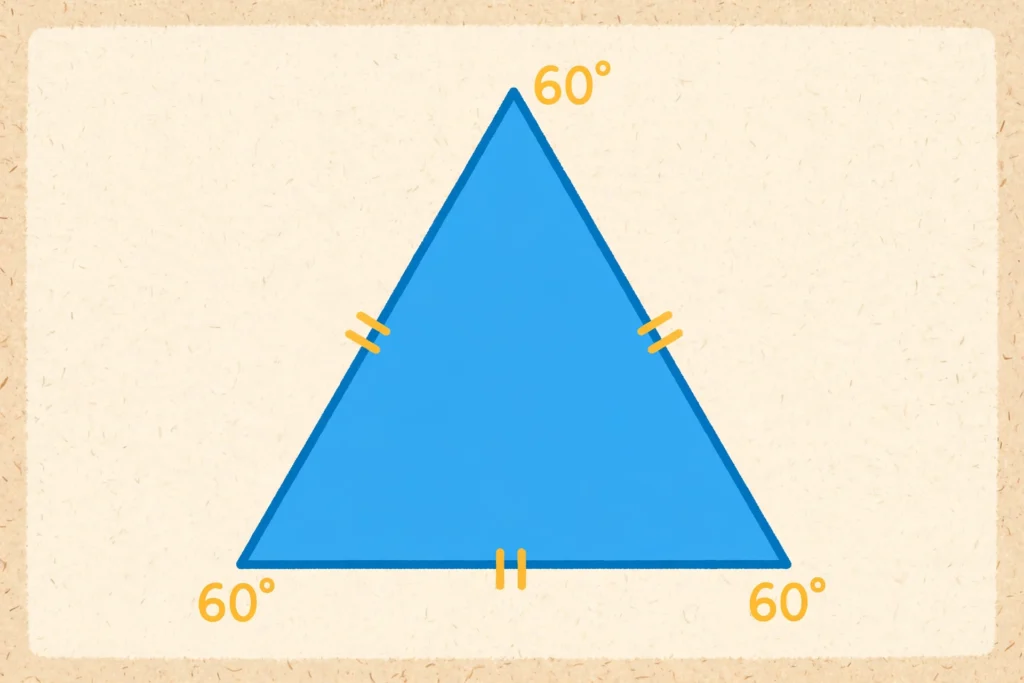
An equilateral triangle is a triangle with all three sides exactly the same length. All three of its angles match too, and each one measures 60 degrees.
How Do You Spot an Equilateral Triangle?
The name gives you the first clue. Equilateral sounds like equal, and equal is what this triangle is all about. Every side matches the other two in length, so if one side is 5 centimeters, the other two are 5 centimeters as well.
The second clue sits in the corners. When all three sides are equal, all three angles turn out equal too. Since the angles of any triangle add up to 180 degrees, each angle in an equilateral triangle must be exactly 60 degrees. That is why teachers sometimes call it an equiangular triangle, which is a fancy way of saying all the angles are equal.
In math books and on tests, you will often see tiny matching tick marks drawn on each side of the triangle. Those tick marks are the universal symbol for equal length. If you see three tick marks that all look the same, you are looking at an equilateral triangle.
What Are the Three Properties of an Equilateral Triangle?
An equilateral triangle is easy to remember because it has three properties, one for each side.
- It is a regular polygon with three sides. Regular means every side and every angle is the same.
- All three sides are equal in length.
- All three interior angles are equal, and each one measures 60 degrees.
Here is a classroom moment you might recognize. Mrs. Carter draws three triangles on the board. The first has sides of 4, 5, and 6 inches. The second has sides of 5, 5, and 5 inches. The third has sides of 5, 5, and 8 inches. She asks the class to point to the equilateral triangle. The students who notice all three sides matching raise their hands for the second triangle.
How Many Degrees Are in Each Angle?
Sixty. Always sixty. No matter how big or small the triangle is, each corner holds a 60-degree angle. You can check the math yourself: 60 + 60 + 60 = 180.
Try a quick test in your head. A triangle drawn on the board has corners of 50, 60, and 70 degrees. Can it be equilateral? No, because the corners do not match. An equilateral triangle never plays favorites. All three corners stay at 60 degrees.
How Many Lines of Symmetry Does an Equilateral Triangle Have?
Three. Draw a line from any corner straight to the middle of the side across from it, and the triangle folds into two matching halves. You can do this from each of the three corners, so you get three fold lines in total.
Spin the triangle and it has one more trick. Turn an equilateral triangle by 120 degrees and it lands in the exact same spot, looking the same as before. Rotations of 120 degrees, 240 degrees, and a full 360 degrees all leave the triangle looking unchanged. Mathematicians call this rotational symmetry of order 3.
How Do You Find the Perimeter of an Equilateral Triangle?
Because all three sides are the same, finding the perimeter is quick work. Multiply the length of one side by 3.
Perimeter = 3 x side length
Say each side is 7 inches long. The perimeter is 3 x 7 = 21 inches. If each side were 10 centimeters, the perimeter would be 30 centimeters. One multiplication step and you are done.
Can an Equilateral Triangle Be a Right Triangle?
No, and the angle math shows why. A right triangle needs one 90-degree angle, but an equilateral triangle only allows 60-degree angles. You cannot fit a 90-degree corner into a shape where every corner is 60 degrees.
The same idea blocks other combos. An equilateral triangle can never be an obtuse triangle either, because an obtuse angle is bigger than 90 degrees. It always counts as an acute triangle, since 60 degrees is less than 90 degrees. Every equilateral triangle is also an isosceles triangle, because isosceles only asks for at least two equal sides.
Did You Know: an equilateral triangle is a regular polygon, which means it is a closed shape with all sides and all angles equal. The yield sign on the road is an upside-down equilateral triangle. Builders love this shape too. Bridge frames and roof trusses use equilateral triangles because equal sides spread weight evenly, which makes the structure strong.
Try It: Build an Equilateral Triangle With String

You will need a long piece of string, some tape, and a partner. Tie the ends of the string together to make a loop, then have your partner hold one point of the loop while you stretch it into a triangle shape on the floor.
Now comes the measuring part. Use a ruler or a strip of paper to check each of the three sides. If one side is longer than the others, slide the corners along the string until all three sides match. Tape the corners down once the sides are equal.
For a challenge, draw your triangle on paper first. Label each side with the same measurement, such as 8 centimeters, and write 60 degrees in each corner. Then recreate that exact triangle with your string. If your string triangle has three equal sides, you just built an equilateral triangle with your own hands.
Quick Practice
Question: An equilateral triangle has sides that are each 9 centimeters long. What is its perimeter, and what is the measure of each angle?
Answer: The perimeter is 3 x 9 = 27 centimeters. Each angle measures 60 degrees, because every angle in an equilateral triangle is 60 degrees.
Related Terms
- Acute Angle: Every angle in an equilateral triangle is acute, since 60 degrees is less than 90 degrees.
- Obtuse Angle: An equilateral triangle can never contain an obtuse angle, because all its angles are 60 degrees.
Frequently Asked Questions
Is an equilateral triangle also an isosceles triangle?
Yes, under the most common definition. An isosceles triangle has at least two equal sides, and an equilateral triangle has three. A few textbooks define isosceles as exactly two equal sides, which would leave equilateral triangles out.
What is the difference between equilateral and equiangular?
Equilateral describes equal side lengths, while equiangular describes equal angle measures. In triangles, one always leads to the other. Every equilateral triangle is equiangular, and every equiangular triangle is equilateral. That is not true for other polygons, so this is a special triangle trick.
How do you draw an equilateral triangle with a compass?
Draw a line segment for the base. Place the compass point on one end, open it to reach the other end, and draw an arc above the segment. Without changing the compass width, repeat from the other end. Mark the spot where the two arcs cross, connect it to both ends of the base, and you have an equilateral triangle.
What objects are shaped like equilateral triangles?
Yield signs on roads, tortilla chips, some guitar picks, and triangular warning signs used in many countries. Bridge frames and roof trusses also use equilateral triangles for strength.
Reading about it is one thing, practising it is another. Our free What Are 2D Shapes? lesson builds the idea step by step, with slides, a printable worksheet and a full answer key.
Members unlock every lesson in the library, including the full Fractions, Multiplication, Place Value, Addition & Subtraction, Time & Money and Geometry & Shapes units. See the full library


