
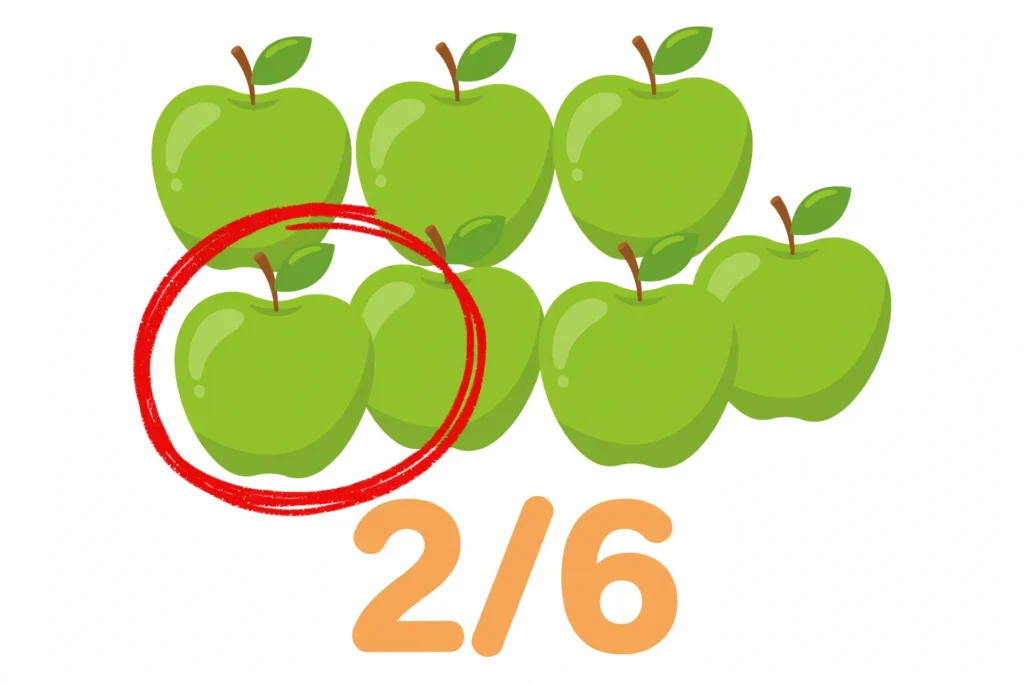
A part of a set is a fraction that describes some of the objects in a group. You count the objects you are asking about, put that number on top, and count every object in the group for the bottom number.
Take a simple case: a set has 6 apples and 2 are circled. The circled apples are 2 out of 6, written as the fraction 2/6. The top number counts the circled apples, and the bottom number counts all the apples.
How Do You Write a Fraction of a Set?
Writing a part of a set is a two-count job. First, count the objects in the whole set. That count becomes the denominator, the bottom number of the fraction. Then count the objects you are describing. That count becomes the numerator, the top number.
Try it with a jewelry box holding 3 jewels: 1 red and 2 blue. The set is all 3 jewels, so every fraction here has 3 on the bottom. The red jewel is 1/3, and the blue jewels are 2/3. Say it out loud: “One-third of my jewels are red.”
Notice how the fractions in one set add up: 1/3 red plus 2/3 blue equals 3/3, the whole set. That is a built-in check: if your fractions do not add up to the whole, the counting went wrong.
What Is the Difference Between Part of a Whole and Part of a Set?
This is the question that unlocks the whole topic. A part of a whole describes one single thing cut into equal pieces, like one pizza sliced into 8 pieces. A part of a set describes separate objects grouped together, like 8 marbles where 3 are green. Same fraction idea, different picture.
The counting changes in one important way. With a pizza, the denominator counts the slices of that one pizza. With a set, the denominator counts separate objects. With the pizza, each piece must be the same size for the fraction to work. With a set of marbles, the objects can be different colors, shapes, or sizes; each object still counts as one.
A child who learned fractions with pizzas may stare at 5 dogs and wonder where to “cut.” No cutting needed: the set is already in pieces, one piece per dog. 2 black dogs out of 5 total is the fraction 2/5.
How Do You Find a Fraction of a Set?
Finding a fraction of a set means working backward: you know the fraction and the set, and you want the count. The trick is to divide first, then multiply. To find 1/3 of 24 objects, divide 24 by the denominator 3, which gives 8. So 1/3 of 24 is 8 objects.
Fractions with a top number of 1 are called unit fractions, and they are the easiest to find because the divide step is the whole job. 1/4 of 20 is 20 ÷ 4 = 5. 1/2 of 10 is 10 ÷ 2 = 5. When the top number is bigger than 1, add a multiply step. To find 2/3 of 24, divide 24 by 3 to get 8, then multiply by the numerator 2 to get 16. So 2/3 of 24 is 16.
Common Mistake: Students often put the count of the described objects on the bottom. If 2 out of 6 apples are circled, the wrong fraction is 2/2 or 6/2. The bottom number must always count the entire set: 2/6. When in doubt, point at the whole group and ask, “How many in all?” That number goes on the bottom.
Do All the Pieces Have to Be Equal in a Set?
No, and this is one of the friendliest differences from part-of-a-whole fractions. In a set, each object counts as one no matter what it looks like. A set of 4 crayons with 1 broken crayon gives the fraction 1/4 broken, even though the broken crayon looks different from the rest. The count is what matters, not the appearance.
What must stay fixed is the set itself. If 3 out of 10 crayons are yellow, that is 3/10. But pull 2 more yellow crayons from a drawer and the set is 12, so the fraction becomes 5/12. The fraction always describes one specific, finished group.
This is why set problems always state the total first: “There are 12 students. 5 are wearing glasses.” The total, 12, locks in the denominator. Circle that total number first, and set problems get much easier.
Try It: The Crayon Sort

Dump a box of crayons on the table and count them all. Suppose you count 12. That is your set, and 12 is every denominator you will write today. Now sort the crayons by color. Let us say you find 4 red, 5 blue, and 3 green.
Write the fractions: red 4/12, blue 5/12, green 3/12. Check: 4/12 + 5/12 + 3/12 = 12/12, the whole set. Now find a fraction of the set: 1/3 of 12 crayons is 12 ÷ 3 = 4. And 2/3? Multiply 4 by 2 to get 8. Try the same game with buttons, toy cars, or fruit.
Quick Practice
Question: A bag has 9 marbles: 3 green, 4 blue, and 2 red. What fraction of the marbles are blue? What is 1/3 of the 9 marbles?
Worked answer: The set has 9 marbles, so the denominator is 9. There are 4 blue marbles, so the blue fraction is 4/9. For 1/3 of 9 marbles, divide 9 by 3 to get 3 marbles. As a check, 4/9 + 3/9 + 2/9 = 9/9, the whole bag.
Related Terms
Frequently Asked Questions
What grade learns part of a set?
US classrooms meet part-of-a-set fractions in second grade with simple counting problems, and the idea becomes formal in third grade under Common Core 3.NF.1, where students understand a fraction as a quantity formed by parts of a whole or parts of a set.
Can a part of a set be more than the whole?
No. A part of a set always describes some or all of the group, so the fraction is always between 0 and 1. You cannot circle more apples than the set contains. Fractions larger than 1 belong to other ideas, like improper fractions of a whole.
How do you read a fraction of a set out loud?
Read it as a sentence about the group. 2/6 is “two-sixths of the apples are circled” or “two out of six apples are circled.” The phrasing “out of” is the giveaway that you are talking about a part of a set.
What is a unit fraction of a set?
A unit fraction has 1 on top, like 1/3 or 1/4. For sets, it means one part out of the whole group, and it is the easiest kind to find: just divide the total by the bottom number. 1/4 of 20 objects is 20 ÷ 4 = 5 objects.
Where do parts of a set appear in real life?
Everywhere groups are counted. A survey result like “3 out of 10 dentists” is a part of a set. So are sports stats, poll results, and class votes. Whenever someone reports how many out of a group share a trait, they are using this exact idea.
Every topic clicks faster with practice. Our Resource Library has free lesson packs with slides, printable worksheets and full answer keys, ready to download and teach.
Members unlock every lesson in the library, including the full Fractions, Multiplication, Place Value, Addition & Subtraction, Time & Money and Geometry & Shapes units. See the full library


