

A prism is a 3D solid with two matching, parallel ends and flat sides, like a camping tent or a cereal box.
What Is a Prism?
Hold a Toblerone box in one hand and a shoebox in the other. Different shapes, right? Now look at their ends. The Toblerone box has two triangle ends that match exactly. The shoebox has two rectangle ends that match exactly. Everything between the ends is flat.
That is a prism. Two ends that are the same shape and size, sitting parallel to each other, joined by flat faces. Mathematicians call the two ends bases.
Here is the test that never fails. Slice a prism anywhere parallel to its bases and every slice looks exactly like the base. Slice a Toblerone box and every slice is a triangle. If the slices change shape as you move along, it is not a prism.
How Many Faces, Edges, and Vertices Does a Prism Have?
The counts follow one simple pattern, and once students see it, they can predict any prism they meet.
| Prism | Faces | Edges | Vertices |
|---|---|---|---|
| Triangular prism | 5 | 9 | 6 |
| Rectangular prism | 6 | 12 | 8 |
| Pentagonal prism | 7 | 15 | 10 |
| Hexagonal prism | 8 | 18 | 12 |
The pattern is the fun part. If the base has n sides, the prism has n + 2 faces, 3n edges, and 2n vertices. A triangle base with 3 sides gives 5 faces, 9 edges, and 6 vertices. Ask a student to predict a hexagonal prism before telling them the answer. The moment they realize they can compute a shape they have never seen feels like a magic trick.
How Do You Name a Prism?
Look at the base and the prism names itself. Triangle bases make a triangular prism. Rectangle bases make a rectangular prism. Pentagon bases make a pentagonal prism. That is the whole rule.
A cube is a square prism with a special bonus. All six of its faces are squares, and all of its edges are the same length. So every cube is a rectangular prism, but not every rectangular prism is a cube. That sentence alone settles half the arguments in a geometry lesson.
What Are Some Examples of Prisms in Real Life?
Prisms are packaging shapes. Boxes want to be prisms because flat faces stack neatly and matching ends are easy to cut from cardboard.
- cereal box (rectangular prism)
- camping tent (triangular prism)
- Toblerone chocolate box (triangular prism)
- brick (rectangular prism)
- tissue box (rectangular prism)
- shoebox (rectangular prism)
- aquarium (rectangular prism)
- pencil, before it is sharpened (hexagonal prism)
The pencil surprises everyone. An unsharpened pencil is a hexagonal prism, six flat sides around a hexagon core. Hand one to a student and ask them to find the two matching ends. They will roll it, count the sides, and never look at a pencil the same way again.
Is a Cube a Prism? Is a Cylinder a Prism?
Yes to the cube, no to the cylinder, and both answers teach something.
A cube is a square prism. Its two square bases are congruent and parallel, and its four side faces are squares. It passes the prism test perfectly. Students who resist this are usually thinking a prism has to look long or stretched. It does not. The shape of the ends is all that matters.
A cylinder fails the test even though it looks close. It has two matching circular ends, but its side is curved, not flat. A prism’s side faces must be flat polygons. This is the single most tested confusion on 3D shape quizzes, so it is worth saying plainly: curved sides mean not a prism.
Prism vs Pyramid: What Is the Difference?
Prisms and pyramids sound alike and both get named after their bases, which is exactly why students mix them up. One question separates them: how many bases?
| Feature | Prism | Pyramid |
| Bases | 2, congruent and parallel | 1 |
| Side faces | rectangles (or parallelograms) | triangles meeting at one point |
| Top | a full second base | a single vertex called the apex |
| Example | tent, cereal box | pyramid of Egypt, party hat shape |
Picture the difference as a building project. A prism is two matching floors with walls between them. A pyramid is one floor with walls that lean inward until they meet at a point.
Common Mistake: “The Ends Match, So It Must Be a Prism”
Common Mistake: matching ends are necessary but not enough. The side faces must be flat too. A cylinder has matching ends and still is not a prism because of its curved side.
The second trap is orientation. Tip a rectangular prism onto its side and some students stop seeing the rectangle ends. They point at the big face on the table and call it the base. But a prism’s base is defined by which faces are congruent and parallel, not by which face sits on the desk. Roll the shape around. The pair of matching parallel faces is the pair of bases, no matter how the prism is parked.
Try It: Build a Prism From Straws
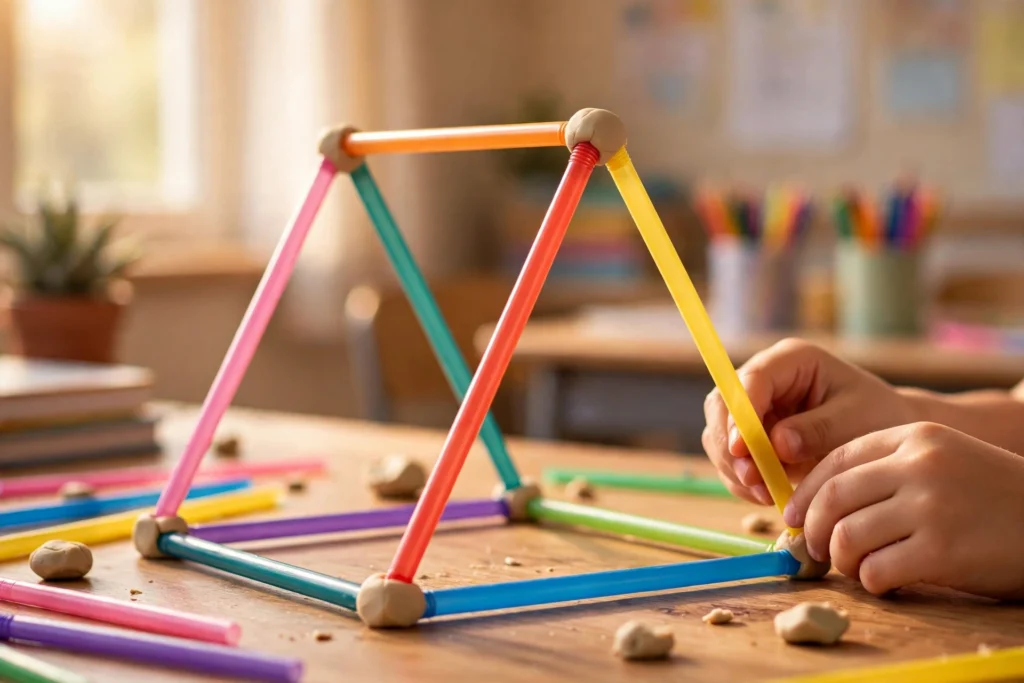
Give each pair of students drinking straws and small balls of playdough. The challenge: build a triangular prism skeleton. First they build two matching triangles, then they connect the matching corners with three more straws.
The playdough balls become the vertices, which makes the count physical. When the second triangle goes on, someone always notices the vertex count doubled. That is the 2n rule, discovered by hand instead of memorized from a table.
For a finale, challenge them to build a pentagonal prism and predict the straw count first. They will argue, count, rebuild, and remember the pattern far longer than any worksheet can manage.
Quick Practice
A solid has 7 faces, 15 edges, and 10 vertices. Its two ends are congruent pentagons sitting parallel to each other. What is it, and how do you know?
Answer: a pentagonal prism. Two congruent parallel ends make it a prism, and pentagon ends name it pentagonal. Check the counts: a 5-sided base gives 5 + 2 = 7 faces, 5 x 3 = 15 edges, and 5 x 2 = 10 vertices. Every number matches.
Related Terms
Explore rectangular prism and pyramid.
Frequently Asked Questions
Can a prism roll?
A prism with flat faces cannot roll smoothly the way a cylinder or sphere can. Tip a triangular prism onto one of its rectangular faces and it will tumble end over end, but it clunks instead of rolling because every face is flat.
What is a right prism?
A right prism is one whose side faces meet the bases at right angles, like a box standing straight. If the prism leans to one side, it is called an oblique prism. In elementary school, almost every prism students meet is a right prism.
How do you find the volume of a prism?
Multiply the area of one base by the height, the distance between the two bases. This works because every slice of a prism matches the base, so you are just stacking base-sized slices.
Does a prism have to sit on its base?
No. The bases are the two congruent parallel faces, whichever way the prism is turned. A Toblerone box lying on its side is still a triangular prism. The base is a relationship between two faces, not a position on the table.
The next time you open a cereal box, pause before the first pour. Two matching ends, four flat sides, edges you can count on your fingers. You are holding a rectangular prism, and now you know its whole family.
Reading about it is one thing, practising it is another. Our free What Are 2D Shapes? lesson builds the idea step by step, with slides, a printable worksheet and a full answer key.
Members unlock every lesson in the library, including the full Fractions, Multiplication, Place Value, Addition & Subtraction, Time & Money and Geometry & Shapes units. See the full library


