
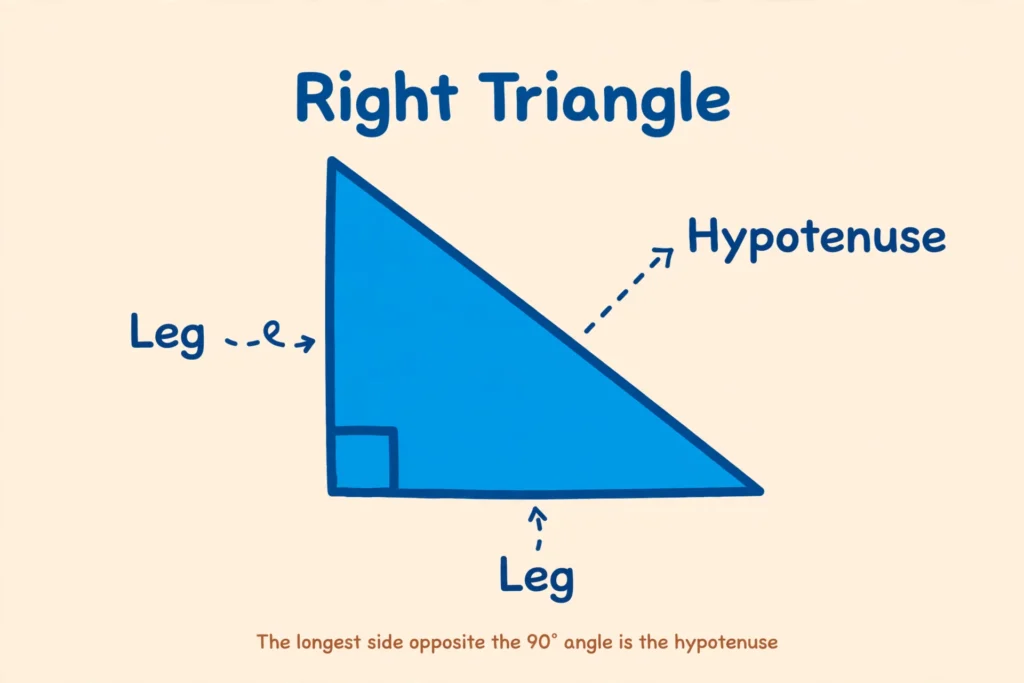
A right triangle is a triangle with one angle that measures exactly 90 degrees. That 90-degree angle is called a right angle, and it gives this triangle its name.
How Do You Spot a Right Triangle?
Look for the little square. In math drawings, a right angle is marked with a small square tucked into the corner instead of a curved angle mark. That square is the triangle’s name tag. If you see it, you are looking at a right triangle.
The square matches the corner of a book, the corner of a whiteboard, or the corner where a wall meets the floor. Once you know what a right angle feels like in the real world, the little square on paper starts to make sense. One square in one corner is all it takes to name the whole triangle.
What Are the Legs and the Hypotenuse?
A right triangle has three sides with special names. The two sides that form the right angle are called the legs. The third side, which sits across from the right angle, is called the hypotenuse.
The hypotenuse is always the longest side of the triangle. Think of it as the side that stretches across the corner. If you are ever unsure which side is the hypotenuse, find the little square first, then look at the side that does not touch it. That side is the hypotenuse.
Here is how a teacher might say it in class. Hold up a drafting triangle, the plastic tool used in geometry class. Point to the two short edges that meet at the square corner and call them the legs. Then run your finger along the long slanted edge and call it the hypotenuse. Students remember the names faster when they can touch each side.
What Are the Other Two Angles in a Right Triangle?
Both of the other angles are acute, which means each one is less than 90 degrees. Together they add up to 90 degrees, because every triangle’s angles total 180 degrees and the right angle already uses up 90 of them.
Try some combos. A right triangle might have angles of 90, 60, and 30 degrees. It might have 90, 45, and 45. It might have 90, 70, and 20. In every case, the two non-right angles add to 90, and each one stays under 90. This gives students a quick way to check their work: if the two small angles do not add to 90, something went wrong.
Can a Right Triangle Be Equilateral?
No. An equilateral triangle needs all three angles to be 60 degrees, but a right triangle needs one angle to be 90 degrees. Those two rules cannot both be true at once. A triangle cannot have a 90-degree corner and three 60-degree corners in the same shape.
A right triangle can be isosceles, though. The famous 45-45-90 triangle has two equal legs and two equal 45-degree angles. It can also be scalene, with all three sides different lengths, like the 3-4-5 triangle. Equilateral is the one family that is always off limits.
How Do You Find the Area of a Right Triangle?
Cut a rectangle in half along its diagonal and you get two right triangles. That picture gives you the area formula: multiply the two legs, then divide by 2.
Area = (leg 1 x leg 2) / 2
Say a right triangle has legs of 5 inches and 12 inches. The matching rectangle would have an area of 5 x 12 = 60 square inches. Half of that is 30 square inches, which is the triangle’s area. The division by 2 is what turns the rectangle’s area into the triangle’s area.
Quick Answer: look for the little square. A triangle with a square tucked into one corner is a right triangle. The two sides that touch the square are the legs, and the side across from the square is the hypotenuse, always the longest side.
Try It: Find Right Triangles in Your Classroom

Fold a sheet of paper in half, then fold it in half again. The folded corner is a right-angle tester you made yourself. Now walk around the classroom and test corners with it.
Check the corner of a book, the edge of a desk, and the frame of the whiteboard. Each time your folded corner fits exactly, you found a right angle. Sketch three right angles you find and draw a small square in each corner, the way math books do.
For the final challenge, find an object shaped like a whole right triangle, not just a corner. A drafting triangle, a folded napkin, or half of a rectangular index card all count. Label the legs and the hypotenuse on your sketch.
Quick Practice
Question: A right triangle has legs that are 6 centimeters and 8 centimeters long. What is its area?
Answer: Multiply the legs and divide by 2: (6 x 8) / 2 = 48 / 2 = 24 square centimeters.
Related Terms
- Acute Angle: The two non-right angles in a right triangle are always acute.
- Obtuse Angle: A right triangle can never have an obtuse angle, because 90 plus anything over 90 breaks the 180-degree total.
Frequently Asked Questions
Can a right triangle have two right angles?
No. Two right angles would add to 180 degrees, leaving zero degrees for the third angle. A triangle needs three real corners, so one right angle is the limit.
What is the Pythagorean theorem?
It is the rule that connects the three sides of a right triangle: the square of the hypotenuse equals the sum of the squares of the legs. Written as a formula, a^2 + b^2 = c^2, where c is the hypotenuse. The 3-4-5 triangle is the most famous example: 3^2 + 4^2 = 9 + 16 = 25, and 5^2 = 25.
Is a right triangle always half of a rectangle?
Yes. Draw any rectangle and cut it along a diagonal, and you get two matching right triangles. This is why the area formula for a right triangle is half the area of the rectangle built from its two legs.
Where do you see right triangles in real life?
A playground slide forms a right triangle with the ground and the ladder. A ladder leaning against a wall makes one too. Set squares in a geometry kit, the sail on some small boats, and the corner brace inside a bookshelf are all right triangles at work.
Reading about it is one thing, practising it is another. Our free What Are 2D Shapes? lesson builds the idea step by step, with slides, a printable worksheet and a full answer key.
Members unlock every lesson in the library, including the full Fractions, Multiplication, Place Value, Addition & Subtraction, Time & Money and Geometry & Shapes units. See the full library


