

A square is a flat shape with four straight sides that are all the same length and four square corners. Look around any classroom and you will find squares in floor tiles, window panes, and sticky notes.
What Is a Square?
In math, a square is a quadrilateral, which is a word for a shape with four sides. But a square is not just any four-sided shape. It is a regular quadrilateral, because all four sides match and all four corners are right angles of exactly 90 degrees.
Think of it as a club with two strict rules for joining. Rule one: the shape must have four straight sides. Rule two: every side must be exactly as long as the others. If a shape follows both rules and has square corners, it is a square.
What Makes a Square Special?
A square has a short list of traits that never change, no matter how big or small it is or which way it is turned:
- Four sides that are all the same length.
- Four right angles, or corners that look like the corner of a book.
- Four vertices, which is the math word for corners where two sides meet.
- Opposite sides that are parallel, meaning they run in the same direction and never meet.
Those traits are why squares stack so neatly. Floor tiles line up edge to edge with no gaps because every side meets its neighbor at a right angle. Builders and game makers love that tidy fit.
How Is a Square Different From a Rectangle?
Here is a fact that surprises many students: every square is a rectangle. A rectangle needs four straight sides and four right angles, and a square has both. But not every rectangle is a square, because a rectangle can have two long sides and two short sides.
Common Mistake: Many kids think a square turned on its corner becomes a diamond and stops being a square. Turn a square so it balances on one point and it is still a square, because its sides are still equal and its corners are still right angles. Turning a shape never changes what it is.
When a teacher asks about squares and rectangles, the answer they want is simple: a square is a special rectangle, one where all four sides are equal.
Where Do We See Squares in Real Life?
Squares hide in plain sight. Each face of a die is a square. The spaces on a chessboard are squares. Napkins, wall clocks, postage stamps, and many window panes are squares too. Even the screen you might be reading this on is close to a square, though most screens are rectangles with unequal sides.
Next time you walk down a school hallway, count the square ceiling tiles or floor tiles. Builders use squares because they fit together with no wasted space, and game makers use them because every space on the board treats every player the same.
How Do You Draw a Square?
All you need is a ruler and a pencil. Draw one straight side, then measure it. Turn your paper and draw the next side the exact same length, meeting the first side at a corner like the corner of a book. Draw the third and fourth sides the same way until the shape closes.
Then check your work. Measure all four sides to make sure they match. Look at each corner and ask whether it looks square. If one side came out longer, you drew a rectangle, which is fine, just not a square this time.
Try It: The Square Hunt
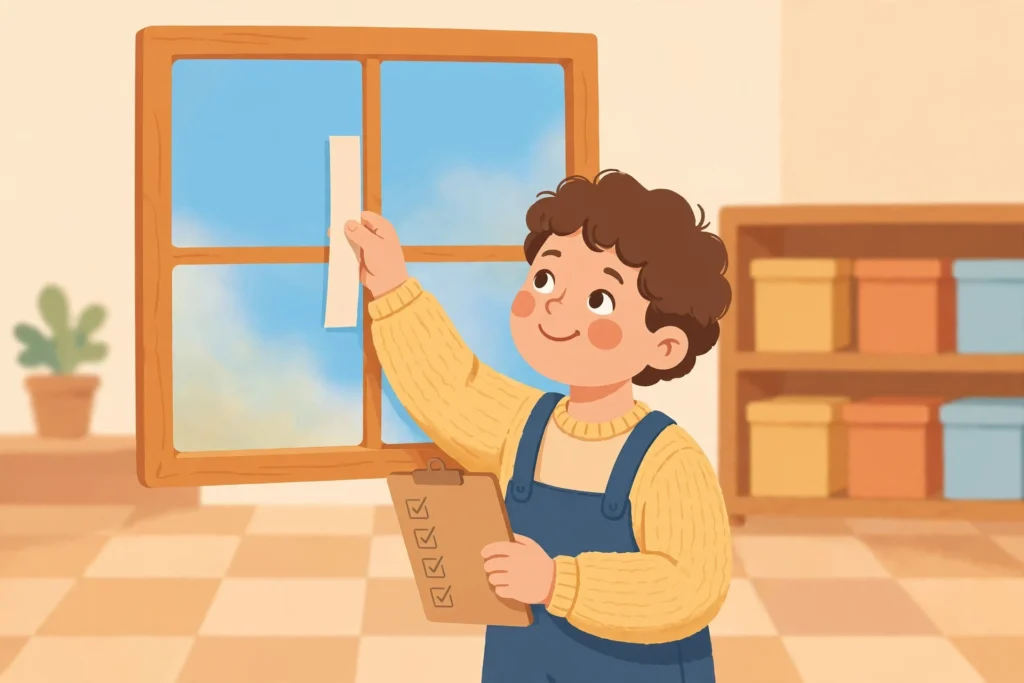
Grab a strip of paper and go on a square hunt around your classroom or home. Pick an object that looks square, such as a tile or a book cover. Hold your strip against one side and mark its length with a pencil.
Now test the other three sides against your mark. If all four sides match your mark and the corners look square, you found a real square. Keep a list of everything you find. Most hunters are shocked by how many squares were hiding in their room the whole time.
Quick Practice
Maya draws a shape with four straight sides. Three of the sides measure 6 centimeters and the fourth side measures 8 centimeters. Is her shape a square? Explain your thinking.
Answer: No. A square needs all four sides to be equal, but Maya has one side that is longer than the rest. Her shape is a quadrilateral, yet it breaks the equal-sides rule, so it cannot be a square.
Related Terms
Frequently Asked Questions
How many sides does a square have?
A square has four straight sides, and all four are the same length. It also has four corners, called vertices.
Is a square a rectangle?
Yes. A square meets every rule for being a rectangle: four straight sides and four right angles. A square is simply a rectangle with all sides equal.
What is a vertex?
A vertex is a corner point where two sides of a shape meet. The plural is vertices. A square has four vertices.
Can a square be tilted and still be a square?
Yes. Turning a shape does not change its sides or angles. A square standing on one corner is still a square, even though it might look like a diamond at first glance.
What is the difference between a square and a cube?
A square is flat, with only length and width. A cube is solid, with length, width, and height. A cube has six faces, and every face is a square.
Reading about it is one thing, practising it is another. Our free What Are 2D Shapes? lesson builds the idea step by step, with slides, a printable worksheet and a full answer key.
Members unlock every lesson in the library, including the full Fractions, Multiplication, Place Value, Addition & Subtraction, Time & Money and Geometry & Shapes units. See the full library


