
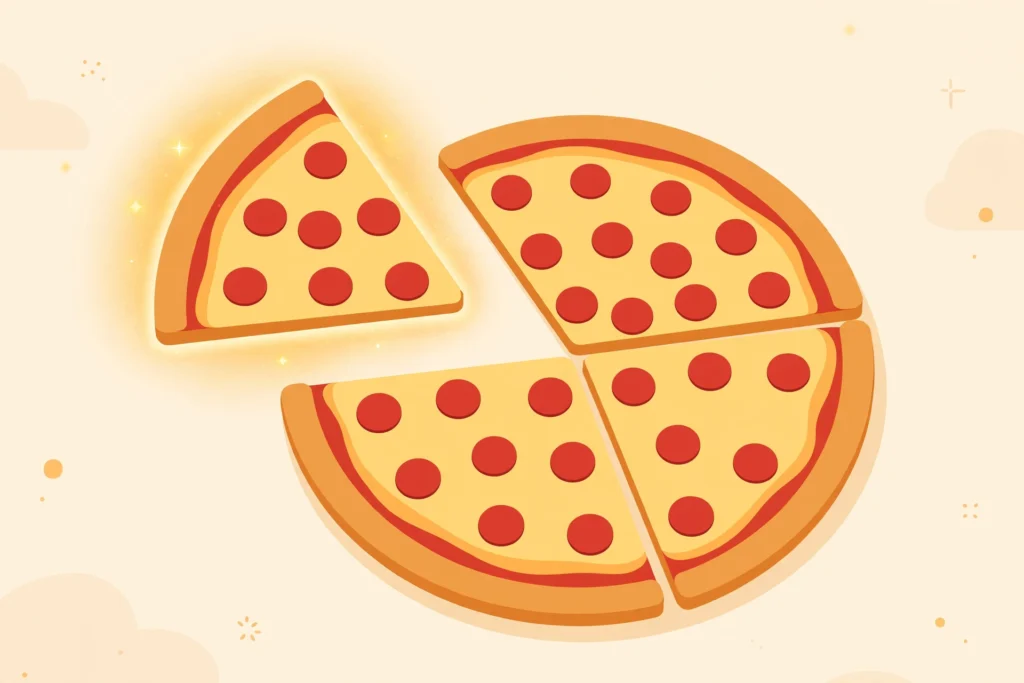
Thirds are what you get when you split one whole into three equal parts. Each part is one third, written as the fraction 1/3.
What Are Thirds in Math?
Every kid knows the lunch-table negotiation. One cookie, two friends, and a serious discussion about fairness. Halves solve the two-friend problem. But when a third friend shows up, halves will not do. You need thirds: three parts, all exactly the same size, so nobody can complain.
In math, thirds work the same way. Take any whole, a pizza, a strip of paper, a group of 24 counters, and divide it into three equal parts. Each part is one third. The three parts together rebuild the whole: 1/3 + 1/3 + 1/3 = 1.
Thirds belong to the fraction family, and they arrive early. After halves and fourths, thirds are usually the next fraction kids meet. They open the door to trickier ideas later, like equivalent fractions and dividing remainders fairly, because three does not split as neatly as two or four.
How Do You Know the Parts Are Truly Thirds?
The word that makes or breaks thirds is equal. Three pieces of any size are just three pieces. Three equal pieces are thirds. If one slice of pizza is big and the other two are tiny, you do not have thirds. You have an argument.
Here is the part that surprises kids: equal does not mean same shape. Picture a rectangle cut into thirds three different ways. One way makes three tall strips. Another makes three short strips. A third way makes a zigzag. If you weighed each piece, the scale would read the same every time. Same size, different shapes, still thirds.
Classrooms test this with paper folding. Give each child a paper strip and ask for thirds without a ruler. Most kids fold it in half first, then fold again, and end up with fourths or uneven chunks. The aha moment comes when they fold one end to meet an imaginary line one third of the way in, crease, then fold the other end to meet the crease. Three equal parts, no ruler needed.
How Do You Write One Third as a Fraction?
One third is written as 1/3. The bottom number, the denominator, tells how many equal parts the whole was split into: 3. The top number, the numerator, tells how many of those parts you have: 1. Read it as “one third.”
Once you have one third, the rest of the family follows. Two of the three parts is two thirds, written 2/3. All three parts is three thirds, written 3/3, which equals one whole. A quick table keeps the family straight:
| Words | Fraction | Meaning |
|---|---|---|
| one third | 1/3 | 1 part out of 3 equal parts |
| two thirds | 2/3 | 2 parts out of 3 equal parts |
| three thirds | 3/3 | all 3 parts, one whole |
Saying the fractions out loud helps them stick. “One third of the pizza is mine” sounds much more grown-up than “one piece,” and it says exactly how big the piece is.
Where Do You See Thirds in Real Life?
Thirds pop up in kitchens, clocks, and classrooms. A recipe that calls for 1/3 cup of sugar is asking for one of three equal parts of a cup. A pizza cut for three friends gives each friend one third. An hour has 60 minutes, and one third of an hour is 20 minutes, which is why “twenty minutes” and “a third of an hour” mean the same thing.
Teachers use thirds to settle sharing disputes with math instead of opinions. Put 24 counters on a table and ask three kids to share them fairly. Each child takes one counter in turn until the pile is gone. Count each share: 8 counters. One third of 24 is 8, and every child can see the fairness with their own eyes.
Did You Know: One third written as a decimal never ends. The fraction 1/3 equals 0.333…, with the 3 repeating forever. Halves stop neatly at 0.5 and quarters stop at 0.25, but thirds keep going. Mathematicians write the repeating 3 with a tiny bar over it, like 0.3 with a line on top.
Try It: Share the Pizza Fairly
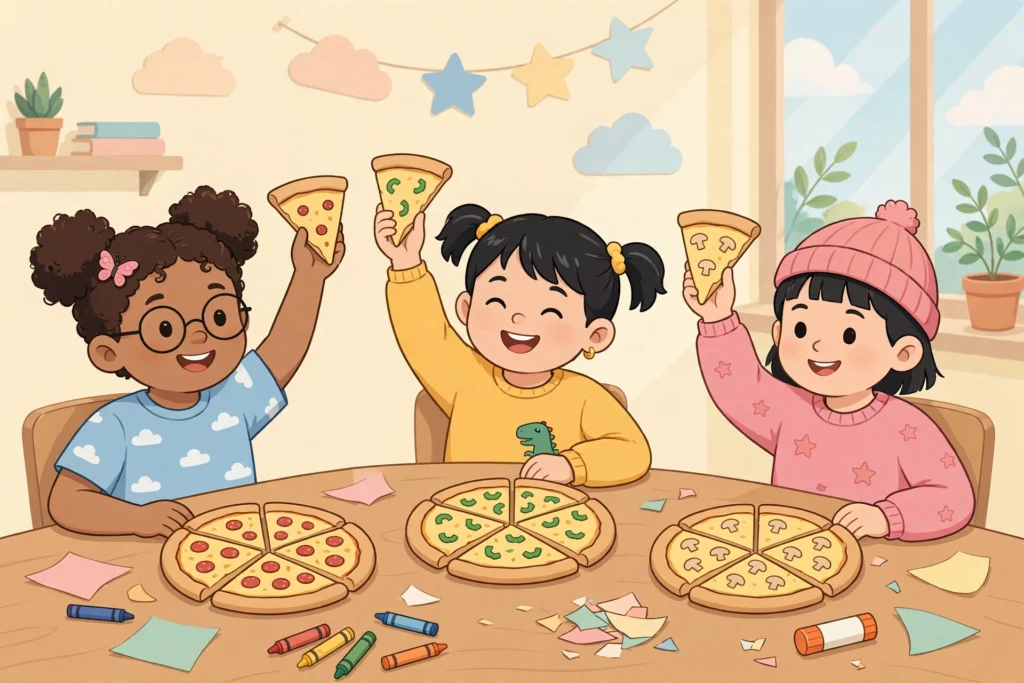
This activity needs paper plates or paper circles, scissors, and crayons. Plan for about fifteen minutes with partners.
First, each partner draws a “pizza” on a paper circle and adds toppings with crayons. Pepperoni, mushrooms, extra cheese, anything goes. The sillier the pizza, the more kids care about sharing it fairly.
Next, cut the pizza into thirds. Fold the circle so the edges meet at the center in three equal slices, crease firmly, then cut along the folds. Lay the three slices on top of each other to check: do the edges line up? If one slice is bigger, trim it and try the fold again.
Then, play the sharing game. Partner A takes one slice (one third), Partner B takes one slice (one third), and one slice is left over. Ask the class: what fraction of the pizza is left? Two thirds are gone, one third remains. Finally, put all three slices back together and watch the whole pizza reappear: 1/3 + 1/3 + 1/3 = 1.
Quick Practice
Question: What is one third of 24?
Answer: To find one third of a number, divide it by 3. So 24 ÷ 3 = 8. Check by adding: 8 + 8 + 8 = 24. One third of 24 is 8.
Related Terms
- Equivalent Fractions: different fractions that name the same amount, like 1/3 and 2/6.
- Improper Fraction: a fraction like 4/3 where the numerator is bigger than the denominator.
- Quarter: one of four equal parts, the fraction 1/4, a close cousin of one third.
Frequently Asked Questions
What is two thirds?
Two thirds, written 2/3, means two out of three equal parts. If a pizza is cut into thirds and you eat two slices, you ate two thirds of the pizza.
Do thirds have to be the same shape?
No. Thirds must be the same size, but they can be different shapes. Three strips, three wedges, or three zigzag pieces are all thirds as long as each piece covers the same amount.
What is one third as a decimal?
One third equals 0.333…, with the 3 repeating forever. As a percentage, one third is about 33.3%.
When do kids learn thirds?
Most students meet thirds in second grade, when they partition circles and rectangles into halves, thirds, and fourths. The idea returns in third and fourth grade with fraction comparison and equivalence.
What is one third of 33?
Divide by 3: 33 ÷ 3 = 11. One third of 33 is 11.
Every topic clicks faster with practice. Our Resource Library has free lesson packs with slides, printable worksheets and full answer keys, ready to download and teach.
Members unlock every lesson in the library, including the full Fractions, Multiplication, Place Value, Addition & Subtraction, Time & Money and Geometry & Shapes units. See the full library


