
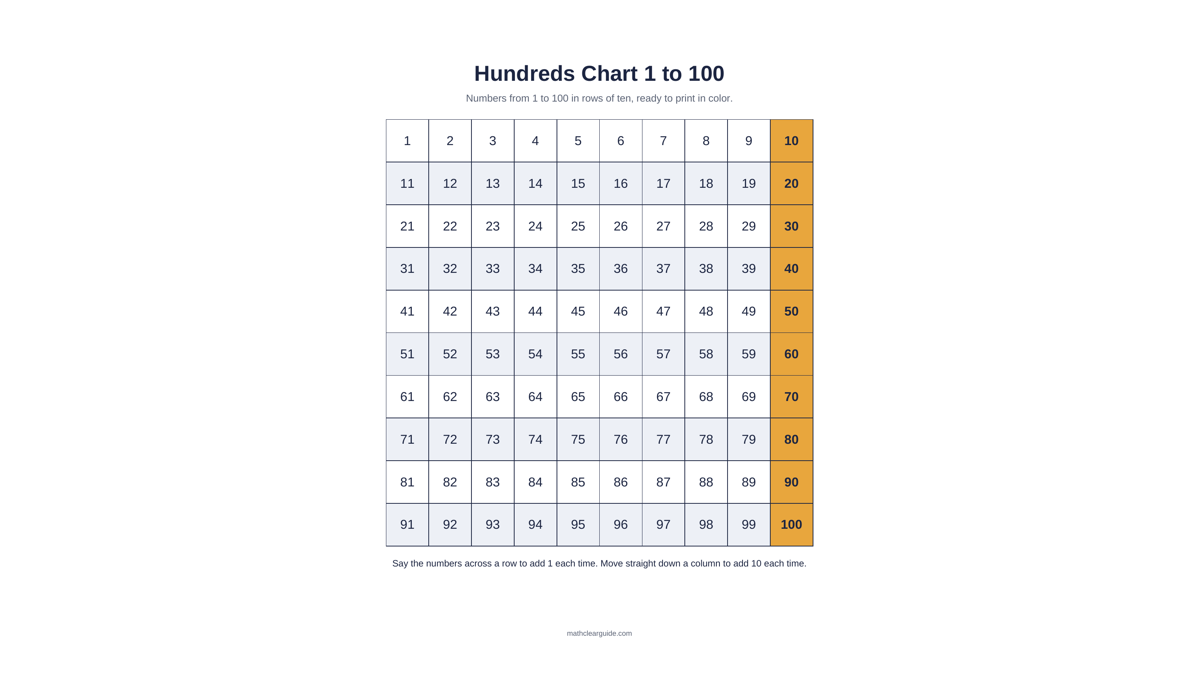
A hundreds chart looks simple. It is just the numbers from 1 to 100, set out in rows of ten.
But in the hands of a young child, this one page is one of the best tools we have for building number sense.
This post shows what the chart is, the two patterns that run it, and eight activities that turn it into real learning.
Every activity works with our free hundreds chart printable, so you can print a copy and start today.
What is a hundreds chart?
A hundreds chart is a grid with ten rows and ten columns.
The numbers run from 1 in the top left corner to 100 in the bottom right corner, in counting order.
Because the numbers sit in rows of ten, the chart shows how our number system is built.
On one page, a child can see counting order, the tens pattern, and the way numbers grow.
The chart also gives children a first feel for place value, the idea behind dictionary pages like hundreds place.
The two patterns that run the whole chart
Move one step to the right, and the number grows by 1.
Move one step down, and the number grows by 10.
That is all. Every activity in this post is built on those two moves.
Ask a child at the number 34. One more is 35, one step right. Ten more is 44, one step down.
When a child can do that from any starting number, the chart stops being a poster and starts being a map they own.
Right is one more, down is ten more. When a child can say that without thinking, the chart is doing its job.
Eight hundreds chart activities
Print one chart for each child, and keep a few spares. Charts get colored, covered and cut up in these games, and that is a good sign.
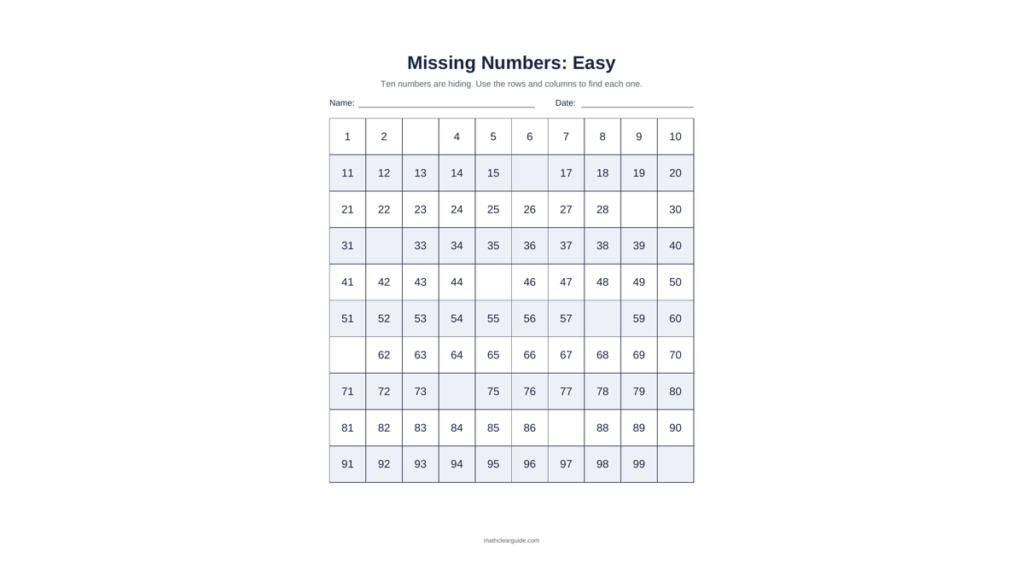
1. Find a Number. Call out a number, like 47. Your child finds it by counting down the rows of ten, then moving across the row. Start with round tens, then try any number.
2. One More, Ten More. Point to a number and ask for one more, ten more, one less and ten less. The game takes one minute and builds real place value sense.
3. Cover a Number. Cover one number with a coin or a small piece of paper. Can your child name the hidden number? The numbers above, below and beside it are the clues.
4. Count by 2s, 5s and 10s. Color every second number on a spare chart to count by 2s. Use a fresh chart for 5s and another for 10s, and look at the patterns the colors make.
5. Race to 100. Two players start with a counter on 1. Take turns rolling a dice and moving that many steps along the chart. The first player to land on 100 wins.
6. Odd and Even Hunt. Color all the odd numbers one color and all the even numbers another. The stripes that appear make the pattern easy to see and easy to talk about.
7. Puzzle Pieces. Cut a spare chart into a few big pieces. Your child puts the puzzle back together by using the number patterns, not the picture on the back.
8. Which is Bigger? Name two numbers, like 38 and 83. Your child finds both on the chart and says which is bigger, and how the chart shows it.
Graded missing number puzzles and ready made coloring pages for these games sit in our Hundreds Chart Pack for members, with a full answer key.
Common mistakes to watch for
Reading down instead of across. New readers sometimes count down the columns. Show them that we read a chart the way we read a book, across the rows, one row at a time.
Losing the row. Small fingers slip. A ruler or a strip of paper under the row helps a child stay on track.
Mixing up the teen numbers. Numbers like 13 and 17 sound alike and look alike. Say them slowly, and find them together a few times before asking for them alone.
Counting on from 1 every time. If your child starts at 1 for every question, practice starting at a round ten instead, like 40, and counting on from there.
A chart on the wall teaches all day long. A chart in a drawer teaches nobody.
Which chart should you print?
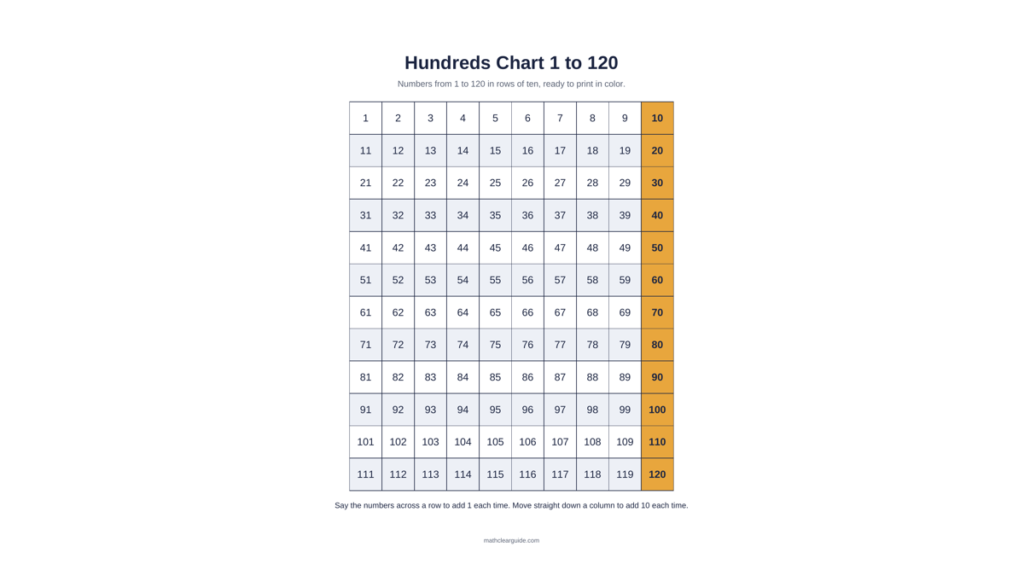
Start with the filled chart from 1 to 100 for kindergarten and early first grade.
Move to the chart from 1 to 120 when your class counts past 100, as first graders learn to do.
Hand out the blank chart when a child is ready to write the numbers alone, with no filled chart to peek at.
All three sit in our free hundreds chart printable, in color and in black and white, in A4 and US Letter sizes.
Print two copies. One for the wall, and one for the child to mark up, color in and make their own.
Questions parents and teachers ask
Is a hundreds chart the same as a number line? No. A number line is one long line of numbers. A hundreds chart folds that line into rows of ten, so children see the tens pattern as well as the counting order.
What age is a hundreds chart for? Most children meet the chart in kindergarten and use it through second grade. Older children still use it for skip counting and for the first times table patterns.
Should I print the 100 chart or the 120 chart? Print the 100 chart first. Move to the 120 chart when your child counts past 100 with ease, because first grade counting goes up to 120.
Can a hundreds chart help with times tables? Yes. Color the multiples of 3 on one spare chart and the multiples of 4 on another. The patterns children see here make the first tables easier to learn.
Where can I get a free printable hundreds chart? In our Resource Library. The free entry holds the color charts, a black and white chart and a blank chart, ready to print.
A hundreds chart costs one sheet of paper.
Used well, it teaches counting, place value and patterns across two school years.
Print the free chart, try the first activity today, and let the chart do the teaching.
Every topic clicks faster with practice. Our Resource Library has free lesson packs with slides, printable worksheets and full answer keys, ready to download and teach.
Members unlock every lesson in the library, including the full Fractions, Multiplication, Place Value, Addition & Subtraction, Time & Money and Geometry & Shapes units. See the full library


