
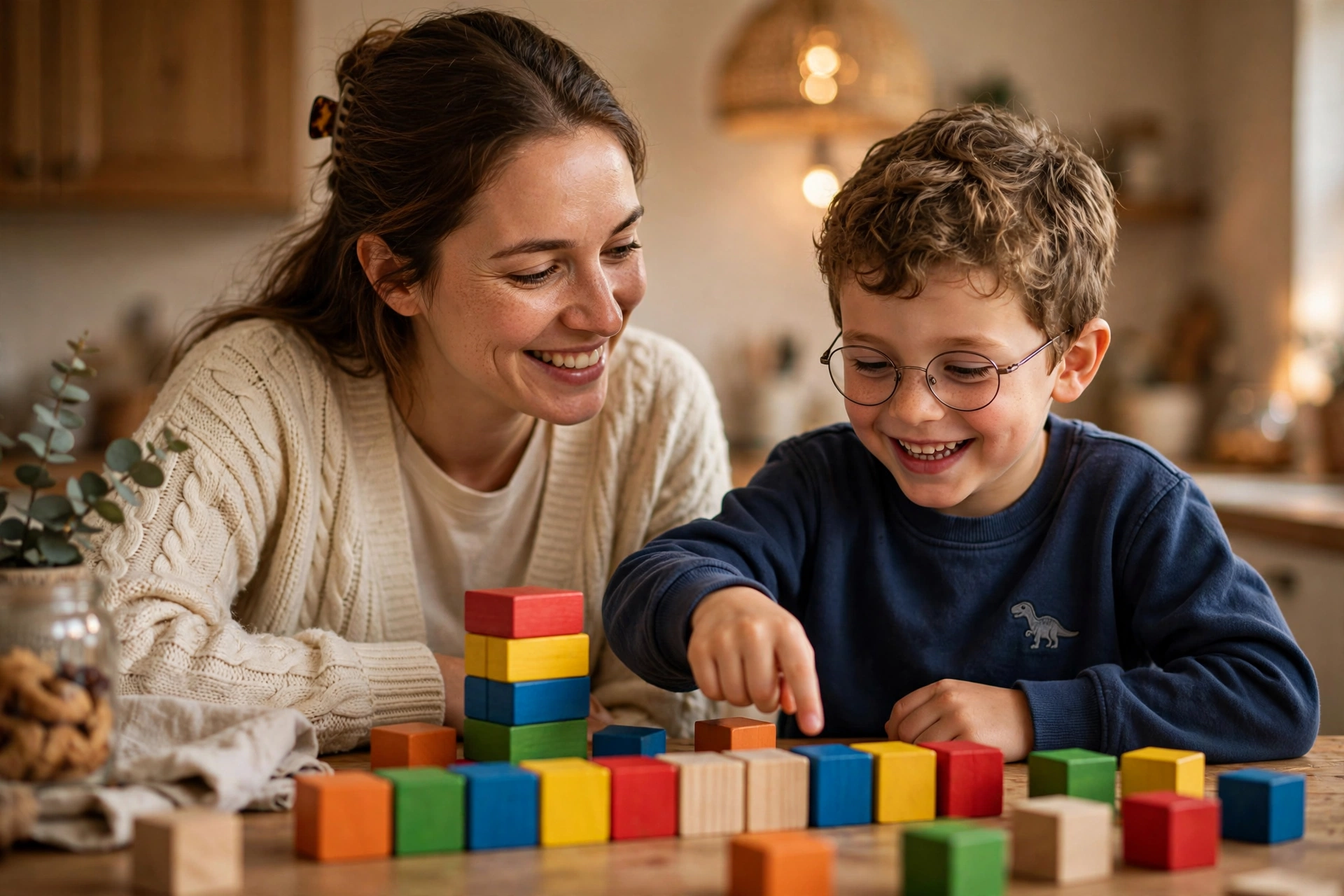
Kindergarten math standards describe what your child will learn in math during kindergarten: counting to 100, adding and subtracting within 10, naming shapes, and measuring and sorting the world around them.
What Are the Kindergarten Math Standards?
When teachers say “standards,” they mean a shared list of goals for the year, so every child learns the same big ideas no matter which classroom they sit in. In the United States, most states use the Common Core State Standards for math, and a few states use their own version with the same shape. Think of each kindergarten math standard as one clear promise: by June, your child will be able to do that specific thing.
Here is the surprise: kindergarten math focuses on just two critical areas. First, representing and working with whole numbers, starting with real objects. Second, describing shapes and space. Numbers get the bigger share of time, because everything later leans on them.
Every kindergarten math standard fits into one of five domains, which is just a grown-up word for five big buckets of learning. Walk through each one and the whole year stops feeling mysterious.
What Are the 5 Big Ideas of the Kindergarten Math Standards?
1. Counting and Cardinality. This is the heavyweight of kindergarten: counting to 100 by ones and tens, counting forward from any number, writing numbers 0 to 20, and counting objects one by one. The deep idea is cardinality: the last number you say tells how many there are, no matter how the objects are arranged.
2. Operations and Algebraic Thinking. That grand title means adding and subtracting within 10, kindergarten style: joining groups, taking some away, and solving little word problems with objects, fingers, or drawings. By year’s end, they add and subtract fluently within 5.
3. Number and Operations in Base Ten. One small but mighty goal: seeing numbers 11 to 19 as ten plus some more. Eighteen is a ten and eight ones. This ten-first way of seeing numbers is the seed of place value.
4. Measurement and Data. Children describe measurable things, like which stick is longer or which bag is heavier, and they sort objects into groups and count how many landed in each. Your kitchen junk drawer is secretly a measurement and data lab.
5. Geometry. Children name flat and solid shapes, from squares and triangles to cubes and spheres, and describe where things sit using words like above, below, beside, and behind. Position words are math words too.
Which Kindergarten Math Standards Will My Child Know by June?
By June, most kindergartners can do this short list, and it is shorter than parents fear:
- count to 100 by ones and tens, and count forward from any number
- write numbers 0 to 20 and match each numeral to a group of objects
- add and subtract within 10 using objects or drawings, fluently within 5
- see teen numbers as ten plus ones, like 14 as ten and four
- compare groups and numbers using greater than, less than, and equal to
- name flat and solid shapes and describe where objects are with position words
- describe and compare measurable things like length and weight, and sort objects into categories
Children reach these goals on different schedules, and that is normal. Teachers watch for steady growth across the year, not perfection in September.
How Can Families Support the Kindergarten Math Standards at Home?
You do not need workbooks or a teaching degree. Kindergarten math grows best inside ordinary life, in five-minute bursts.
Count everything. Steps to the car, apple slices, socks from the dryer. Count forward from 14 instead of always starting at 1, and count by tens in line. That is counting and cardinality in everyday clothes.
Play with small numbers. Roll one die and count the dots, then two dice and put the groups together: “You had 4, now 3 more?” Board games are operations practice that feels like play.
Talk about tens. When you see 13 crackers, say, “A ten and three more.” Egg cartons, paper ten frames, and fingers all make ten visible. This tiny habit pays off in first grade.
Measure and sort. Which spoon is longer? Which pumpkin is heavier? Sort laundry by color, count each pile, and ask which has more. That is data work, done with socks.
Name shapes in the wild. The clock is a circle, the door is a rectangle. Then add position words: the picture hangs above the couch, your shoes sit below it. Geometry lives in your living room.
Did You Know? Numbers Get the Most Time on Purpose
The standards writers say it plainly: more kindergarten math time should go to numbers than to anything else. Shapes matter, but number sense is the foundation every later topic stands on.
If you only have ten minutes, spend them counting, comparing small groups, and playing with numbers to 20. That is exactly what the kindergarten math standards ask teachers to prioritize.
What Does Kindergarten Math Look Like on a Good Day?
Walk into a strong kindergarten classroom during math time and you will not see worksheets. You will see a teacher on the rug with a basket of counting bears, asking “How many do we have now?” as one more bear joins the group. A child counts, touches each bear once, and announces “Seven!” The teacher asks how they know, and the child counts again, slower, to prove it. That thirty-second exchange is the standards in action: counting, cardinality, and explaining thinking.
Later, two children argue over who has more blocks. The teacher does not settle it. She hands them a balance scale and asks how they could find out. They pile blocks on each side, watch the scale tip, and the argument dissolves into discovery. Comparison, measurement, and problem solving happened because the teacher resisted the urge to give the answer. This is what the standards ask of adults: set up the situation, then step back.
At the end of the day, a child lines up crayons from shortest to longest without being asked. Nobody taught that as a lesson. It leaked out of a classroom where math is something you do with your hands and your eyes, not something you fill in. Families should know this is the goal. If your kindergartner comes home describing what they built, sorted, or counted, the standards are working.
How Can Families Spot Real Learning Versus Busywork?
Real kindergarten math leaves traces in conversation. Your child starts using words like “more,” “fewer,” “longer,” and “heavier” without prompting. They count the stairs as they climb. They notice that their sandwich is cut into two equal pieces and announce it. These are signs that math is becoming a lens, not a subject.
Busywork looks different. If the homework is always coloring in the right number of circles, or tracing numerals over and over, ask the teacher what concept it connects to. There is nothing wrong with practicing numeral formation, but it should not be the whole diet. The standards devote the most time to counting and cardinality for a reason: a child who truly understands “sevenness” will learn to write 7 in an afternoon.
The best question a family can ask at conferences is not “Is my child on grade level?” but “What does my child do when they get stuck?” A child who tries another way, draws a picture, or asks for manipulatives is developing the mathematical practices the standards value most. A child who freezes or waits to be told may need more hands-on experience, not more worksheets.
Try It: Play the 5 Big Ideas at Home
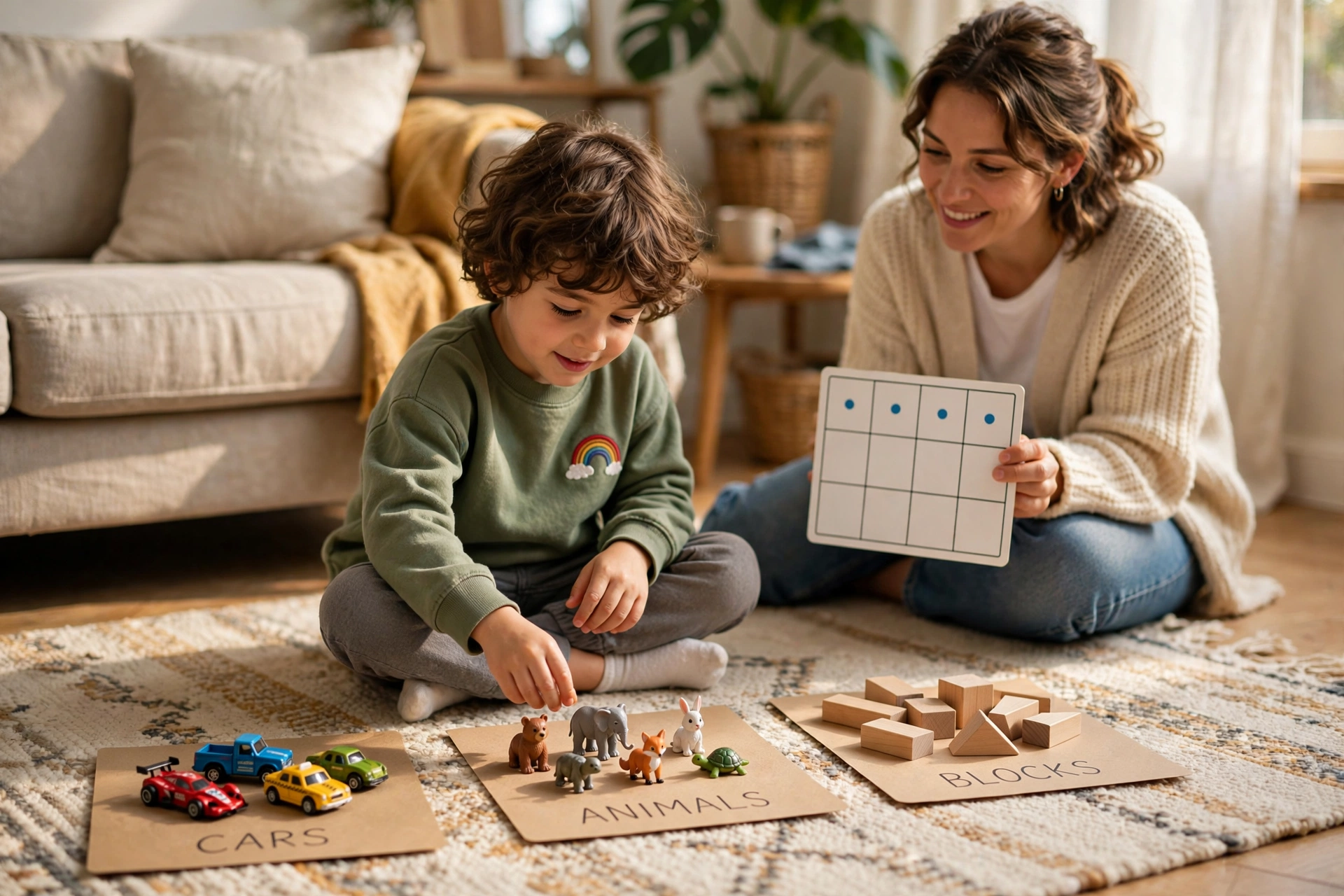
Dump a basket of mixed toys on the rug. Sort into groups: cars, animals, blocks. Count each group and line them up from fewest to most. That is measurement and data plus counting.
Take the animal group: put out 4, add 3 more. “How many now?” That is operations within 10. Build 13 blocks as a tower of 10 plus 3, saying “ten and three” out loud. That is base ten.
Finish with a shape hunt: find a circle, a rectangle, and a triangle, and describe where each sits. Five domains, one basket of toys, zero worksheets.
Quick Practice
Your kindergartner counts 12 grapes on the plate: 1, 2, 3, all the way to 12. Then you move the grapes into a circle and ask how many there are. She starts counting again from 1. What is she still learning, and how do you help?
Answer: she is still building cardinality: the last number said names the whole set no matter the arrangement. Say, “We already know there are 12 grapes. Moving them did not change the number,” then let her say the total with confidence.
Related Terms
Explore skip counting and base ten.
For printable practice matched to these early skills, our free worksheet generator makes fresh pages in seconds.
Frequently Asked Questions
Do all states use the same kindergarten math standards?
Most states use the Common Core State Standards or standards built directly from them. A few states, like Texas and Virginia, use their own standards, but the content is nearly the same: counting, small-number operations, shapes, and measurement appear everywhere.
What if my child cannot count to 100 yet?
Counting to 100 is an end-of-year goal, and teachers build it gradually, often reaching only 20 or 30 in the fall. Steady practice counting real things at home moves it along faster than any app.
Should my kindergartner be doing worksheets?
Not much. The standards emphasize working with objects, fingers, drawings, and real situations. A child who can show 7 as 5 blocks and 2 blocks understands more than a child who only fills in 5 + 2 on paper.
How is kindergarten math different from preschool math?
Preschool explores numbers through play with no fixed targets. Kindergarten keeps the play but adds clear goals: writing numerals to 20, fluent adding within 5, and naming solid shapes. The bridge is gentle, and good classrooms keep it joyful.
What are the Standards for Mathematical Practice in kindergarten?
Alongside the content goals, eight practice standards describe how children should work: making sense of problems, reasoning, building arguments, modeling with math, using tools, being precise, finding structure, and repeating reasoning. When your child explains why 4 and 3 make 7 using blocks, that is practice standard 3 in action.
My kindergartner can count to 100 but cannot tell me how many are in a pile of 8. Is that normal?
Completely normal, and it reveals something important. Reciting numbers is a memory skill, like singing the alphabet. Knowing “how many” requires cardinality: understanding that the last number said tells the size of the whole group. Practice by counting real objects slowly, touching each one, and emphasizing the final number. The reciting and the understanding will merge with time.
Should I teach my kindergartner addition facts?
Not as memorization. Instead, play with composing and decomposing small numbers: “We have 5 crackers. If you eat 2, how many are left?” or “Can you show me 6 fingers two different ways?” This builds the number sense that makes fact fluency easy later. Memorizing 3 plus 4 now, without understanding, is a shortcut that leads nowhere.
How much screen time for math apps is okay?
A little is fine, but it should never replace hands-on math. Tapping the right answer on a screen does not build the same brain connections as physically grouping objects, pouring water between containers, or building towers. If you use apps, choose ones that ask children to explain or show their thinking, not just pick from three choices.
Every topic clicks faster with practice. Our Resource Library has free lesson packs with slides, printable worksheets and full answer keys, ready to download and teach.
Members unlock every lesson in the library, including the full Fractions, Multiplication, Place Value, Addition & Subtraction, Time & Money and Geometry & Shapes units. See the full library


