
A place value chart looks plain. It is a row of boxes with names like hundreds, tens and ones.
But this one page explains how our whole number system works, from small numbers all the way to millions.
This post shows what the chart is, how to read a big number with it, and seven activities that make big numbers click.
Every activity works with our free place value chart printable, so you can print a chart and start today.
What is a place value chart?
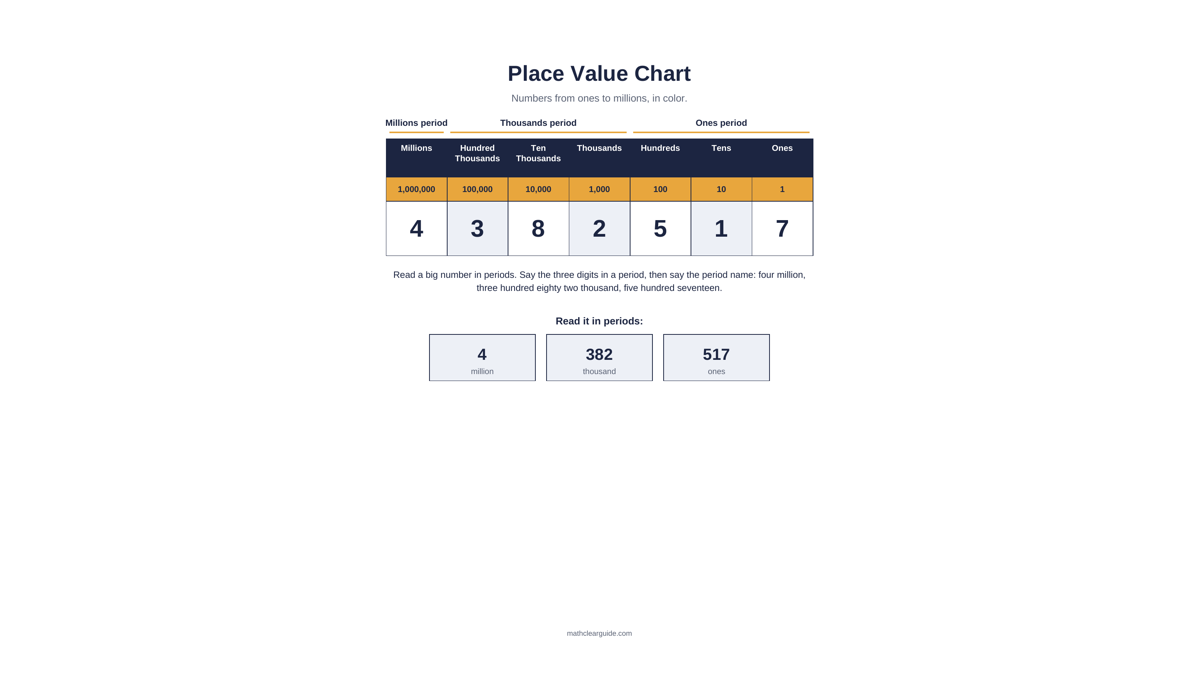
A place value chart is a table with one column for each place.
The places run from ones on the right up to millions on the left. Each column holds one digit of a number.
Under the place names sit the values: 1, 10, 100, 1,000 and more. The value tells you what one digit in that column is worth.
Put the number 4,382,517 on the chart and every digit lands in its own box. The 8 sits in the ten thousands place, so it is worth 80,000.
The chart grows out of the hundreds chart your child may already know. Our free hundreds chart printable is the right first step for counting and for numbers to 120.
A place value chart turns a long string of digits into a row of boxes a child can point to, name and read.
Reading in periods
Big numbers are read in periods. A period is a group of three digits.
The ones period holds hundreds, tens and ones. The thousands period holds the same three places, one step up. Then comes the millions period.
To read 4,382,517, read each period like a small number, then say the period name. Four million, three hundred eighty two thousand, five hundred seventeen.
Children who read in periods stop guessing at big numbers. The number breaks into three small numbers they already know how to say.
The ten times rule
One rule runs the whole chart. Each place is worth ten times the place to its right.
Ten ones make a ten. Ten tens make a hundred. Ten hundreds make a thousand, and the rule keeps going all the way to millions.
So the digit 4 is worth 4 in the ones place, 40 in the tens place and 400 in the hundreds place. Same digit, new value, every time it moves one place left.
Ask your child to prove it on the chart. Start at 40, move one place left, and land on 400. The chart shows the jump.
Every step left makes a digit worth ten times more. That one rule explains the whole chart.
Decimals on the chart
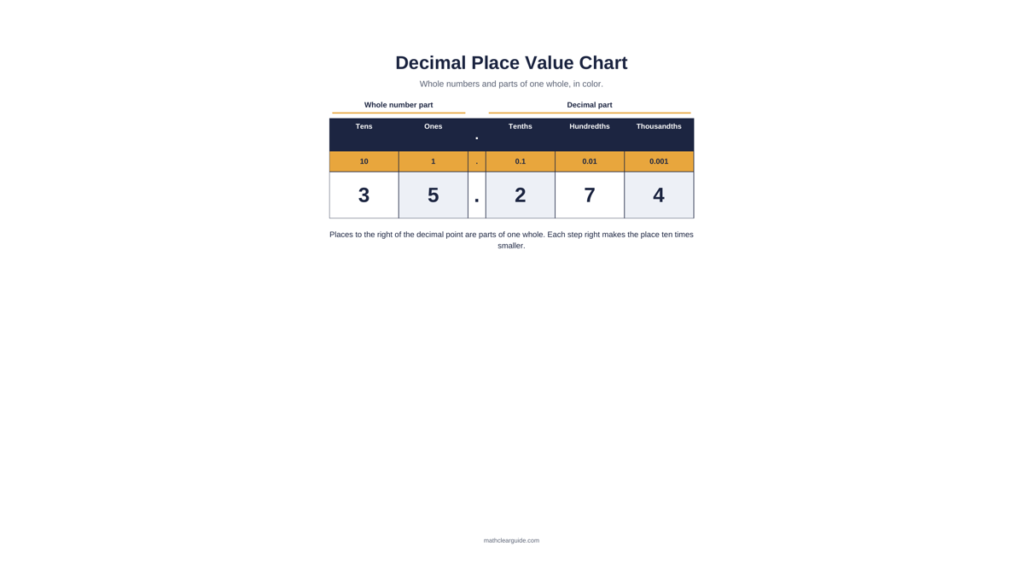
The chart does not stop at the ones place. A decimal point sits after the ones, and the places keep going to the right.
These places hold parts of one whole. Tenths, hundredths and thousandths get ten times smaller with each step to the right.
On the decimal chart, 35.274 shows 3 tens, 5 ones, 2 tenths, 7 hundredths and 4 thousandths. The 2 is worth 0.2, a part, not two whole ones.
The same chart holds both sides of the point, so children see decimals as part of the number system, not a brand new topic.
Seven place value activities

Print a chart for each child and keep digit cards handy. Most of these games take five minutes and a pencil.
1. Build It with Digit Cards. Cut out digit cards from 0 to 9. Call out a number, like six thousand forty two. Your child builds it on a blank chart, one digit in each box.
2. Say It in Periods. Write a big number on the chart. Your child reads it in periods, tapping each group of three as they say it. Start with thousands, then try millions.
3. Expanded Form Race. Call out a number. Both of you write it in expanded form, as a sum of the value of each digit. The first correct sum wins the round.
4. Digit Detective. Point to one digit in a big number and ask what it is worth. In 4,382,517, the 8 is worth 80,000. Zeros are the best test of all: a 0 in a place is worth 0, but it holds the place.
5. Ten Times Jump. Put a counter on a digit. Jump one place left and say the new value, ten times bigger. Jump right to make it ten times smaller.
6. Decimal Steps. Use the decimal chart. Build 35.274 with digit cards, then ask which digit sits in the tenths place, and what the 7 in the hundredths place is worth.
7. Riddle Time. Give clues one at a time: my ones digit is 3, my tens digit is twice my ones digit. Your child works out the digits and builds the number on the chart.
Digit cards, build a number mats, graded worksheets and six full riddles with an answer key sit in our Place Value Chart Pack for members.
Common mistakes to watch for
Reading every digit one by one. A child who reads 4,382,517 as a string of single digits has not met periods yet. Cover two periods with your hand and read one period at a time.
Forgetting the zeros. Zeros hold places. In 7,080,040, the zeros keep the 8 in the ten thousands place. If a child drops the zeros, the whole number falls apart.
Mixing up tenths and tens. Tens sit to the left of the ones, tenths sit to the right of the decimal point. The words sound alike, so say them slowly and point at the place each time.
Most place value mistakes are place mistakes, not counting mistakes. The chart shows the place, so the chart fixes the mistake.
Questions teachers and parents ask
What is a place value chart? It is a table with one column for each place, from ones up to millions, with decimal places after the point. Digits sit in the columns, so children can see what each digit is worth.
What age is a place value chart for? Children meet simple charts in second and third grade, work with millions in fourth grade, and add decimal places in fifth grade.
How do you read a big number? Read it in periods of three digits. Say the digits in each period, then say the period name: four million, three hundred eighty two thousand, five hundred seventeen.
Why does my child mix up tenths and tens? The words differ by only a few letters, and the two places sit on opposite sides of the ones. Point at each place on the chart as you say its name.
Where can I get a free place value chart? In our Resource Library. Our free place value chart printable holds the chart to millions, a decimal chart and a blank chart, in color and in black and white.
A place value chart costs one sheet of paper.
Used well, it carries a child from counting to millions, and into decimals.
Print the free chart, try the first activity today, and let big numbers click.
Reading about it is one thing, practising it is another. Our free What Is Place Value? lesson builds the idea step by step, with slides, a printable worksheet and a full answer key.
Members unlock every lesson in the library, including the full Fractions, Multiplication, Place Value, Addition & Subtraction, Time & Money and Geometry & Shapes units. See the full library


