3D Shapes

Children meet solid shapes everywhere – balls, cans, boxes and party hats – but naming them and predicting how they move takes a strategy. This free Grades 2-3 lesson teaches the cube, cuboid, sphere, cone, cylinder and pyramid with one memorable tool: the touch test. Flat faces stack and slide, curved surfaces roll, and a … Read more
What Are 2D Shapes?

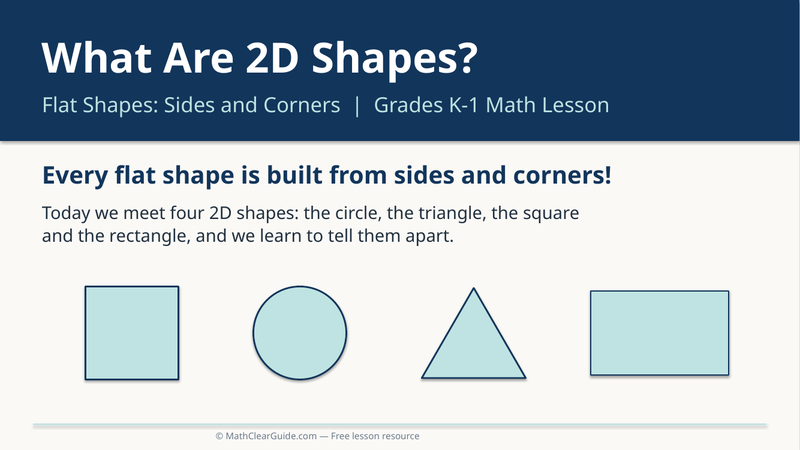
Flat shapes stop being a guessing game once children can count. This free Grades K-1 lesson teaches the circle, triangle, square and rectangle the reliable way: count the straight sides, count the corners, and let the numbers name the shape. The circle breaks the pattern with 0 sides and 0 corners, which makes it the … Read more

Time and Money Word Problems

The final lesson of the Time & Money unit puts every earlier skill to work inside real stories. Children meet the routine that unlocks word problems at this age – read for the question, plan with the right tool, solve one step at a time, and check the answer against the story. Timelines handle the … Read more

Making Change

Making change is the money skill children actually use in shops, and the subtraction behind it defeats many of them. This Grades 2-3 lesson swaps the hard subtraction for the shopkeeper’s own method: count up from the price to the money handed over, jumping to friendly numbers – the next ten, the next dollar, then … Read more

Counting Bills and Making Amounts

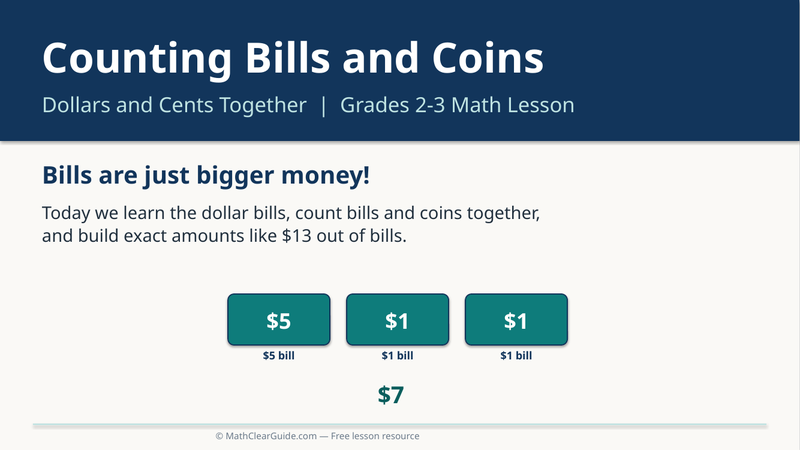
Once coins are secure, dollars join in. This Grades 2-3 lesson teaches the $1, $5, $10 and $20 bills, then the habit that keeps mixed money simple: count the bills biggest first, count the coins biggest first, and join the two with a dot – $10.50 is ten dollars and fifty cents. Children also learn … Read more

Counting Coins

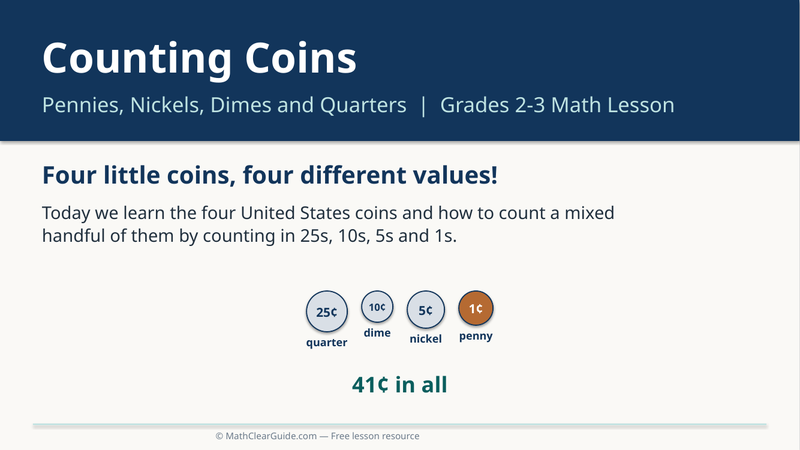
Counting coins looks simple until a child counts four coins and announces four cents. This Grades 2-3 lesson teaches the four United States coins by value first – penny 1 cent, nickel 5, dime 10, quarter 25 – then builds the one strategy that makes every handful easy: sort the coins, count the biggest values … Read more

Elapsed Time

Elapsed time is where telling time turns into problem solving, and it trips children up in two predictable places: counting minutes as if they climbed to 100, and freezing when the hours roll past 12. This Grades 2-3 lesson fixes both with one strategy used from start to finish – jump in chunks on a … Read more

AM and PM and Calendar Time

Every clock time happens twice a day, and this free Grades 2-3 lesson teaches children the two letters that tell those times apart. A pair of day timelines splits the 24 hours into the AM half and the PM half, everyday activities get sorted into their half of the day, and the tricky boundary at … Read more

Telling Time to 5 Minutes

Once children can read o’clock and half past, every other time on the clock comes down to one move: counting by fives. This free Grades 2-3 lesson builds that move on big drawn clock faces, with a minute ring that shows what each number really stands for, then adds the quarter-hour landmarks – quarter past … Read more

Telling Time to the Hour and Half Hour

Telling time starts with two hands doing two different jobs, and this free Grades K-2 lesson makes that split impossible to miss. Children meet the short hour hand and the long minute hand on big drawn clock faces, learn that the minute hand on the 12 means o’clock, then take the half-hour step: the minute … Read more