Missing Numbers and Fact Families

Missing-number questions are where fact families stop being a poster on the wall and start earning their keep, and this Grades 2-3 lesson makes the link explicit. Children meet the family triangle, learn that the position of the question mark picks the method – a missing part flips to subtraction, a missing start flips to … Read more
Addition and Subtraction Word Problems

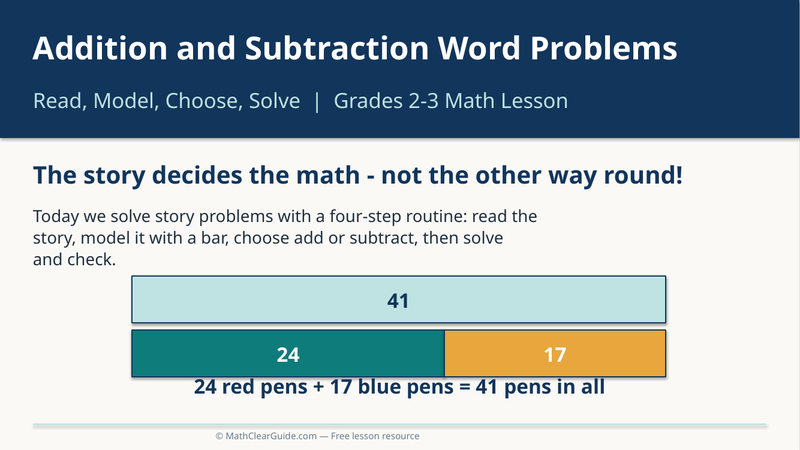
Children fail word problems long before the arithmetic starts, usually because they grab the numbers and hunt for a keyword. This Grades 2-3 lesson replaces that habit with a four-step routine used on every story: read it fully, model it with a bar, let the missing piece choose the operation, then solve and check the … Read more

Adding and Subtracting 3-Digit Numbers

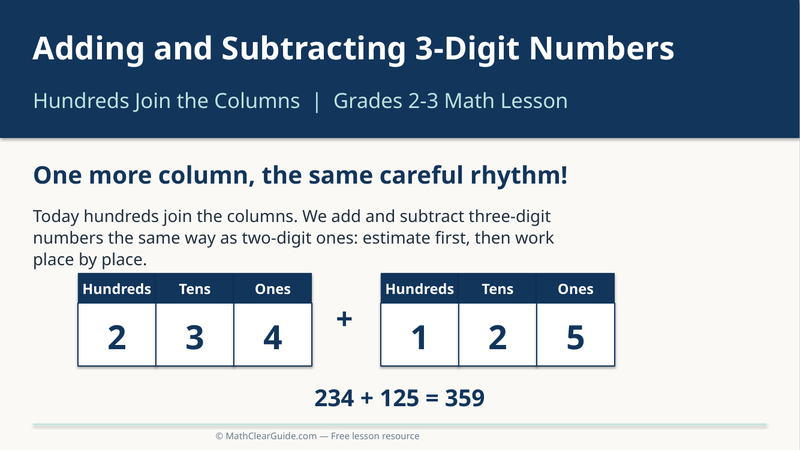
Three-digit numbers frighten children who are secretly still guessing, so this Grades 2-3 lesson begins every calculation with an estimate – round to the nearest hundred, say the rough answer out loud, then work the columns to keep that promise. Carrying and trading are taught as the same moves from the two-digit lessons, now running … Read more

Subtracting 2-Digit Numbers

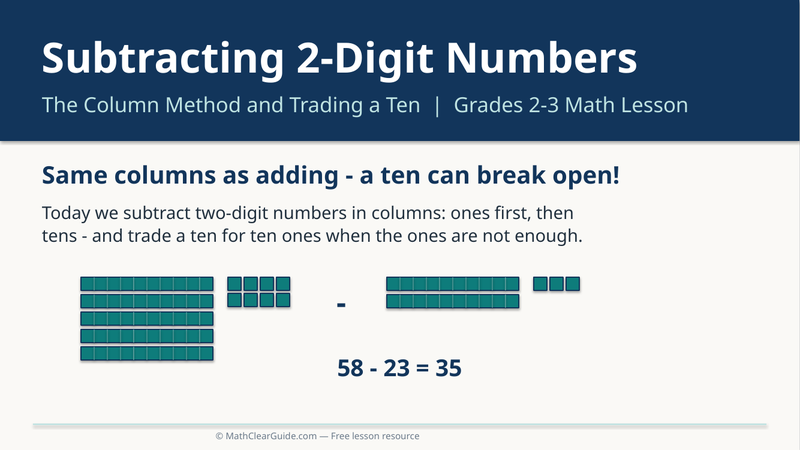
Borrowing stops being scary when children see it happen with blocks first. This Grades 2-3 lesson teaches subtracting 2-digit numbers in columns: ones first, then tens, and a ten breaking open into ten ones whenever the top ones digit is too small – shown with base-10 blocks before it is ever written as digits. Every … Read more

Adding 2-Digit Numbers

Two-digit addition goes wrong in predictable places, and this Grades 2-3 lesson fixes them in order. Children set numbers up in columns with base-10 blocks beside them, add the ones first and the tens second, and meet regrouping as a fair trade – ten ones for one ten – before they ever carry a digit. … Read more

Subtraction Facts to 20

Subtraction facts stick when children have more than one way to find them. This free Grades 2-3 lesson teaches three: taking away by crossing out counters and ten frames, counting back in jumps on a number line for small takes, and think addition, where the partner fact (5 + 8 = 13) answers the subtraction … Read more

Addition Facts to 20

Counting on works, but it is slow and it slips. This free Grades 2-3 lesson replaces it with three strategies that make addition facts to 20 fast and reliable: doubles learned as anchor facts, near doubles solved as a double plus one, and make-a-ten for the stubborn facts like 9 + 4 and 8 + … Read more

What Is Addition?

Addition is the very first operation children meet, and it lands best as an action, not a rule: two groups come together and become one group. This free Grades K-2 lesson builds that idea with counters children can picture, introduces the + and = signs through a part-part-whole bar model, and teaches counting on from … Read more

Place Value in Addition and Subtraction

Place Value in Addition and Subtraction lesson cover for Grades 1-3

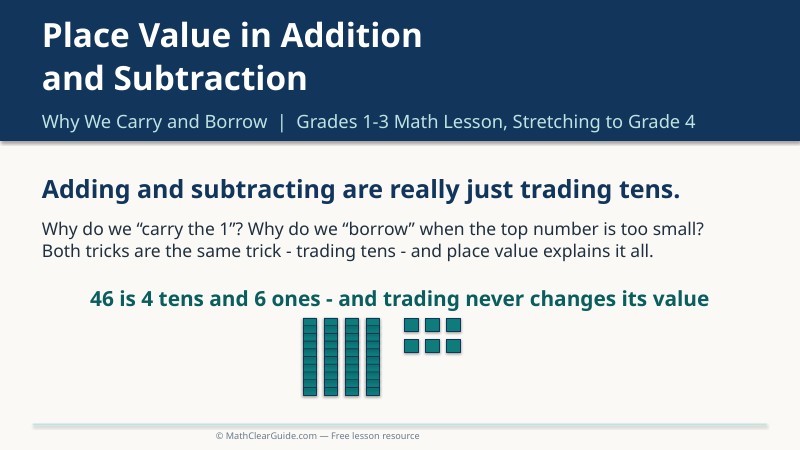
“Carry the 1” and “borrow from the tens” are instructions, not explanations – children follow them blindly until the first flipped subtraction (52 − 27 = 35) gives them away. This lesson teaches place value in addition and subtraction through the trade itself: a 23-slide deck builds every method on drawn base-10 blocks, so students … Read more

Rounding Numbers

Rounding Numbers lesson cover for Grades 3-4

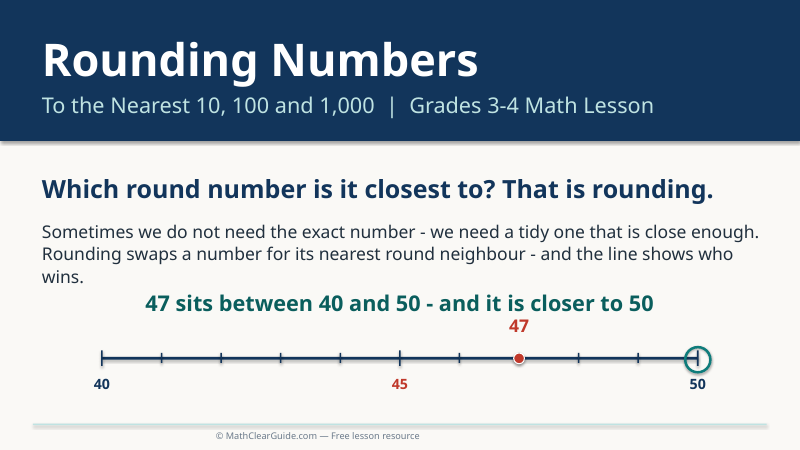
“Five or more, round up” is a chant, not an understanding – the first time a child meets 348, the chant gives no reason why it slides down to 300. This Grades 3-4 lesson teaches rounding numbers the number-line way: every number sits between two round neighbours, the halfway point between them does the deciding, … Read more