
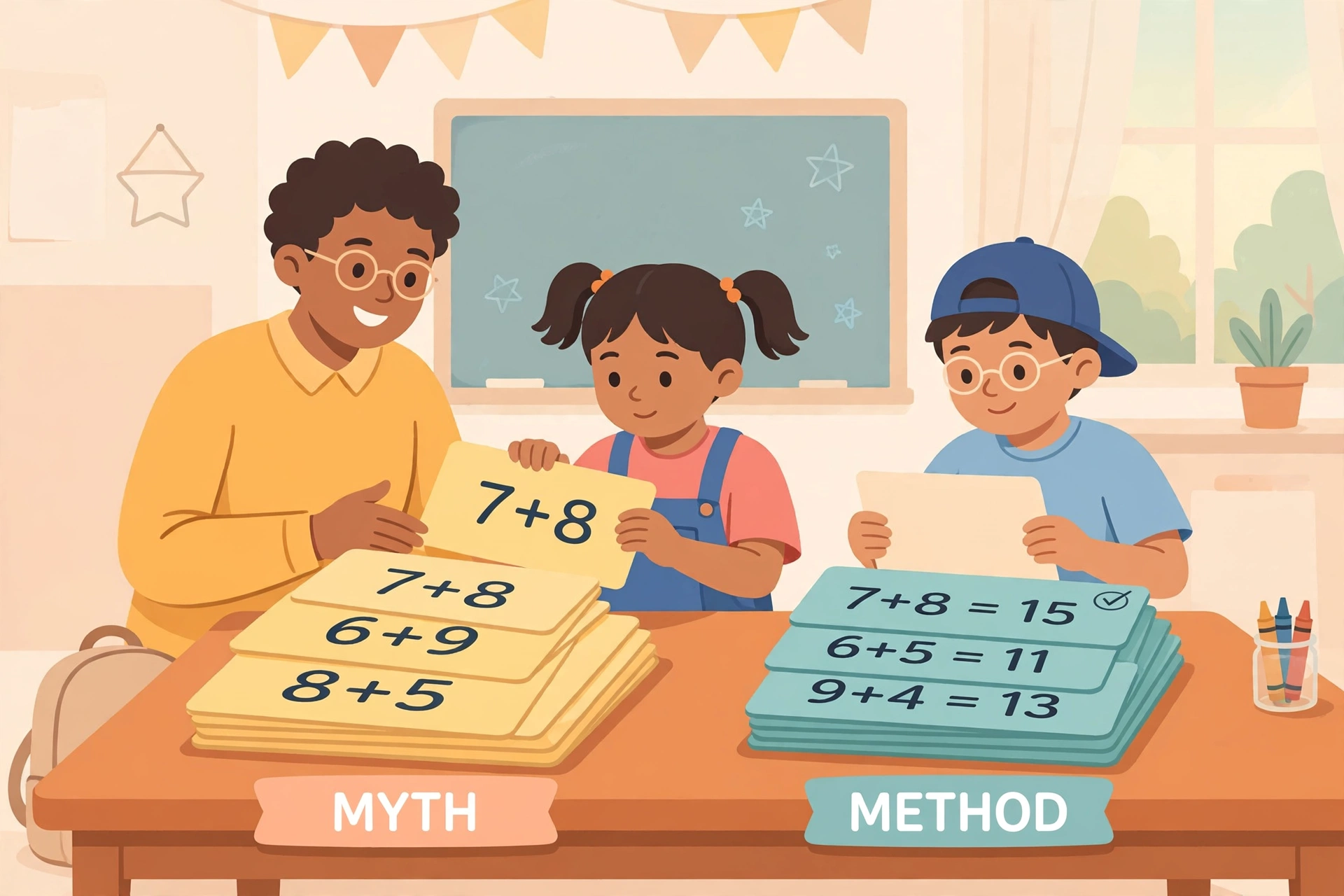
Every teacher has heard a version of this math fluency myth: “These kids just need to memorize their facts.” It sounds like plain common sense. It also hides some of the most stubborn myths in math education. What you believe about fluency shapes every flashcard, game, and quiz you assign, so it pays to check which beliefs hold up.
How did math fact fluency get reduced to a stopwatch and a stack of flashcards? The answer matters for your students.
What Does Math Fact Fluency Mean?
Math educators describe fluency as three things working together: accuracy, efficiency, and flexibility. A fluent student answers 7 + 8 = 15 and gets it right. That same student can also explain a second path, like turning 7 + 8 into 7 + 7 + 1 or 10 + 5, and can pick the path that fits the problem at hand. The familiar math fluency myth that speed is everything misses this richer picture.
Speed is a side effect of those three, not the goal itself. When speed becomes the target, students start guessing, freezing, or leaning on tricks they cannot explain. One of the National Council of Teachers of Mathematics’ eight Mathematics Teaching Practices is to build procedural fluency from conceptual understanding. Keep that three-part definition close, because every myth below breaks one of its parts.
7 Math Fluency Myths, Busted
Myth 1: Fluency is just memorization. Memorized facts with no number sense are fragile. Students who only memorize forget under pressure and stall when a problem looks slightly new. Facts stick longest when they grow out of strategies students understand, like doubles or making ten.
Myth 2: Faster always means more fluent. A fast wrong answer is not fluency, and a fast right answer with no strategy behind it is luck. True fluency pairs a correct answer with a sensible path. Watch for students who answer quickly but cannot say how they knew.
Myth 3: Timed tests are the best way to build fluency. Researcher Jo Boaler warned in 2015 that timed tests can trigger math anxiety and damage students’ number sense. Testing measures fluency. It does not build it. Short strategy games, partner practice, and sorting facts by strategy build it far better.
Myth 4: Every child masters facts on the same schedule. Some students lock in their sevens in a week. Others need a month and three different strategies. A single class deadline turns normal variation into failure. Track each student’s set of known facts and let the pace fit the learner.
Myth 5: Games are a waste of practice time. A good game delivers dozens of fact repetitions with instant feedback, which is exactly what practice needs. The catch: the game must make every child answer, not just watch. Partner card games beat whole-class games where one student plays and twenty watch.
Myth 6: Understanding must finish before fluency starts. The National Research Council’s “Adding It Up” (2001) shows conceptual understanding and procedural fluency growing together, each feeding the other. Waiting for perfect understanding before practicing facts stalls both. Teach a strategy, then practice it right away.
Myth 7: Fluency practice steals time from problem solving. The opposite is true. Cognitive science shows that automatic facts free working memory for harder thinking. A student who still counts 8 + 5 on fingers has little brain space left for the word problem around it. Fluency fuels problem solving.
What Should Fluency Practice Look Like Instead?
Think short, focused, and strategy-first. Give students a small set of facts tied to one strategy, like the make-ten facts. Let them practice that set for five to ten minutes a day through partner games or quick sorts. Ask them to explain their thinking out loud at least once per session.
Quick Answer: If an activity only rewards fast answers, it is testing fluency, not building it. Building happens when students name a strategy, sort facts by the strategy they used, and revisit small fact sets across many days. Measure growth against each student’s own past scores, never against the class.
Where Did the Speed Myth Come From?
The timed test was born from good intentions. Generations ago, educators noticed that students who knew their facts cold had more brain space for harder math, and timed drills seemed like the fastest way to get there. The logic was not crazy. The problem was what got measured and what got lost. Speed is easy to test, so speed became the goal, and everything harder to measure, like flexibility and number sense, quietly disappeared from the definition of fluency.
Research in the last two decades has dismantled this story piece by piece. Brain imaging shows that timed tests activate the brain’s fear centers in many children, literally shutting down the working memory needed for mathematical thinking. Students who freeze on timed tests often know the facts perfectly well in untimed settings. We were not measuring fluency. We were measuring performance under threat, and calling the casualties “bad at math.”
The myth persists because it feels like common sense. Fast must mean fluent, right? But think about reading. Nobody believes a child who speed-reads without understanding is a fluent reader. We know fluency in reading means accuracy, expression, and comprehension at a reasonable pace. Math fluency deserves the same nuanced definition, and the research now gives us one.
What Replaces Timed Tests in a Modern Classroom?
Start with strategy interviews. Sit beside a student, show 8 plus 5, and ask, “How did you figure that out?” Listen for the strategy: did they make ten, count on, or just know it? Record what you hear. Over weeks, these two-minute conversations build a detailed map of each student’s thinking that no timed score could provide. You will know exactly which facts are solid and which strategies are missing.
Use games that reward thinking, not speed. Card games where students explain their strategy before collecting the cards. Dice games where the goal is to find two different ways to make the target. Digital tools that adapt to the student’s level and never show a countdown clock. The common thread: students practice facts while thinking about relationships, which is what builds lasting fluency.
Keep some timed practice if your school requires it, but change what it measures. Instead of “how many in one minute,” try “beat your own record for facts you can explain.” Let students time themselves, privately, on facts they have already mastered through strategies. The stopwatch becomes a celebration tool instead of a weapon. Same device, completely different message about what mathematics values.
Try It: Spot the Math Fluency Myth in Your Routines
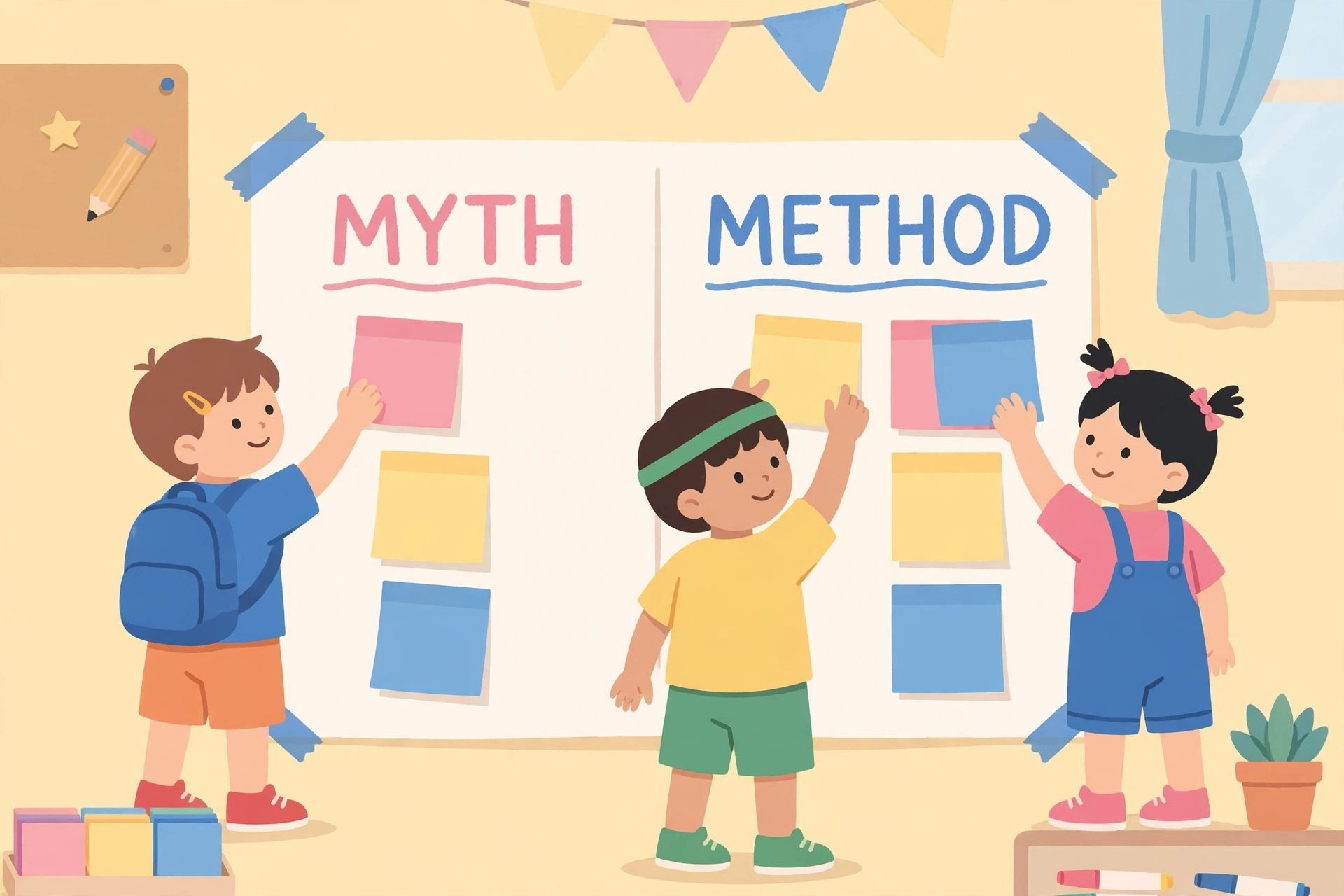
Grab chart paper and draw two columns labeled Myth and Method. List your current fluency routines on sticky notes: flashcards, timed quizzes, partner card games, fact sorts, apps, worksheets. With your grade team or alone, place each note in a column and defend the choice using the three-part definition: accuracy, efficiency, flexibility.
For every note in the Myth column, rewrite it as a Method. A timed quiz becomes a partner game with the same facts. A worksheet becomes a sort where students group facts by strategy. Keep the rewritten list where you plan lessons. Revisit it monthly and watch the Method column grow.
Quick Practice
Question: A student answers 9 + 6 = 15 in two seconds but cannot explain how. Is this student fluent? What would you do next?
Answer: Not yet. The answer is accurate and fast, but the missing explanation signals weak flexibility. Ask the student to show 9 + 6 on a ten frame or number line, then practice the make-ten strategy with a partner until the student can name the path, not just the answer.
Related Terms
- Fact Family – a set of related addition and subtraction facts built from the same three numbers.
- Decompose – to break a number into smaller parts, like splitting 8 into 5 and 3.
- Skip Counting – counting by a number other than one, like 2, 5, or 10.
- Regrouping – trading ten ones for one ten, or one ten for ten ones, when adding or subtracting.
Frequently Asked Questions
Is math fact fluency the same as memorization?
No. Memorization is one route to recall, but fluency adds accuracy, efficiency, and flexibility. A fluent student knows the fact and can explain more than one way to find it. Treating memorization as the whole job is a math fluency myth worth retiring.
Do timed tests help students learn math facts?
Timed tests measure recall under pressure, which is not the same as building it. Research links timed testing to math anxiety in young learners. Strategy practice with feedback builds facts more reliably. The math fluency myth that timed tests build fluency simply does not hold up.
When should students be fluent with addition facts?
Common Core expects fluency within 10 by the end of grade 1 and within 20 by the end of grade 2. Timelines vary by child, so use the standards as guides, not deadlines.
Does fact fluency still matter in upper elementary?
Yes. Multiplication, division, fractions, and multi-digit work all lean on addition and subtraction facts. Gaps in basic facts slow down every topic that follows.
How is fluency different from automaticity?
Automaticity is instant recall with little effort. Fluency is broader: it includes automaticity plus the flexibility to choose smart strategies. Think of automaticity as one ingredient in fluency.
How do I convince parents who loved timed tests?
Show them the strategies their child is learning. When a parent watches their second grader solve 9 plus 6 by making ten, explaining each step, the value becomes obvious. Most parents do not actually love timed tests. They love the idea of their child being confident with numbers, and strategy-based fluency delivers that better.
What about students who are naturally fast? Are we holding them back?
Not at all. Fast students thrive when asked to find multiple strategies or explain their thinking to peers. Speed without understanding hits a ceiling around third grade. Speed built on strategies keeps accelerating. We are not slowing anyone down. We are giving everyone a higher ceiling.
How long does it take to build real fluency?
Longer than a unit, shorter than you fear. With daily strategy practice, most students develop solid fluency within basic facts over one school year. The key is consistency: ten minutes daily beats an hour weekly. Fluency is a habit, not an event.