

Good news first: for most children, 3rd grade state math test prep does not mean a cram course, a tutor, or a stack of workbooks.
The state test covers what third grade math class already taught: multiplication and division within 100, first fractions, area and perimeter, place value and rounding, and two-step word problems.
If your child is working near grade level, 15 to 20 calm minutes a day for about six weeks is enough to walk in familiar with the format and confident about the content.
This guide walks the whole journey in order: find your state’s test, see exactly what is on it, follow a simple six-week plan, handle test day calmly, and know how to read the score report when it arrives months later.
Quick answer: The 3rd grade state math test covers five areas: multiplication and division within 100, place value and rounding, first fractions, measurement with area and perimeter, and shapes and graphs.
Most states give it in spring, though Florida and Indiana also check progress during the year. No calculator is allowed in grade 3. Six weeks of 15 to 20 minutes a day is enough prep for most kids.
There is no national passing score: the on-grade-level level, usually called Proficient or Meets, is the target, and in most states a low grade 3 math score brings extra help at school, not being held back.
First, Find Out What Your State’s Test Is Called
The first surprise for most families is that there is no single national test. Each state runs its own program, with its own name, and grade 3 is the first testing year in most states, so the name is new to almost every parent reading this. The big ones:
| Test | Where | Good to know |
|---|---|---|
| Smarter Balanced (called CAASPP in California) | About a dozen states | Computer-adaptive test based on the Common Core |
| STAAR | Texas | Given in spring. Approaches is the lowest passing level, Meets is the grade-level target |
| FAST | Florida | Replaced the old FSA in 2022, with shorter check-ins three times a year |
| ILEARN | Indiana | Spring test, with short checkpoints during the year |
Other states use their own names, including MCAS in Massachusetts, the PSSA in Pennsylvania, Ohio’s State Tests, Georgia Milestones, the New York State tests, and SC READY in South Carolina. One name you may still hear, PARCC, has been retired.
States that used it now run successors like the IAR in Illinois, NJSLA in New Jersey, and MCAP in Maryland. The same warning applies to old FSA materials in Florida. If a prep book in your cupboard carries a retired name, its format practice is out of date even if the math is fine.
Your school sets the exact testing days inside a spring window chosen by the state, and it will send those dates home.
The fastest way to confirm your test’s name and window is the school newsletter or your state education department’s parent page.
Everything else in this guide, the skills, the plan, and the test-day advice, applies whichever name is on your child’s test.
What Is Actually on the 3rd Grade State Math Test
There is no secret syllabus. The test is built from the same grade 3 standards your child’s teacher has used all year, and in most states those follow the same five areas below (Texas and Florida use their own standards documents, but the grade 3 topics are nearly identical).
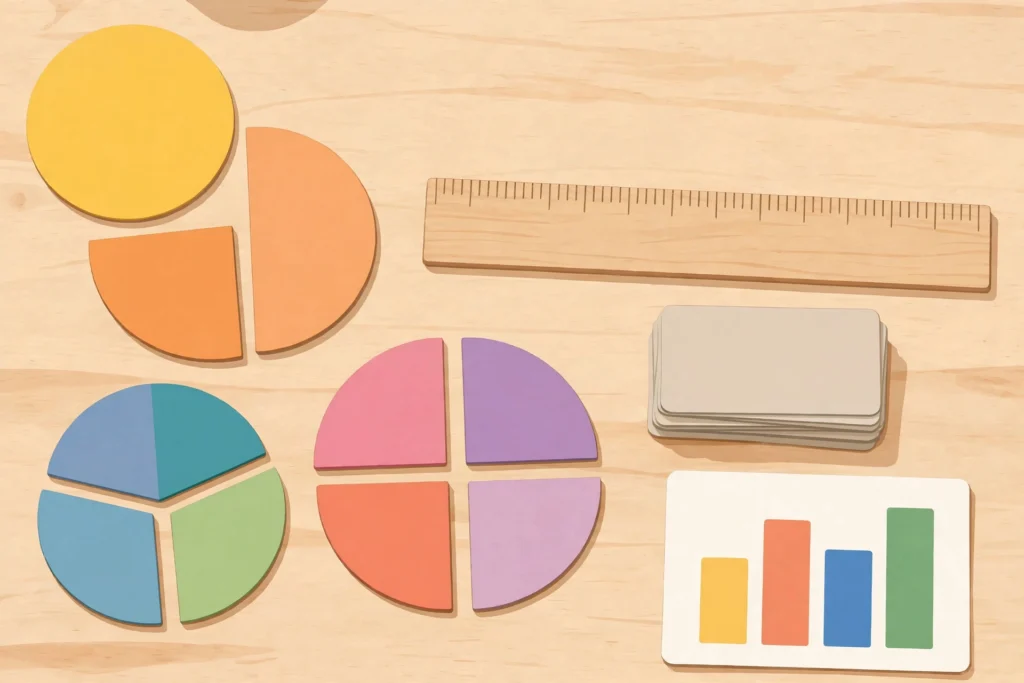
| Math area | What your child needs to do | The part that trips kids up |
|---|---|---|
| Multiplication and division | Know the facts within 100 from memory and solve problems about groups, arrays, and sharing | Facts not yet automatic, so longer problems run out of steam |
| Word problems | Solve one- and two-step problems with all four operations and write an equation for the story | Deciding which operation the story is really asking for |
| Place value and rounding | Round to the nearest 10 and 100, add and subtract within 1,000, multiply by multiples of 10 | Rounding halfway numbers and regrouping under pressure (review place value first) |
| Fractions, new in grade 3 | Show fractions on a number line, spot simple equivalents like 1/2 = 2/4, compare fractions with the same top or bottom number | Thinking 1/4 is bigger than 1/2 because 4 is bigger than 2 |
| Measurement and data | Tell time to the minute, find the area and perimeter of rectangles, read bar graphs, picture graphs, and line plots | Mixing up area and perimeter |
| Geometry | Sort shapes by their attributes and split shapes into equal parts, naming each part as a fraction | The quadrilateral family: a square is also a rectangle |
Two areas carry the most weight: operations (multiplication, division, and word problems) and fractions. And teachers flag the same three stumbling blocks every year: two-step word problems, fractions on a number line, and area. The six-week plan below gives those three extra room on purpose.
Your 6-Week 3rd Grade State Math Test Prep Plan
Three ground rules before the weeks. Keep sessions to 15 to 20 minutes, four or five days a week, and stop while it is still going well.
Work on one skill at a time, in the order below, rather than doing a little of everything. And mix in two minutes of older skills at the start of each session, because the test mixes everything and memory likes the reminder.
Weeks 1 and 2: facts first. Multiplication and division facts within 100 are the single highest-leverage skill on this test. They feed word problems, area, and even fractions, and a child who still counts on fingers for 7 × 8 runs out of time and confidence on everything else.
Do short daily fact sprints, play fact games, and use our interactive multiplication chart to spot patterns, like how the 9s digits always add to 9. The goal by the end of week 2 is facts that arrive without counting.
Week 3: word problems.
Teach one routine and use it all week: read the problem, picture or act out what is happening, write an equation, solve it, then ask “does this answer make sense?” Start with one-step problems in all four operations, then move to two-step problems by midweek.
Most grade 3 word problem errors are reading errors, not math errors, so have your child underline what the question is actually asking before touching a pencil to the numbers.
Week 4: fractions. Fractions are brand new in grade 3, which makes this the week that matters most after facts.
Fold paper strips, cut sandwiches and pizzas (real or drawn) into halves, thirds, and fourths, and put fractions on a number line between 0 and 1 until your child sees that 1/2, 2/4, and 3/6 land on the same point.
Practice comparing fractions with the same denominator or the same numerator, and say the key idea out loud together: the bigger the bottom number, the smaller each piece.
If you want to check your own fraction work before helping, our fraction calculator shows every step.
Week 5: measurement, area, perimeter, and graphs. Find the area of rectangles first by counting squares on grid paper, then by multiplying length times width, until the two methods agree.
Measure perimeters with string around books and tabletops, and keep asking the difference: area covers, perimeter goes around.
Add telling time to the nearest minute on a real clock, and read a few bar graphs and picture graphs together, asking “how many more” questions, which is the form graphs take on the test.
Our free worksheet generator makes mixed grade 3 sets at exactly this level for the days you do not want to invent problems yourself.
Week 6: rehearsal week. Do one or two short, calm practice sittings using your state’s free official practice items, so the on-screen question types (multiple choice, multi-select, drag-and-drop, typing a number into a box) are familiar before test day.
Keep it to test length or shorter, at the kitchen table, with scratch paper. Afterwards, sort any misses into three piles: did not know it, read it wrong, or rushed. Each pile has a different fix, and most children discover their pile is mostly “rushed,” which is very fixable.
In the final two days, taper down to light games only. No new hard topics in the last week, no weekend cram marathons, and no daily practice tests: by week 6 the work is done, and the job is rest and confidence.
Free vs Paid Practice: What Is Actually Worth It
Start with what is free, because at this grade the free materials are genuinely the best ones. Every major testing program publishes official practice tests and sample items, and those are the only resources that match your child’s real test format exactly.
Add our free tools: the worksheet generator for targeted practice sets, the multiplication chart for fact patterns, and the fraction calculator for checking work. School-assigned platforms and your library’s homework resources round out a complete free kit.
Paying makes sense in narrower cases. A workbook with full worked solutions (not just an answer key) is worth it if your child has one specific weak area and likes paper practice. Judge it by whether it covers all five areas, explains answers, and matches your state’s standards label.
Marketplace practice packs run roughly $10 to $15 each as of October 2026. A tutoring or app subscription is worth it only if a real gap is still there after a few weeks of the free route, not as insurance bought in January.
Skip three things entirely. Anything advertising “real” or “actual” test questions: state tests are secure, those questions cannot legally be sold, and recycled question banks teach familiarity with one seller’s items instead of the skills.
Giant undifferentiated question packs with hundreds of pages and no teaching. And anything sold with fear language about your child falling behind. Calm is a strategy at this age, not a soft extra.
The Night Before and the Test Morning

The night before, keep everything ordinary. Lay out clothes, pack the bag and water bottle, keep bedtime normal or a touch earlier, and let the only math be a game if your child asks for one.
The most useful preparation left is a sentence from you: “This test just shows what you learned this year. Do your best, and if one question is hard, skip it and come back.” Children borrow their parents’ temperature about tests, so lend them a calm one.
On the morning, aim for unhurried: a real breakfast, a normal departure time, and no quizzing in the car. Remind them of the two strategies from rehearsal week, using scratch paper to draw the problem and skipping and returning to hard questions, then let it go.
One practical tip many parents miss: if your child has an IEP or 504 plan, confirm the testing accommodations in that plan with the teacher about a week ahead, so the extended time or small-group setting is actually in place on the day.
After the Test: How to Read the Score Report
For most spring tests, score reports reach families in the summer or early fall, often in the next school year. Florida’s FAST reports are the fast exception, arriving soon after each testing window. The wait is normal and it is not a sign of anything.
Two numbers matter. The scale score is a number on your state’s own scale: it only means something inside that test, but it does let you compare this year with next year in the same subject.
The performance level is the plain-language verdict, usually three to five levels. The level labeled Proficient, Meets, or Level 3 (the name varies) means on grade level. One level below usually means “close, with some skills still shaky,” which is information, not failure.
The most useful part of the report is the breakdown by topic area. It names which domains came out strong and which need attention, fractions or measurement, for example, and that is a ready-made, gentle summer practice list.
As for consequences: in most states a low grade 3 math score triggers extra support and closer monitoring at school, not being held back. Some states do have third grade promotion laws, but those are about reading, not math.
Check your own state’s rules for anything that affects your child, and know that there is no retake at grade 3: the report is a map for next year, not a verdict on this one.
Frequently Asked Questions
What is the 3rd grade state math test called?
It depends on your state. Most children take Smarter Balanced (called CAASPP in California), STAAR in Texas, FAST in Florida, or ILEARN in Indiana, and many other states use their own names, like MCAS or the PSSA. Grade 3 is the first year of state testing in most states, which is why the name is new to most families.
When do 3rd graders take the state math test?
Most states test in a spring window, usually April or May, and your child’s school picks the exact days and sends them home. Florida’s FAST and Indiana’s checkpoints also run at other points in the year.
Is the 3rd grade state math test timed?
States set their own session limits, and they are generous. Most children finish well inside the limit, and testing is usually spread over one or two sittings. The exact rules vary by state.
Is a calculator allowed on the 3rd grade state math test?
No. No major state test allows a calculator in grade 3, because the test is designed to check by-hand fluency. That is exactly why the plan spends its first two weeks on facts.
What score does my child need to pass the state math test?
There is no national passing score. Each state sets its own performance levels, and the on-grade-level level, usually called Proficient, Meets, or Level 3, is the target schools talk about. Scoring below it in grade 3 math usually brings extra support, not retention, though rules vary by state.
Can I opt my child out of the state test?
It depends entirely on your state. A few states give parents a written opt-out right, some allow excusing a child only on narrow grounds, and Texas does not allow opting out of STAAR at all. Ask your school or district in writing, and check your state education department’s parent page for the current rule.
The test itself is one snapshot of one spring. The things in the plan above, automatic facts, a word problem routine, and the habit of checking whether an answer makes sense, are the real prize, and they carry straight into fourth grade.
You will find every free tool mentioned here, the chart, the worksheet generator, and the fraction calculator, together on our free math tools page whenever you need them.
Test names, windows, and rules were checked against state and consortium sources in October 2026 and can change. Your school and your state education department’s parent page are the final word for your child’s test.
Every topic clicks faster with practice. Our Resource Library has free lesson packs with slides, printable worksheets and full answer keys, ready to download and teach.
Members unlock every lesson in the library, including the full Fractions, Multiplication, Place Value, Addition & Subtraction, Time & Money and Geometry & Shapes units. See the full library


