
Here is the whole method in one breath. To teach fractions on a number line, treat a fraction as a number with its own place, not as a slice of pizza. Mark 0 and 1 first. Split the space between them into equal parts, where the denominator tells you how many parts to make.
Build every fraction out of unit fractions, so 3/4 is three jumps of 1/4 from 0. Teach children to count the spaces they travel, not the tick marks they pass.
Then keep going past 1 for improper fractions, stack two lines to show that equivalent fractions land on the same point, and compare two fractions by asking which point sits farther right.
That sequence turns a confusing diagram into the moment a child says, oh, a fraction is just a number that lives between other numbers.
A Fraction Is a Number With Its Own Address
Most children meet fractions as pieces of things. Half a sandwich. A quarter of a pie. That picture helps for a week or two, then it quietly starts to hurt them.
A child who only sees pieces struggles to believe that 5/4 is a real number, because you cannot point at five quarters of one pie without bringing in a second pie. The number line fixes that belief early. On a line, 3 and 4 already have addresses.
The line simply shows that plenty of numbers live between them, and fractions are those numbers.
Say it to the class in exactly those words. A fraction is a number. It has a place. Its job is to find its place. That sentence changes the questions children ask.
Instead of asking how many pieces are shaded, they start asking how far from 0 the point is, and distance is the idea that carries them through equivalents, comparing, and later decimals on the same line.
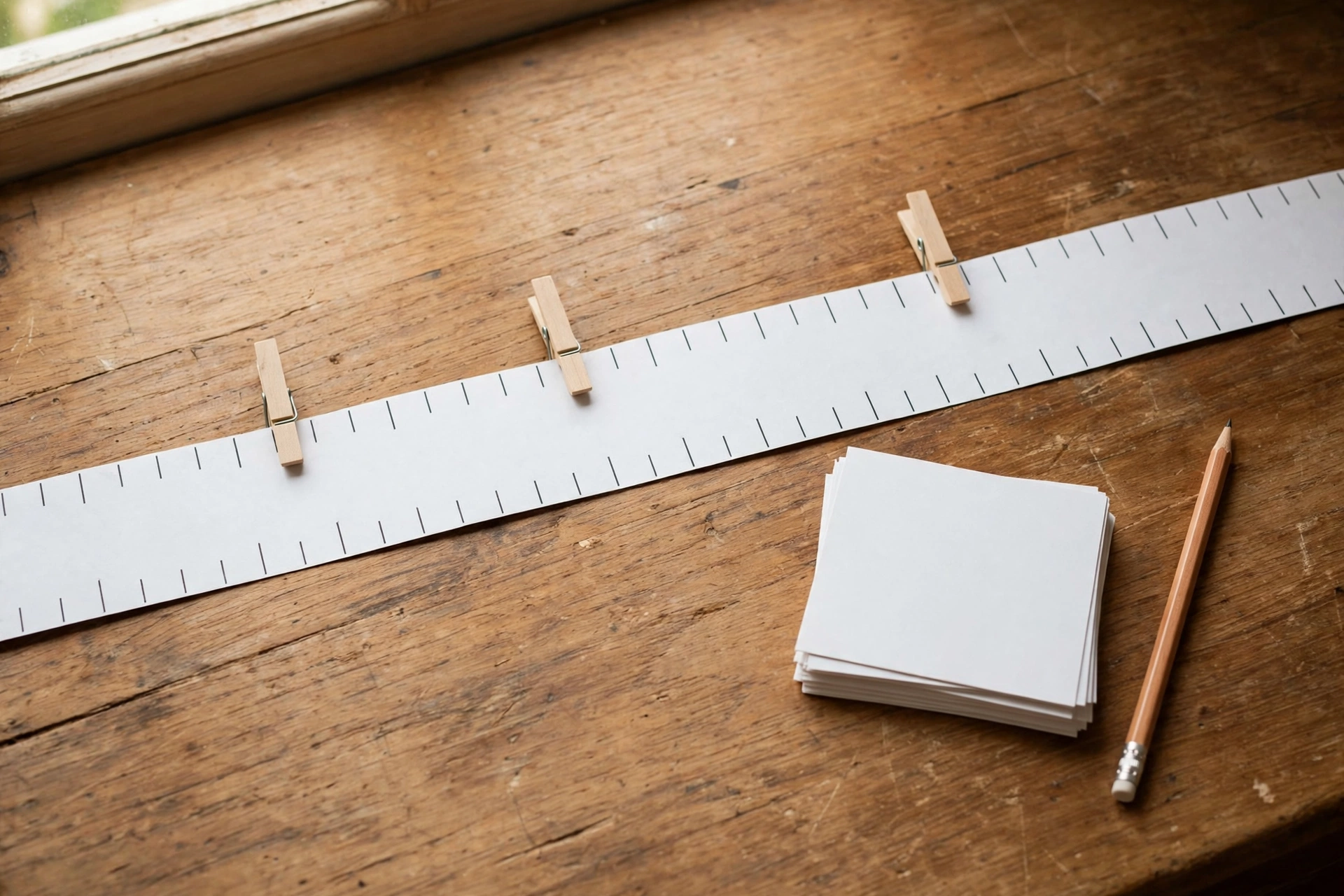
A useful first lesson needs nothing fancy. A long strip of paper taped to the board, a marker, and two clothespins. Mark 0 at the left end and 1 at the right. Ask where 1/2 lives.
Nearly every hand points to the middle, because halves are friendly. Clip a pin there. Now ask where 1/4 lives, and watch the room split, between children who point halfway between 0 and 1/2 and children who guess near 0.
That disagreement is the lesson. Settle it together by folding the strip, and you have taught more in ten minutes than a page of shaded circles teaches in a week.
Start With Equal Parts and Unit Fractions

Every error that shows up later in this topic is born in the first five minutes, when the parts are not equal. A fraction only means something when the whole is split into parts of the same size. So before any symbols go on the board, hand out paper strips and let children fold them.
Fold one strip in half, crease it hard, and open it up. Two equal parts. Fold another into fourths. The folding matters because a child can feel when the edges do not meet, and that feeling teaches equal better than any definition.
Then name the pieces properly. The denominator is the bottom number, and it tells you how many equal parts the whole was cut into.
The numerator is the top number, and it tells you how many of those parts you count. Keep the language physical. The denominator cuts. The numerator counts.
Children who learn those two jobs as actions rarely mix the numbers up later.
Next comes the single most important building block, the unit fraction. A unit fraction has a numerator of 1, like 1/2, 1/3 or 1/4, and it names one single part. Every other fraction is built by counting copies of it. So 3/4 is 1/4 plus 1/4 plus 1/4, three jumps of the same small step.
Have the class count out loud as a finger hops along the line, one fourth, two fourths, three fourths, four fourths, and let them hear that four fourths lands exactly on 1. When a child can build a fraction by hopping, placing fractions stops being a guessing game.
Count the Spaces, Not the Tick Marks
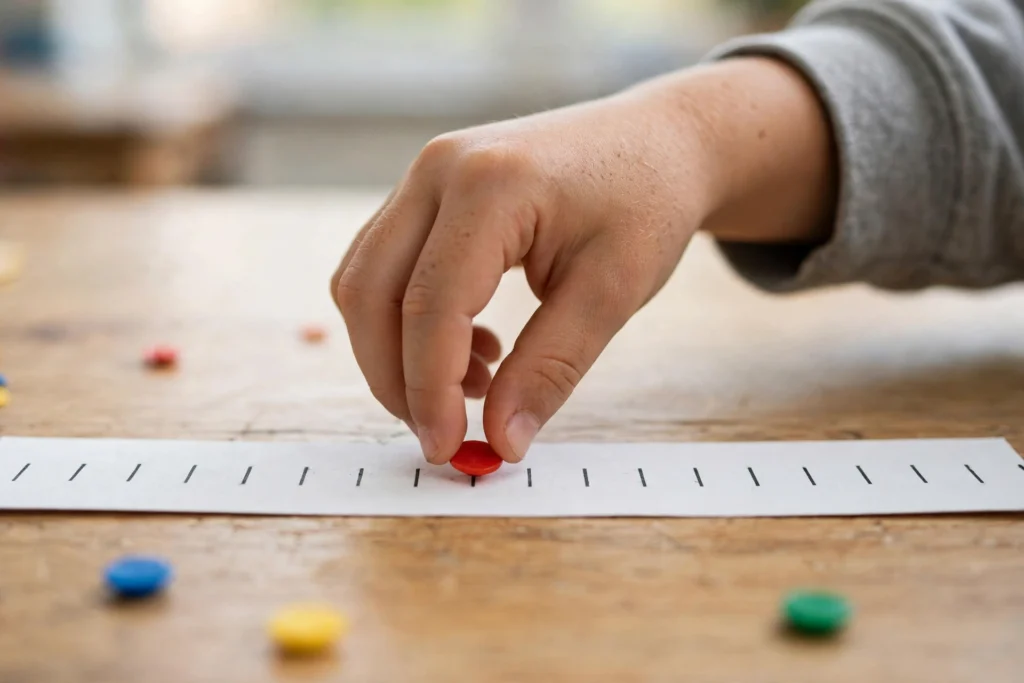
If your class learns one sentence from this whole unit, make it this one. Fractions live in the spaces, and you count the spaces you travel from 0. The tick marks are just the fences between the spaces. Children get this wrong in a predictable way.
Show a line split into fourths and ask for 3/4, and many will count the tick marks themselves, starting with the mark at 0, and land one part off. Their counting is careful. Their target is wrong.
The fix is movement. Have children hop a finger, a counter or a clothespin along the line and count each landing space out loud. Start at 0. Hop. That was one space, so you are standing at 1/4. Hop again, 2/4.
Hop again, 3/4. The number names the distance traveled, never the fence you are standing next to.
A line split into fourths has three tick marks between 0 and 1, but it has four spaces, and it is the four spaces that make it fourths.
Once children see that the marks between are always one fewer than the parts, a whole family of test errors disappears.
Reading a point that is already marked works the same way, in reverse. Count all the equal spaces between the two whole numbers first, and that count is your denominator. Then count the spaces from 0 to the point, and that count is your numerator.
A point sitting three spaces along a line split into eight equal spaces is 3/8, every time. Practice this reading direction as often as the placing direction, because tests ask both.
Going Past 1: Improper Fractions and Mixed Numbers
Nothing on the line says you have to stop at 1. Keep the same size jumps going and the counting simply continues, one fourth, two fourths, three fourths, four fourths is 1, five fourths, six fourths. That count carries children straight into improper fractions without any drama.
A fraction like 5/4 has a numerator bigger than its denominator, and on the line that just means you hopped past the whole. It sits between 1 and 2, one fourth into the next whole.
Mixed numbers fall out of the same picture. The point at 5/4 is one whole and one extra fourth, so it also wears the name 1 1/4. The point at 7/4 is 1 3/4.
Children who count along the line accept this in minutes, because they watched the hops happen. Children who met improper fractions as a rule to memorize often believe for years that a numerator is not allowed to be bigger, and the line is the fastest cure.
Keep the line long enough to matter. Tape two strips together if you have to, so the journey past 1 is visible in one piece, not hidden on a second page. When children can see 5/4 sitting next to 1 1/4, the two names stop feeling like two different topics.
Equivalent Fractions Land on the Same Point

Equivalence is where the number line earns its keep. Take two strips of the same length. Split one into fourths and one into eighths, and line them up. The point for 1/2 on the fourths strip sits exactly over 2/4 and 4/8 on the other strips. Different names, same address.
That is the whole idea, and it is easier to believe when you can see the pins line up than when a worksheet tells you to multiply top and bottom by the same number.
Stacking lines makes the pattern general. A fraction has many names because you can cut the same distance into smaller pieces and count more of them. So 2/4, 3/6 and 4/8 are not three facts to memorize. They are three ways of naming one point.
Children who learn equivalence this way also spot it later, when they simplify, add fractions with different denominators, or compare 2/3 and 3/4 by asking which point is farther right.
Try it as a classroom routine. Give each pair two strips, different splits, and one counter. Ask them to find a point where both strips agree, and to write every name that point wears. In five minutes you will have a wall of equivalent pairs, and nobody had to be told a rule first.
Our guide to equivalent fractions goes deeper if you want the full sequence, but the line itself does most of the teaching.
Comparing Fractions Without a Trick
Comparing is simple once a fraction is a place. Two fractions, two points, one question: which point is farther right? That question needs no cross multiplication, no common denominator chant, and no rule about bigger denominators meaning smaller pieces, although that rule is true and will show up on its own.
Put 2/3 and 3/4 on the same line, with the same whole, and the answer is visible. The farther right point is the bigger number, full stop.
The same whole matters, and it is worth saying out loud every time.
A half of a small strip is not the same distance as a half of a long strip, and comparing fractions from different wholes is a trap, not a test of understanding. Keep the strips the same length, keep 0 lined up, and the comparison is honest.
For a quick classroom check, ask children to place both fractions before they answer which is bigger. Placing first slows the guess, and the placed points do the arguing.
If a child still answers from a remembered rule instead of the points, ask them to point to the two places and read the distances. The line corrects the rule without a lecture.
A 20 Minute Lesson That Works
Here is a lesson shape that fits a normal class period and leaves time for practice. It works because every step is physical before it is symbolic.
| Step | Minutes | What happens |
|---|---|---|
| Fold and name | 5 | Fold strips into halves and fourths, name the denominator and numerator |
| Place 1/2 and 1/4 | 5 | Clip pins on a long strip, settle the 1/4 disagreement by folding |
| Hop and count | 5 | Count spaces out loud, build 3/4 as three jumps of 1/4 |
| Place and compare | 5 | Place two fractions, ask which point is farther right |
End with a question, not a worksheet. Ask where 5/4 would live, and let children argue it out with hops. The argument is the learning, and it tells you more than a marked page ever will.
Common Mistakes and How to Fix Them
| Mistake | What children do | Fix |
|---|---|---|
| Counting tick marks | Start counting at the mark at 0 and land one part off | Hop a counter and count landing spaces, not fences |
| Unequal parts | Split a strip into uneven pieces and still call them fourths | Fold again until the edges meet exactly |
| Stopping at 1 | Refuse to place a fraction bigger than 1 | Keep hopping past 1 on a longer strip |
| Comparing different wholes | Compare a half from a short strip with a half from a long strip | Line up 0 and use strips of the same length |
If you want extra practice without making a worksheet by hand, a math worksheet generator can make number line practice sheets in minutes, and the free fraction number line tool lets children place points and check themselves before the next lesson.
The same number line skills carry into data work in our Line Plots with Fractions lesson, where pupils plot halves, quarters and eighths.
Frequently Asked Questions
How do I place a fraction on a number line?
Mark 0 and 1, split the space between them into as many equal parts as the denominator says, then count that many spaces from 0, using the numerator as the count. The point you land on is the fraction.
What if my child counts the tick marks instead of the spaces?
Have them hop a counter and count each landing space out loud. Start at 0, hop once to 1/4, again to 2/4, and so on. Counting landings, not fences, fixes the off by one error.
How do I teach equivalent fractions on a number line?
Stack two strips of the same length with different splits and line up 0. When pins for different names land on the same point, those fractions are equivalent, because they name the same distance.
Why do children struggle with fractions bigger than 1?
Because they learned fractions as pieces of one whole. On a line, keep hopping past 1 with the same size jumps, and 5/4 simply sits between 1 and 2, one fourth into the next whole.
When should I introduce comparing fractions?
After children can place fractions confidently and count spaces. Then comparing is just asking which of two placed points sits farther right, using strips of the same length.
How can I practice this at home?
Use a paper strip, a ruler and a counter. Fold, place, hop and compare for a few minutes at a time, and let the free fraction number line tool check placements before the next lesson.
Reading about it is one thing, practising it is another. Our free What Is a Fraction? lesson builds the idea step by step, with slides, a printable worksheet and a full answer key.
Members unlock every lesson in the library, including the full Fractions, Multiplication, Place Value, Addition & Subtraction, Time & Money and Geometry & Shapes units. See the full library


