

Math fact practice at home works best when it is short, calm and tracked fact by fact. Here is the whole approach up front. Aim for five to ten minutes on most days instead of one long weekend session. Build accuracy first and let speed grow on its own.
Practice one operation at a time in a sensible order, and keep a simple record of which facts are already solid and which ones keep slipping, because random practice spends most of its time on facts your child already knows.
Use a timer only when your child enjoys it or is ready for it, and switch to untimed practice the moment the clock becomes the problem. A child who can answer correctly, calmly and without counting on fingers is building real math fact fluency, even if the stopwatch is still in the drawer.

What Math Fact Fluency Really Means
Fluency gets talked about as if it just means fast. In a classroom it means three things at once. The answer is accurate. It comes without a long detour through counting, skip counting or drawing dots in the air.
And the child can still use the fact when it shows up inside a bigger problem, the way 7 times 8 hides inside a word problem about seven bags with eight marbles in each bag.
That third part is the one parents miss. A child can race through a page of multiplication fact practice on Monday and still stall on Friday when the same facts appear inside long division. The facts were memorized as a list, not learned as tools.
Real fluency is quieter than speed. Your child sees 6 plus 7 and thinks 13 the way you think of your own phone number, and then gets on with the actual problem in front of them.
Fluency also grows in a predictable order, and knowing the order saves a lot of worry. Addition and subtraction facts within 20 are the work of grades 1 and 2.
Multiplication and division facts arrive in grade 3, and grades 4 and 5 mostly use those facts inside harder problems rather than learning a brand new set.
Our guides to addition and subtraction fluency and multiplication and division fluency walk through what solid looks like at each stage if you want the grade by grade picture.
Accuracy Before Speed

Every teacher has watched this scene. A child who knows 8 plus 5 perfectly well at the kitchen table writes 12 on a timed sheet because the clock made the thinking rush. Speed pressure does not reveal weak facts nearly as often as it creates wrong answers out of known ones.
So work in the other direction. First the fact has to be right, every time, with no counting. A home test is simple. Can your child answer the fact correctly on three different days, in the middle of other facts, without pausing to work it out? Then it is accurate and secure.
Only after that does pace matter, and by then pace usually takes care of itself. Children get faster at facts they are sure of, the same way you type your own name faster than an unfamiliar word.
When a fact is still shaky, slow it down on purpose and let your child build it from one they trust. A child who knows 6 plus 6 can meet 6 plus 7 as one more.
A child who knows 5 times 8 can find 6 times 8 by adding one more group of 8. That kind of building is not a crutch. It is how the fact gets a hook in memory, and hooks are what recall hangs on later when nobody is timing anything.
Short Daily Rounds Beat Long Weekend Sessions
Five to ten minutes is a real session. Parents often feel it cannot possibly count, so they skip the weekdays and sit down for a long Saturday drill instead. That session is the one that ends with a slammed pencil. Short rounds win for a plain reason.
A fact your child met yesterday is still warm today, so a brief round mostly refreshes and strengthens it. A fact left alone for a week has to be relearned, and relearning feels like failure to a child even when it is just forgetting doing what forgetting does.
Attach the round to something that already happens. Right after a snack works well. So does the ten minutes before a favorite show, or while dinner is in the oven and you are both in the kitchen anyway.
The anchor matters more than the exact time. When practice lives at the same moment each day, nobody has to negotiate it, and negotiation is where most home practice plans quietly die.
End while it is still going well. This is the hardest rule for parents, because a child on a roll makes you want ten more facts. Stop anyway. A session that ends with your child feeling capable is a session they will agree to tomorrow, and tomorrow is where fluency actually gets built.
Why Mastery Tracking Beats Random Flashcards
A shuffled deck of flashcards feels fair, but it has a hidden flaw. It cannot remember what happened yesterday.
Your child answers 4 times 3 instantly for the ninth day in a row, then misses 7 times 8 for the ninth day in a row, and the deck treats both facts exactly the same.
Most of the round goes to facts that need no practice at all.
Tracking fixes that. When you know which facts are solid, which are close and which are stuck, practice aims itself. The stuck facts come back often. The solid ones appear just often enough to stay solid. This is exactly how our free Math Fact Practice tool works.
It covers addition, subtraction, multiplication and division at three levels, Starter, Builder and Master. A fact counts as mastered only when your child answers it correctly in under 3 seconds in 3 different rounds, which is a much tougher and more honest test than getting it right once on a good day.
Facts your child misses return sooner, and a progress grid for each operation shows the mastered facts filling in over time. Progress is stored in the browser on your own device, and there is no sign up.
You can run the same system on paper if screens are not your thing. Sort a deck into three piles, know it, learning it and stuck, and spend most of each session on the last two piles.
Facts graduate between piles only after they are answered correctly on different days. Either way, the principle is the same. Practice math facts with a memory, and every minute lands where it is needed.
Learning facts in fact families helps the tracking click too, because when 6 times 7 finally sticks, its relatives 7 times 6, 42 divided by 6 and 42 divided by 7 usually come along with it.
Timed Versus Untimed: How to Tell What Your Child Needs
Some children love a timer. Others go blank the moment one appears. Both reactions are information, not character flaws. Use the timer as a tool you can pick up or put down, not as the definition of success.
| What you see | What it usually means | What to do |
|---|---|---|
| Answers are right without a timer, wrong with one | Anxiety, not a gap | Drop the timer and keep accuracy work |
| Answers are slow but right | The fact is known, not yet automatic | Short, relaxed rounds; speed will follow |
| Answers are wrong with or without a timer | The fact is not learned yet | Go back to counters, a number path or a known fact |
| Answers are fast and right, then slip a week later | Not yet mastered | Space the fact out and revisit it on different days |
If your child is ready for a quick check, use the free placement check to find the gaps before you choose a focus. A placement check is only worth doing if it changes what you practice next, so write down the one or two facts or operations it points to and start there.
Practice With Counters and a Number Path
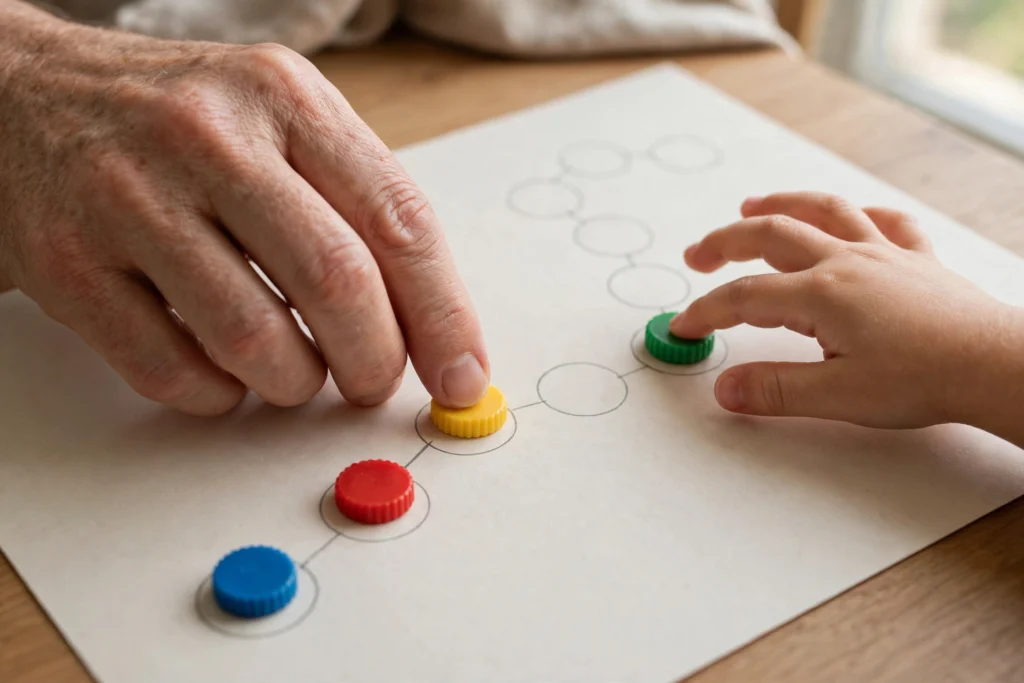
A stubborn fact needs a picture before it needs more repetition. Counters and a number path give it one. Put a counter on the starting number, hop forward for addition or back for subtraction, and say the landing number out loud. For multiplication, lay out equal groups and count the total, then say the fact as a sentence: six groups of seven is forty two.
Keep the routine short and physical. Pick one fact. Walk it on the path. Say it. Write it. Then ask it again without the path, and only move on when the answer comes without the walk. The path is a scaffold, not a permanent crutch, and you remove it fact by fact as each one becomes secure.
A multiplication chart can help in the same way, as long as it is used to find patterns rather than to copy answers. Ask your child to find all the facts that end in zero, or all the doubles, and the chart becomes a map instead of an answer key.
A Simple Weekly Routine by Grade
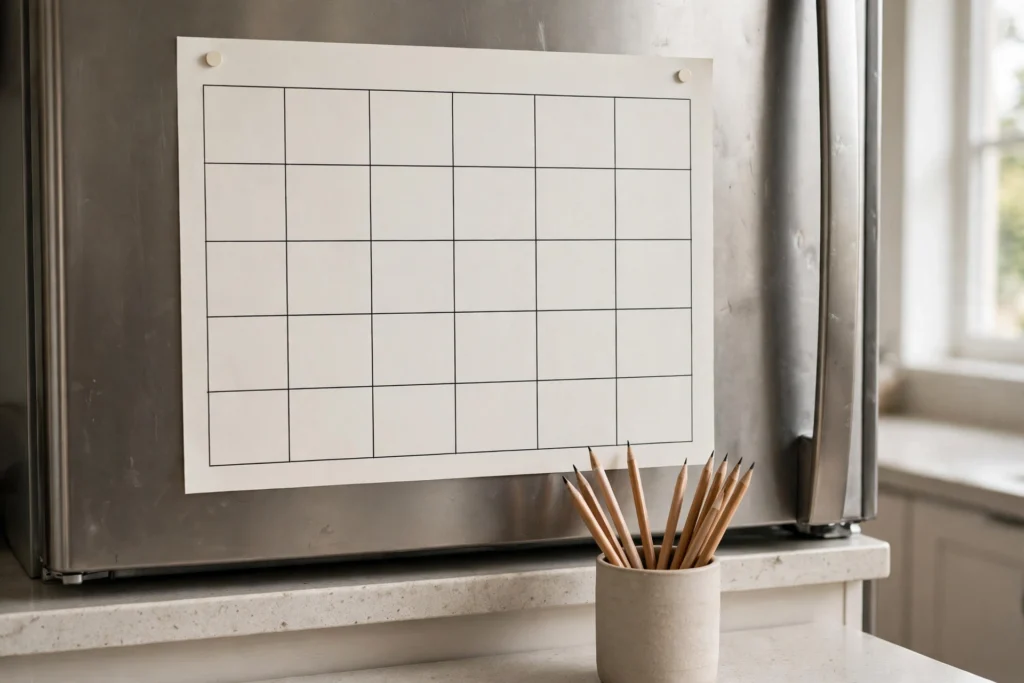
Four or five short sessions beat a perfect plan that never happens. Pick one focus per day, keep the same anchor time, and let the weekend be a light review or a game.
| Grade | Main focus | A week that works |
|---|---|---|
| Grades 1 to 2 | Addition and subtraction within 20 | Two days on doubles and near doubles, one day on making 10, one day on a mixed round, one game day |
| Grade 3 | Multiplication and division facts | Two days on one new times table, one day on its division relatives, one day on a mixed round, one game day |
| Grades 4 to 5 | Using facts inside bigger problems | Two days on mixed facts, one day on multi digit problems that use them, one day on word problems, one game day |
For a ready made set of games, the Fact Fluency Games Pack gives you printable games that fit the same short round, and a math worksheet generator can make extra practice sheets when you want paper instead of a screen. Both sit alongside our free math tools, so you can mix screen and paper without changing the routine.
When Practice Still Feels Hard
If tears appear, stop the session, not the habit. A short break, a game round or a switch to a fact your child already owns can reset the mood. Then ask what felt hard. Was it the timer? The number of facts? A new operation? Fix that one thing before the next round.
Watch for counting that never fades. If your child still counts on fingers for most facts after weeks of practice, go back to the building step: doubles, making 10, and fact families. Speed built on counting is fragile, and it collapses inside bigger problems. Accuracy built on known facts holds.
And keep the goal in view. Fluency is not a race against other children. It is your child being able to use a fact without thinking about it, so the real problem in front of them gets their full attention. That is a quieter win, and it lasts.
Frequently Asked Questions
How long should math fact practice take each day?
Five to ten minutes on most days is enough. Short, regular rounds beat one long weekend session, and ending while it is going well keeps your child willing to come back tomorrow.
Should I time my child?
Only if the timer helps. If answers are right without a timer and wrong with one, the timer is creating the problem. Drop it, build accuracy, and add a gentle timer later only when your child is ready.
What counts as a fact being mastered?
A useful home test is answering the fact correctly on three different days, in the middle of other facts, without pausing to work it out. Our tool uses a stricter version: correct in under 3 seconds in 3 different rounds.
What if my child keeps forgetting the same fact?
Give that fact a picture and a hook. Use counters or a number path, build it from a fact your child already trusts, and bring it back often in short rounds until it is secure on different days.
Is it okay to use a chart or counters?
Yes, at the learning stage. Charts and counters are scaffolds. Use them to find patterns and build understanding, then remove them fact by fact as each fact becomes automatic.
How do I know where to start?
Start with one operation and one small set of facts, and track which ones are solid, close or stuck. A placement check can point to the first focus, but the tracking itself is what keeps practice aimed at the right facts.
Every topic clicks faster with practice. Our Resource Library has free lesson packs with slides, printable worksheets and full answer keys, ready to download and teach.
Members unlock every lesson in the library, including the full Fractions, Multiplication, Place Value, Addition & Subtraction, Time & Money and Geometry & Shapes units. See the full library


