
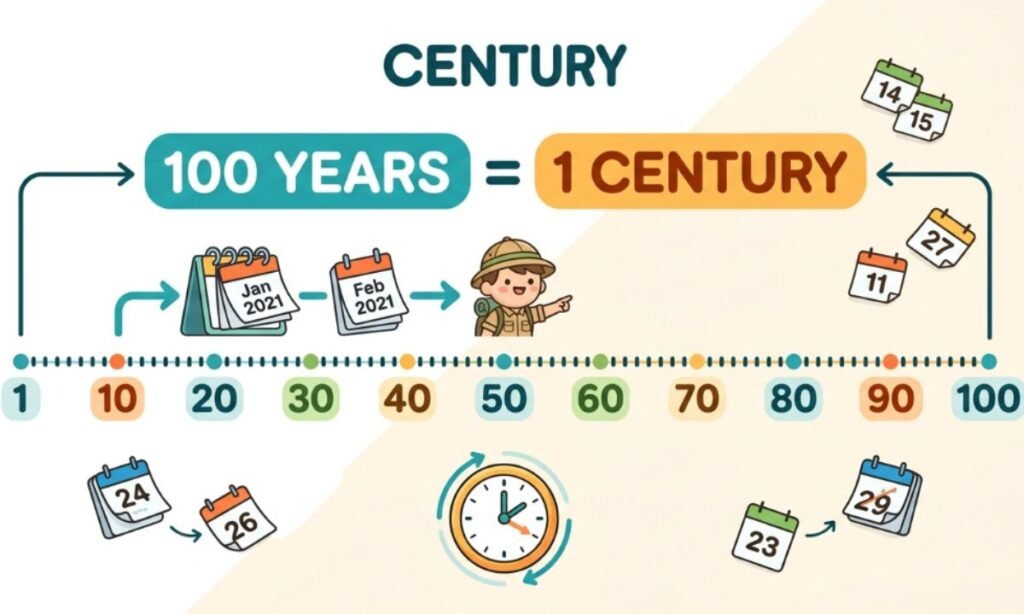
What Is a Century?
A century is a period of 100 years. The word helps us describe long stretches of time and place events on a timeline.
For example, the years from 2001 through 2100 make up the 21st century. The year 2026 is part of that century.
A century is longer than a decade but shorter than a millennium:
| Time unit | Number of years |
| Decade | 10 years |
| Century | 100 years |
| Millennium | 1,000 years |
How Century Names Match Years
Each formal century contains 100 years. The first century included years 1 through 100. The second century included years 101 through 200. The same pattern continues today.
| Century | Years included |
| 1st century | 1–100 |
| 2nd century | 101–200 |
| 19th century | 1801–1900 |
| 20th century | 1901–2000 |
| 21st century | 2001–2100 |
Notice that a century does not begin with a year ending in 00. A century begins with a year ending in 01 and ends with a year ending in 00.
Why 2000 Was in the 20th Century
Many people think the 21st century began in 2000 because the year starts with 20. Formal century names follow a different pattern.
The 20th century ran from 1901 through 2000. The 21st century began on January 1, 2001, and will end on December 31, 2100. The U.S. Naval Observatory confirms these boundaries for the Common Era calendar.
Plain Text
1901 ───────────── 2000 | 2001 ───────────── 2100 20th century | 21st century
In everyday language, people sometimes say “the 2000s” for years from 2000 through 2009. That informal label is not exactly the same as the formal term 21st century. The year 2000 belongs to the 20th century, while the years 2001 through 2009 belong to the 21st century.
How to Find the Century for a Year
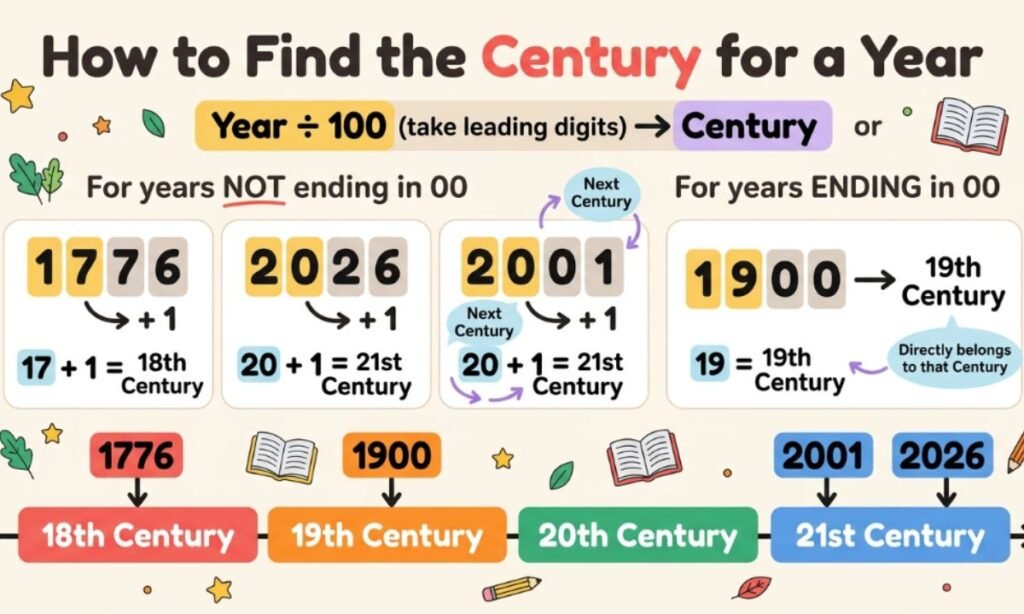
For most four-digit years, look at the first two digits and add 1. This works when the year does not end in 00.
•1492: 14 + 1 = 15, so 1492 was in the 15th century.
•1776: 17 + 1 = 18, so 1776 was in the 18th century.
•1969: 19 + 1 = 20, so 1969 was in the 20th century.
•2026: 20 + 1 = 21, so 2026 is in the 21st century.
There is one important exception. If a year ends in 00, do not add 1. That year is the last year of the century named by its first two digits.
•1800 was in the 18th century.
•1900 was in the 19th century.
•2000 was in the 20th century.
•2100 will be in the 21st century.
A Timeline Activity for Learning Centuries
Write these years on separate cards: 1900, 1901, 1950, 2000, 2001, and 2026.
First, put the cards in order from earliest to latest. Next, place each card under the correct century. Ask why 1900 and 1901 belong to different centuries. Then ask why 2000 and 2001 belong to different centuries.
This activity makes the boundary between centuries visible. It also helps students connect a number line with the formal names used in history. Timelines support students as they learn the order of events and changes over time.
Teaching Strategies for Explaining Centuries
Use a three-step progression so students understand the idea before memorizing the naming rule. First, build a strip showing 100 spaces or 10 groups of 10. Next, label the strip as one century. Finally, connect it to a real timeline, such as 1901–2000.
Ask students to sort and explain, not only identify. Give them year cards such as 1899, 1900, 1901, 1999, 2000, and 2001. After students group the cards, ask them to explain why a card belongs in that century. Their explanation shows whether they understand the boundary.
Use small, repeated comparisons. Compare a decade with a century, then compare a century with a millennium. Saying “10 decades make 1 century” helps students connect the units without treating them as unrelated vocabulary words.
Keep a classroom reference line visible while students practice. Mark the first and last year of each century and highlight the years ending in 00. This visual reminder supports students who remember the quick rule but forget its exception.
Common Mistake: Adding 1 to Every Year
A common mistake is to use the quick rule on a year ending in 00. For example, a student might look at 2000, calculate 20 + 1, and call it the 21st century.
The better method is to check the last two digits first. If they are 00, keep the first two digits as the century number. If they are not 00, add 1 to the first two digits.
Quick Practice
Which century includes the year 2000? How do you know?
Answer: The year 2000 is in the 20th century. It is the final year in the range from 1901 through 2000.
Frequently Asked Questions
How many years are in a century?
There are 100 years in a century.
Is 2000 in the 20th or 21st century?
The year 2000 is in the 20th century. The 21st century began in 2001.
What century is 2026 in?
The year 2026 is in the 21st century because 20 + 1 = 21, and the year does not end in 00.
Is a century longer than a decade?
Yes. A decade has 10 years, while a century has 100 years.
What is the difference between a century and a millennium?
A century has 100 years. A millennium has 1,000 years, which is ten centuries.
People Also Search Questions
What is a century in history?
In history, a century is a named period of 100 years. Historians use centuries to organize events and describe when people, places, and ideas existed.
What is CENTURY Tech?
CENTURY Tech is a separate education technology platform that uses artificial intelligence to personalize learning and provide information to educators. It is not the math meaning of the word century.
What is a century in cricket?
In cricket, a century means that a batter scored at least 100 runs in one innings. This sports meaning comes from the same idea of reaching 100, but it does not describe 100 years.
What is a century in the Bible?
The word century means 100 years when it appears in a Bible history discussion or study guide. It is not a special biblical unit. The surrounding passage determines which historical period the writer means.
Is 10 years a century?
No. Ten years make one decade. A century contains 100 years.
Is 20 years a century?
No. Twenty years equal two decades. A century contains 100 years.
What is a century in years?
A century is 100 years.
Is it spelled centuary or century?
The correct spelling is century. “Centuary” is a misspelling.
A century is a group of 100 years. To name a century correctly, remember that years ending in 01 begin a century and years ending in 00 finish it.