
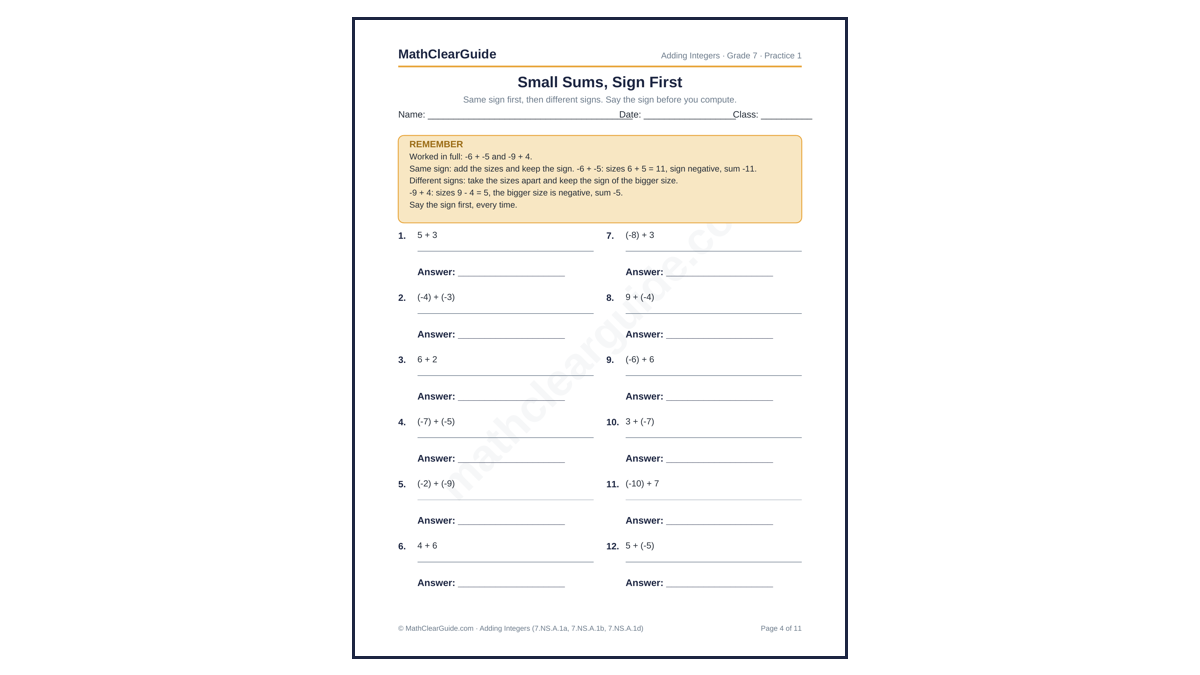
Integer operations in Grade 7 are one idea wearing four coats: every operation is a move with a size and a direction. Add and you step forward or back on the number line. Subtract and you step the other way. Multiply and you repeat a move, or turn it round. Divide and you share a move out, or count how many of one move fit in another. The sign tells the direction before the answer tells the size, and every rule in this unit is that one idea, said four ways. This post is the plain words guide to integer operations grade 7: five lessons, one free, from adding integers to word problems. This is the first Grade 7 unit on our 6-8 road, and it follows the Grade 6 integers unit in order. The first lesson is a complete lesson with slides, task cards, a worksheet and a filled in key: Adding Integers. This post walks through all five lessons.
What an Integer Operation Really Means
An integer operation is a move on the number line. Adding is moving. A positive number moves you up the line, a negative number moves you down it, and the answer is where you land. Subtracting is adding the opposite: to subtract 5 is to add -5, so the move runs the other way. The sign of the answer is a direction before it is a fact, and a pupil who says the direction first rarely loses the size after. One morning, two towns woke at dawn. One was at 3 degrees, the other at 5 below. Which town was warmer, and by how much? That one story carries this whole unit, and it comes back at the end of this post with three levels for three pupils.
The sign is the direction of the answer. A pupil who says it first rarely loses it.
The Unit at a Glance
Every lesson follows the same shape: 23 teaching slides, a printable worksheet with a teacher guide, task cards, practice pages, and a filled in answer key that shows the working, never a bare list. The first lesson is free. The other four are member lessons. The Grade 6 road came first (Units 1 to 4, live), this unit is its Grade 7 step, and the Grade 7 expressions and equations unit is what follows.
| Lesson | What it teaches | Standard | Fits |
|---|---|---|---|
| 1. Adding Integers (free) | Adding integers as moves on a number line, with zero pairs | 7.NS.A.1a, 7.NS.A.1b, 7.NS.A.1d | Week 1 |
| 2. Subtracting Integers | Subtracting as adding the opposite, and distance between two numbers | 7.NS.A.1c, 7.NS.A.1d, 7.NS.A.3 | Week 2 |
| 3. Multiplying and Dividing Integers | The sign rules, proved, and division as the inverse of multiplication | 7.NS.A.2a, 7.NS.A.2b, 7.NS.A.2c | Week 3 |
| 4. Adding and Subtracting Rational Numbers | The same rules with fractions and decimals, in both forms | 7.NS.A.1d, 7.NS.A.2d, 7.NS.A.3 | Week 4 |
| 5. Rational Number Word Problems | All four operations in stories, and one first look at one-step equations | 7.NS.A.3, 7.NS.A.1, 7.NS.A.2 | Week 5 |
Start Free: Adding Integers
The free lesson starts with the move on the line instead of with drill, because a pupil who can see the move can check every rule that follows. Pupils step up and down a vertical line from a dawn temperature hook, build zero pairs with counters, and learn the sign first habit from the first worked example: say the sign, then work the sizes. The Zero Pair task cards turn each addition into a frame a pair can build and check together. Teach it free here: Adding Integers. For fresh practice in the same skills, the free Worksheet Generator builds it.
Subtracting Is Adding the Opposite
Lesson 2 teaches one rewrite, and it teaches it until it is automatic: a minus b is a plus the opposite of b. Every subtraction in the lesson is rewritten before it is solved, so the pupil never has to hold two rules at once. Here is one in full, the way the key writes all of them. Solve -4 – 7. Rewrite it: -4 + (-7). Sign first: negative, because both numbers pull the same way. Sizes add: 4 + 7 = 11. Answer: -11. The same lesson teaches distance as the count of steps from the smaller number up, never negative, and the two towns hook from the slides closes with the same number. The Rewrite It First task cards print the rewrite line for each card, so a stuck pupil can start from the line, not from a blank page.
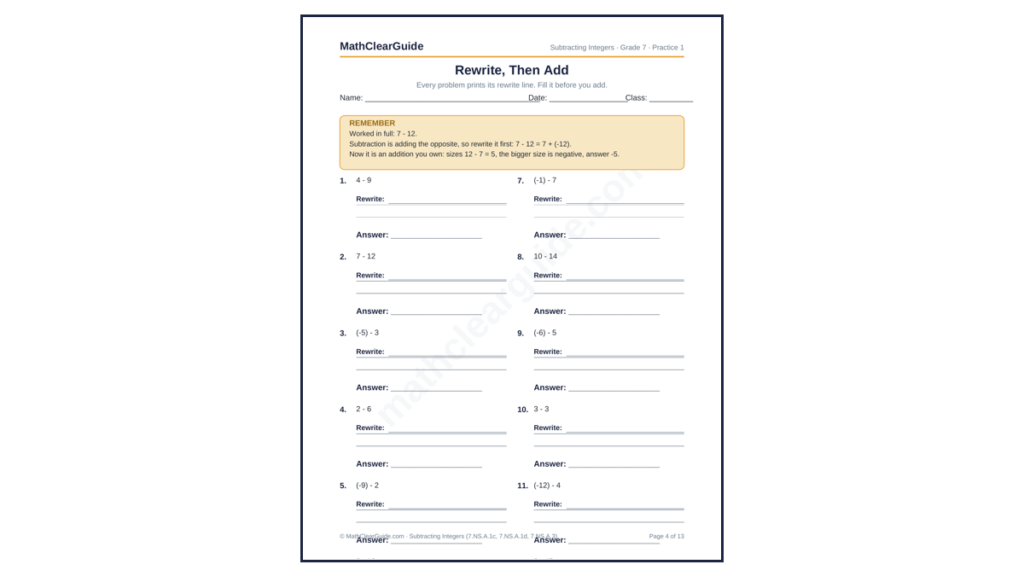
Members teach it here: Subtracting Integers.
The Sign Rules, Proved
Lesson 3 teaches the sign rules the way Grade 7 expects them to be taught: proved, not chanted. A stepping pattern forces the first rule: keep subtracting one from the multiplier and the products fall by the same size each step, until the pattern crosses zero and the sign has to flip. Then the distributive property proves that a negative times a negative is positive, in plain words, on a full slide. Division follows as the inverse of multiplication, so a quotient is checked by the product it came from. The Sign First task cards give every product and quotient a sign box and a size box, so the habit is built into the page.
A rule you can rebuild is worth ten rules you can only recite.

Members teach it here: Multiplying and Dividing Integers.
Fractions and Decimals Join In
Lesson 4 carries the signs into rational numbers, and nothing new is invented: the same rules, the same sign first habit, now with fractions and decimals. Pupils work each sum in two forms, the fraction form and the decimal form, and the Two Forms task cards make the choice visible: a sum that repeats forever in decimals is worked in fractions, and a sum with money is worked in cents. Long division conversions are taught in plain words, so a pupil can say why 1/8 is 0.125 and why 1/3 never ends. The lesson’s one labelled first look at a repeating decimal is a named strip, skippable whole, and claimed nowhere else.
Members teach it here: Adding and Subtracting Rational Numbers.
Word Problems: Reading the Story
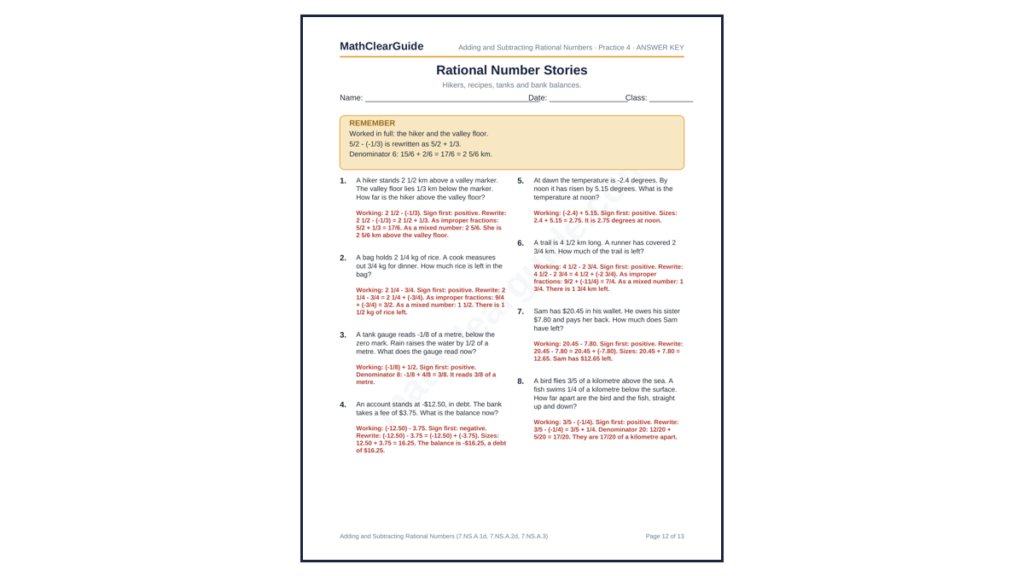
The capstone teaches the story before the numbers. Every story is read three times: what is happening, which numbers carry signs, and which operation the story is spending. Pupils write the operation line first, on a printed line in the Write the Sum First task cards, then solve, then read the answer back as a sentence. The lesson’s traps are honest ones: a keyword that says add when the story means subtract, and a total that is split, not built. Two challenge items carry the only complex fractions in the unit, labelled and skippable.
Members teach it here: Rational Number Word Problems.
Start Where Your Class Stands
Here is the honest ladder. A class that is still shaky on placing and ordering integers starts one unit down, with the Grade 6 integers unit and its free lesson, Positive and Negative Numbers. A class that is strong on Grade 6 integers starts at Lesson 1 and moves fast. And a class that finishes early should hear the plain truth: equations with negative numbers are the next Grade 7 unit’s work, and they wait for their own unit. The full shelf, free and member lessons together, sits in the Resource Library.
One Story, Three Levels
Two towns at dawn, on every desk one morning. One town is at 3 degrees, the other at 5 below. Support pupils find both temperatures on a printed line and say which town is warmer, with the line doing the work. Core pupils write the subtraction and find how much warmer, by the rewrite: 3 – (-5) is 3 + 5, which is 8 degrees. Challenge pupils take a third town below both and order all three gaps, smallest to largest. Same story, same morning, three honest levels, and the key’s shown working makes the levels visible: each answer carries the sign first line, the size work, and the sentence back.
Frequently Asked Questions
Is the first lesson really free?
Yes. Adding Integers is a complete lesson with 23 slides, task cards, practice pages and a filled in key, free with an email signup. It teaches its topic fully.
What standards does the unit teach?
The unit teaches 7.NS.A.1, 7.NS.A.2 and 7.NS.A.3 in full: adding and subtracting integers and rational numbers, multiplying and dividing integers, and solving real world problems with all four operations. The standards are printed on the first slide of every lesson and on every cover.
Does the unit teach solving equations?
No, not as a topic. Operations are taught here in full, and equations and proportions wait for their own Grade 7 units. Lesson 5 carries one labelled first look page with four one-step equations, so a class can see where the road goes next, and a teacher can skip the whole page.
My child learned keep change change, is this the same?
It is the same rewrite in different words. Keep change change says keep the first number, change the subtraction to addition, change the sign of the second number. This unit teaches the same move as adding the opposite, and says why it works, so the phrase is not a magic trick.
What do I need to print?
Each lesson prints as one worksheet PDF: a teacher guide, task cards, practice pages and a filled in key. The slides are a separate file for the board.
A pupil who can say why a negative times a negative is positive holds a rule no test can take away.
Get the Free Lesson
The free lesson is waiting at Adding Integers, and the full unit unlocks with membership. Five lessons, one road from Grade 6 to Grade 7, and a class that says the sign first. For fresh practice any time, the free Worksheet Generator builds it in the same skills.
Every topic clicks faster with practice. Our Resource Library has free lesson packs with slides, printable worksheets and full answer keys, ready to download and teach.
Members unlock every lesson in the library, including the full Fractions, Multiplication, Place Value, Addition & Subtraction, Time & Money and Geometry & Shapes units. See the full library


1 thought on “Grade 7 Integer Operations: A Simple Guide for Teachers and Parents”