
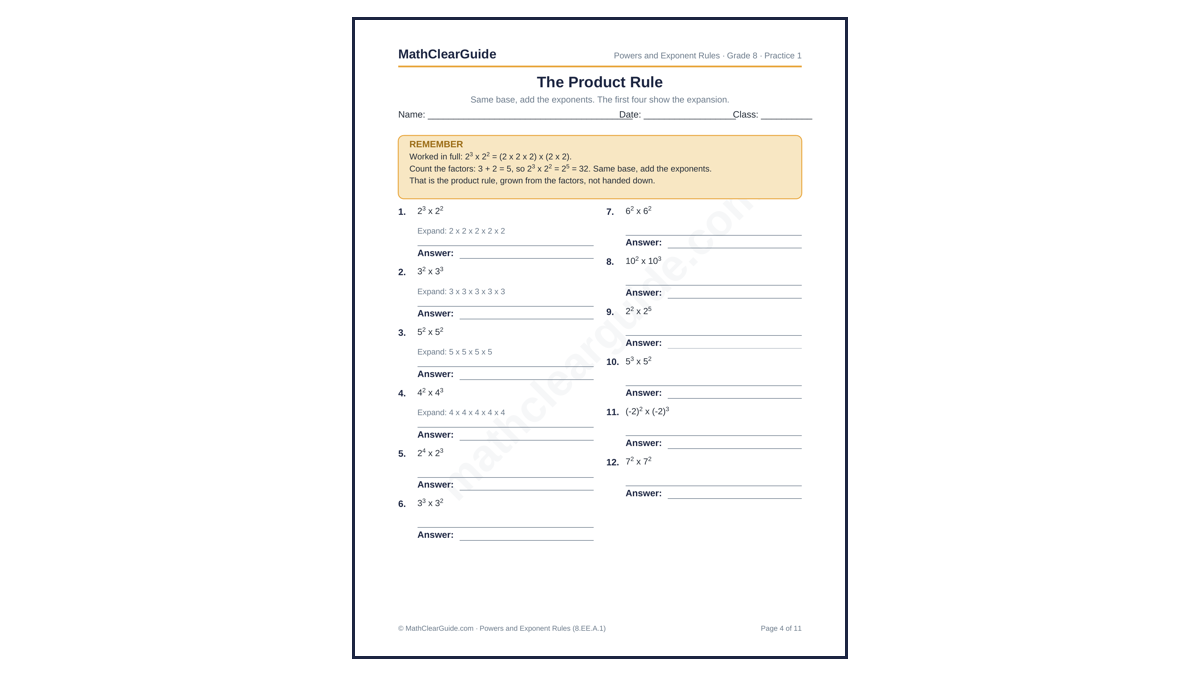
An exponent is a count of factors. 2 to the power 5 means five 2s multiplied together, and the answer is 32. Scientific notation is that count put to work on the very large and the very small. A long number like 384,400 becomes 3.844 times 10 to the power 5, and the power tells you its size at a glance. Every rule in this unit is the count being honest. Multiply and the factors join up, divide and they cancel. This post is the plain words guide to exponents and scientific notation grade 8. Five lessons, one free, from exponent rules to word problems. This is the first Grade 8 unit on our 6-8 road, and it follows the Grade 7 integer operations unit. The first lesson is a complete lesson with slides, task cards, a worksheet and a filled in key. Get it free here: Powers and Exponent Rules. This post walks through all five lessons.
What an Exponent Really Counts
An exponent counts factors. In 2 to the power 5, the base is 2, the factor, and the exponent is 5, the count of factors. The power means 2 times 2 times 2 times 2 times 2, which is 32. The rules are bookkeeping for that count. Multiply two powers of the same base and the factors join into one longer list, so the exponents add. Divide them and the shared factors cancel, so the exponents subtract. Fold a sheet of paper once and you have 2 layers. Fold it again and you have 4. Fold it a third time and you have 8. Each fold doubles the layers, and the exponent counts the folds. A pupil who writes the factors out can check every rule by hand.
Write the factors out first. A pupil who can do that owns every rule that shortens them.
The Unit at a Glance
Every lesson follows the same shape: 23 teaching slides, a printable worksheet with a teacher guide, task cards, practice pages, and a filled in answer key that shows the working, never a bare list. The first lesson is free. The other four are member lessons. The road below came first. Grade 6 powers sit inside Unit 4, and Grade 7 operations is Unit 5, live. This unit is the Grade 8 step on that road, and the Grade 8 Roots and Irrational Numbers unit is what follows it.
| Lesson | What it teaches | Standard | Fits |
|---|---|---|---|
| 1. Powers and Exponent Rules (free) | The product rule and the quotient rule, grown from expansions | 8.EE.A.1 | Week 1 |
| 2. Zero and Negative Exponents | Power of a power, the zero exponent, and negative exponents as reciprocals | 8.EE.A.1 | Week 2 |
| 3. Scientific Notation | Very large and very small numbers in scientific notation, compared by exponent first | 8.EE.A.3 | Week 3 |
| 4. Operations with Scientific Notation | Adding, subtracting, multiplying and dividing in scientific notation, with unit choice and calculator displays | 8.EE.A.4 | Week 4 |
| 5. Scientific Notation Word Problems | All four operations in real stories, with a move line and an estimate on every problem | 8.EE.A.4, 8.EE.A.3, 8.EE.A.1 | Week 5 |
Start Free: Powers and Exponent Rules
The free lesson grows the rules instead of listing them. Pupils expand every power factor by factor, count the factors together, and read the product rule and the quotient rule off the count. The product rule says this: same base, add the exponents. The quotient rule says this: same base, subtract the exponents. The lesson holds 23 slides, Expand and Collapse task cards, three practice pages with 43 problems, and a filled in key that shows the expansion, the rule named, and the answer for every problem. A spot the error example catches the crossed rules early. Teach it free here: Powers and Exponent Rules. For fresh practice in the same skills, the free Worksheet Generator builds it.
Zero and Negative Exponents, Settled
Lesson 2 settles the two facts pupils argue about most, and it settles them with a table, not a rule to memorise. The powers of 3 step down: 3 to the power 3 is 27, 3 to the power 2 is 9, 3 to the power 1 is 3. Each step divides by 3. One more step lands on 3 to the power 0, which is 1. One step past zero gives 3 to the power negative 1, which is 1 over 3. A negative exponent is a reciprocal, one over the positive power. The same lesson teaches the power of a power rule, grown from groups of factors, and it closes with the standard’s own example worked whole.
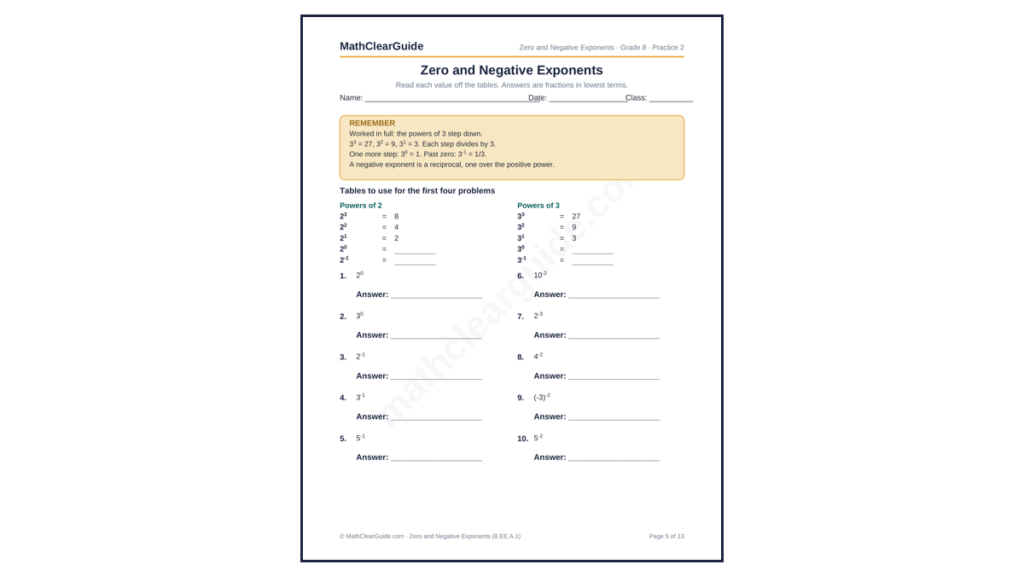
Members teach it here: Zero and Negative Exponents.
Scientific Notation: Numbers That Show Their Size
Scientific notation writes a number as a single digit times a power of 10. The first factor holds the digits that matter, and the power of 10 holds the size. The distance to the nearest star, the mass of a cell, and the width of a hair all fit the same short form. The heart of the standard is how many times as much one number is than another. Compare by the exponent first, and the bigger exponent wins. If the exponents match, the bigger first factor wins. The digit circling example box at the top of the first practice page shows the move in full: circle the digits, move the point, and count the moves into the exponent.
A long number tells you nothing until its short form shows its size at a glance.
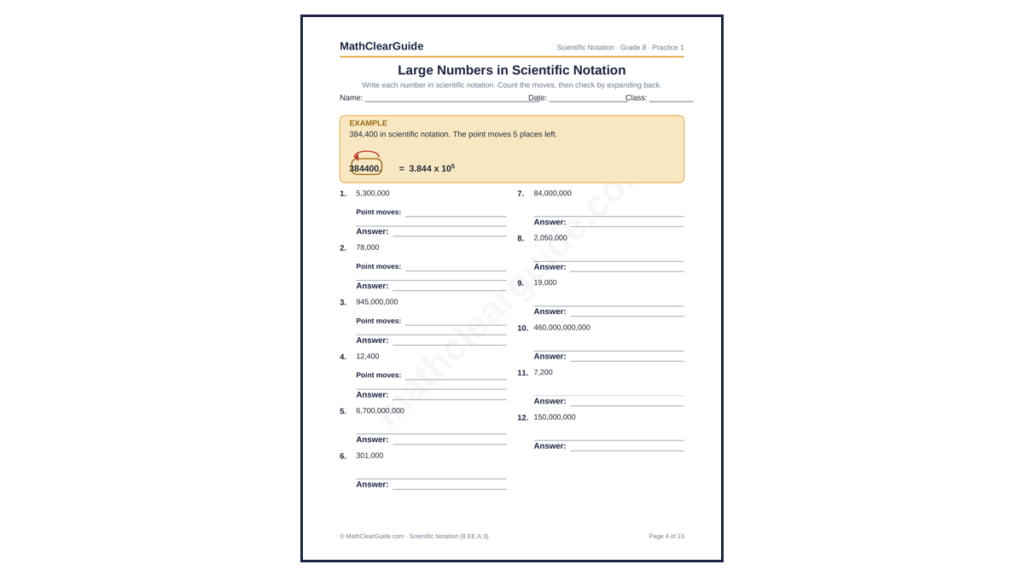
Members teach it here: Scientific Notation.
Computing in Scientific Notation
Lesson 4 teaches one move before any computing: line the powers up first. To add or subtract, the powers must match, so a pupil rewrites the smaller power until they do, then adds or subtracts the first factors while the power stays put. To multiply or divide, no lining up is needed. The first factors operate, and the powers spend the Lesson 1 rules. The lesson also teaches choosing units that keep a measurement readable, and reading a calculator display as a number.
Members teach it here: Operations with Scientific Notation.
Word Problems: Reading the Quantity
The capstone spends every rule in real stories: populations, distances in space, masses of cells, and counts that double by the hour. Every story is read three times before it is worked, and every problem carries a printed move line and a one digit estimate. Pupils write the move, estimate first, solve, then read the answer back as a sentence with its unit, so a wild answer is caught by their own hand. The last practice page is a labelled first look at the next unit, and a teacher can skip it whole.
Members teach it here: Scientific Notation Word Problems.
Start Where Your Class Stands
Here is the honest ladder. A class shaky on what a power means starts one shelf down, with the Grade 6 expressions unit and its free lesson, Numerical Expressions and Exponents. A class shaky on signed numbers starts with the Grade 7 integer operations unit and its free lesson, Adding Integers, the nearer step before. A class that finishes early should hear the plain truth: roots are the next Grade 8 unit’s work, in Grade 8 Roots and Irrational Numbers, and they wait for their own unit. And a class ready for equations finds them taught in full in Algebra 1 Solving Equations. The full shelf, free and member lessons together, sits in the Resource Library.
One Story, Three Levels
One sheet of paper, on every desk one morning. Support pupils fold it and write out the layers fold by fold, counting the factors as they go: 2 layers, then 4, then 8. Core pupils write the count as a power and work out the layers after ten folds: 2 to the power 10 is 1024 layers. Challenge pupils ask how many folds pass a thousand layers, and prove it by stepping the power up: 2 to the power 9 is 512, which is short of a thousand, and 2 to the power 10 is 1024, so ten folds is the first fold past a thousand. Same story, same morning, three honest levels, and the key’s shown working makes the levels visible.

Frequently Asked Questions
Is the first lesson really free?
Yes. Powers and Exponent Rules is a complete lesson with 23 slides, task cards, practice pages and a filled in key, free with an email signup. It teaches its topic fully, and the rest of the unit builds on it.
What standards does the unit teach?
The unit teaches 8.EE.A.1, 8.EE.A.3 and 8.EE.A.4 in full: the properties of integer exponents, scientific notation and comparing very large and very small numbers, and operations with numbers in scientific notation.
Does the unit teach square roots?
No, not as a topic. Roots wait for their own Grade 8 unit, Grade 8 Roots and Irrational Numbers. Lesson 5 carries one labelled first look page, a square rug with an area of 50 square feet whose side is estimated between 7 and 8 feet, so a class can see where the road goes next, and a teacher can skip the whole page.
Does it teach solving equations?
No. Solving equations is taught in full in Algebra 1 Solving Equations, and that is where a Grade 8 reader asking about equations honestly belongs. This unit stays on exponents and notation.
What do I need to print?
Each lesson prints as one worksheet PDF: a teacher guide, task cards, practice pages and a filled in key. The slides are a separate file for the board.
The pupil who asks how many times as much instead of which looks bigger holds the habit every science class will spend.
Get the Free Lesson
The free lesson is waiting at Powers and Exponent Rules, and the full unit unlocks with membership. Five lessons, one road from Grade 6 to Grade 8, and a class that writes the factors out first. For fresh practice any time, the free Worksheet Generator builds it in the same skills.
Every topic clicks faster with practice. Our Resource Library has free lesson packs with slides, printable worksheets and full answer keys, ready to download and teach.
Members unlock every lesson in the library, including the full Fractions, Multiplication, Place Value, Addition & Subtraction, Time & Money and Geometry & Shapes units. See the full library


