
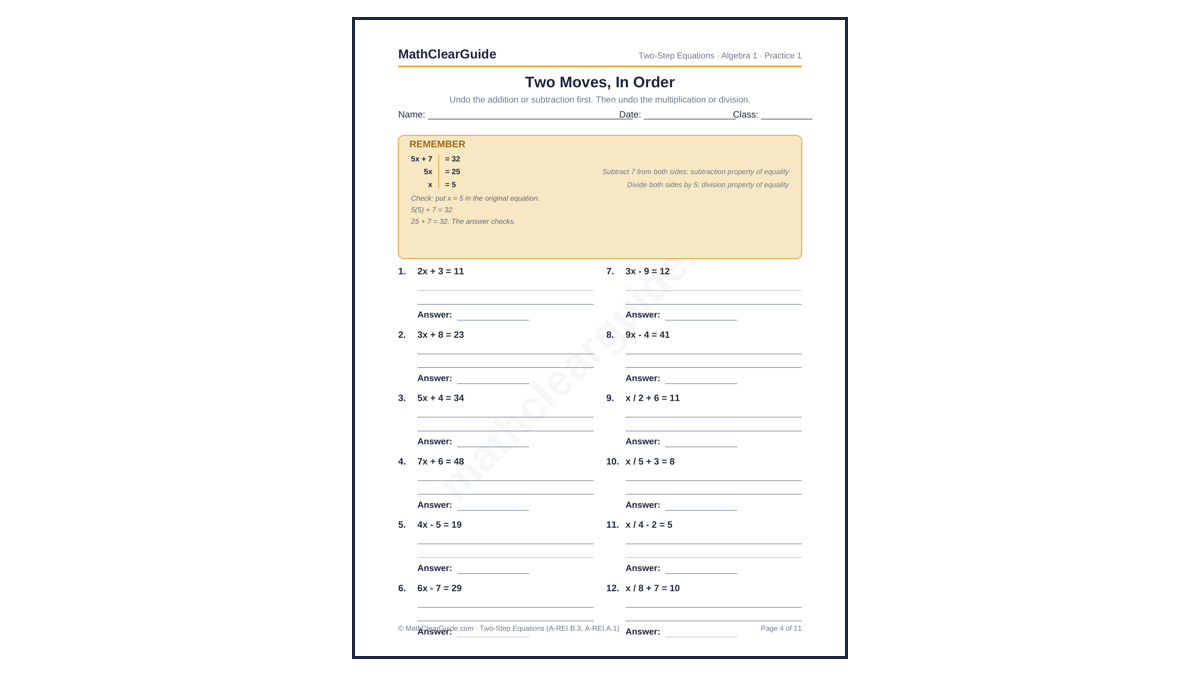
Solving an equation is the first real proof work of Algebra 1, and everything later in the course spends it. Our Solving Equations unit teaches it in order, across five lessons, and it starts with a free one. The first lesson, Two-Step Equations, is a complete lesson with slides, task cards, a worksheet and a filled in key that justifies every step, free with an email signup: Two-Step Equations. This unit is the first on our Grades 9 to 10 shelf. It follows the Grade 6 expressions unit on the road, where one-step equations were taught at that shelf’s depth. This post walks through all five lessons.
What Solving an Equation Really Means
An equation is a promise: two expressions name the same number. A solution is a value that keeps the promise. Solving is rewriting the promise, one legal move at a time, until the letter stands alone and the value is showing. Each move must keep both sides equal, and each move has a reason with a name: subtract from both sides, divide both sides. That is the whole subject in one breath. Two gym plans make it concrete. One charges $25 to join plus $10 a month. The other charges nothing to join and $15 a month. Asking when they cost the same is asking for an equation, and the answer, 5 months, is a value that keeps a promise.
An answer you have not checked is a guess wearing working. The check is not the decoration on the solution. It is the proof.
The Unit at a Glance
Every lesson follows the same shape: 23 teaching slides, a printable worksheet with a teacher guide, task cards, practice pages, and a filled in answer key that shows every step and every check, never a bare list. The first lesson is free. The other four are member lessons. The Grade 6 road came first on this shelf’s road: ratios, percent, integers, and expressions and one-step equations, all live. Algebra 1 Unit 2, on inequalities, is what follows this unit.
| Lesson | What it teaches | Standard | Fits |
|---|---|---|---|
| 1. Two-Step Equations (free) | Two undo moves in the reverse order, each one justified | A-REI.B.3, A-REI.A.1 | Week 1 |
| 2. Variables on Both Sides | Gathering the variable, with distributing and combining first | A-REI.B.3, A-REI.A.1 | Week 2 |
| 3. Equations with Fractions and Decimals | Clearing by the LCD and by 10, 100 or 1000, and proportions | A-REI.B.3, A-REI.A.1 | Week 3 |
| 4. Special Solutions and Literal Equations | No solution, infinitely many solutions, and rearranging formulas | A-REI.B.3, A-CED.A.4, A-REI.A.1 | Week 4 |
| 5. Equation Word Problems | Defining, writing and solving stories, with a first look at Unit 2 | A-CED.A.1, A-REI.B.3, A-REI.A.1 | Week 5 |
Start Free: Two-Step Equations
The free lesson starts with the undo order, not with drill, because the order is the idea everything else stands on. An equation built by adding and multiplying is solved by undoing in reverse: undo the addition or subtraction first, then the multiplication or division. Every worked example names the property that allows each step, and every answer ends with its check written in full. The Two Moves task cards make the order a physical sort before it becomes a habit. For fresh practice in the same skills, the free Worksheet Generator builds it. Teach the free lesson here: Two-Step Equations.
Variables on Both Sides
Lesson 2 teaches the gathering move: when the variable lives on both sides, subtract it from both sides and collect it into one place, then undo as always. The lesson names a five move strategy and spends it on every page: open, gather each side, gather the variable, undo, check. Here is one equation in full, the way the key writes all of them.
Solve 5x – 3 = 2x + 9.
5x – 3 = 2x + 9
3x – 3 = 9 (subtract 2x from both sides: subtraction property of equality)
3x = 12 (add 3 to both sides: addition property of equality)
x = 4 (divide both sides by 3: division property of equality)
Check: 5(4) – 3 = 17, and 2(4) + 9 = 17. The two sides match.
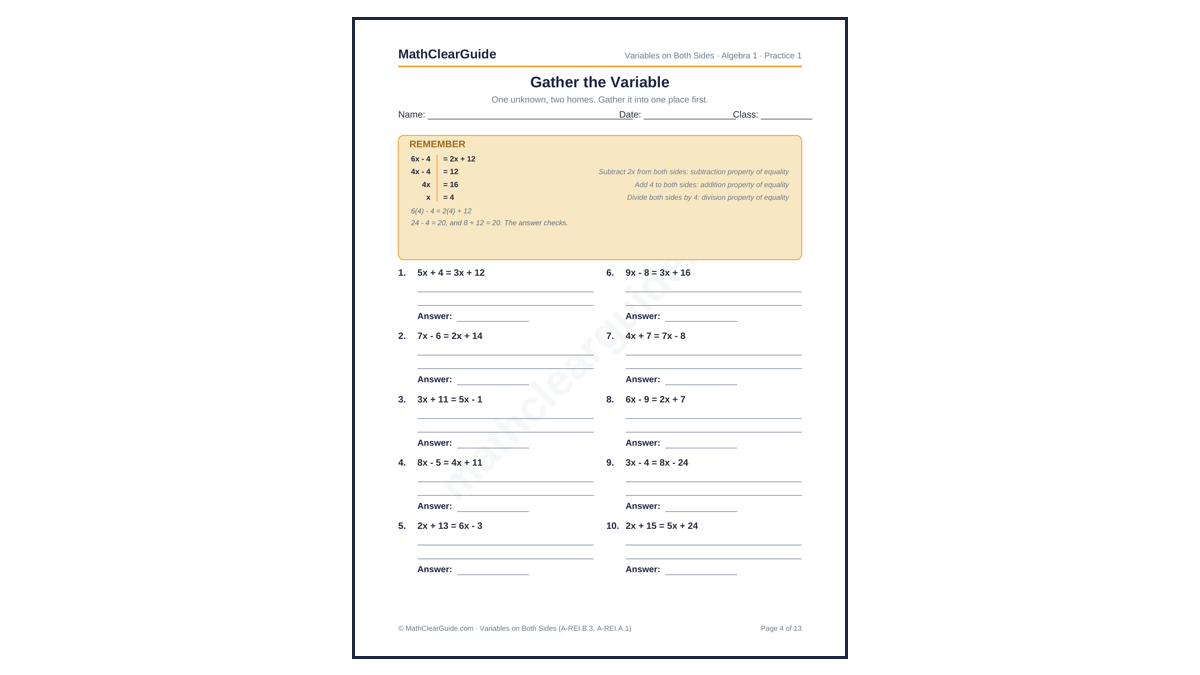
Members teach it here: Variables on Both Sides.
Fractions and Decimals, Cleared Honestly
Lesson 3 teaches the clearing move: multiply every term on both sides by one well chosen number, and the fractions are gone. The equation that remains is the same equation wearing whole numbers. The number is the least common denominator, and the lesson says in the open that this is Grade 6 Unit 1 ground being spent again, the way honest courses spend it. Decimals clear by 10, 100 or 1000, chosen by the longest decimal in the equation, and money is written the way money is written, to the cent.
A fraction in an equation is a whole number equation waiting for one honest multiplication. Clear it first, and the fear goes with the denominators.

Members teach it here: Equations with Fractions and Decimals.
The Endings That Are Not Numbers
Lesson 4 reads what the gathering can leave behind. Sometimes the variable vanishes and the numbers give the answer: 5 = 7 is false for every value, so the equation has no solution, and 6 = 6 is true for every value, so every number is a solution. Pupils learn to predict the ending from the coefficients and constants before solving, and to build equations whose endings come out as named. Then the same moves are spent on literal equations, where the answer is a letter standing alone: the perimeter formula P = 2l + 2w, rearranged in two named moves, gives the width as w = (P – 2l) / 2.
Members teach it here: Special Solutions and Literal Equations.
Word Problems: Writing the Equation
The capstone teaches the giving. Every solution begins with a sentence: let the letter stand for the thing you are asked to find, in its units. Then the story is read for its shape. Most stories wear one of three: a total being reached, a rate being spent, or a difference being left. Pupils write money stories, number stories and geometry stories, and stories that need both sides, and every answer is checked against the story, not only the equation, because swapped numbers solve their own wrong equations happily. One page at the end is a labelled first look at Unit 2 inequalities. It solves nothing, and it can be skipped whole.
Members teach it here: Equation Word Problems.
Start Where Your Class Stands
Here is the honest ladder. A class still shaky on one-step equations starts one shelf down, with the Grade 6 expressions unit and its free lesson, Numerical Expressions and Exponents. Nothing in this unit stands up without that ground. A class strong on Grade 8 solving starts at Lesson 2 or Lesson 3 of this unit and keeps Lesson 1 as the reteach for the pupils who need the undo order again. And a class that finishes early should hear the plain truth: inequalities in depth are Algebra 1 Unit 2 work, and they wait for their own unit, which is coming.
One Story, Three Levels
Put the two gym plans on every desk one morning: $25 to join plus $10 a month, against no joining fee and $15 a month. Support pupils solve the two-step version, where one plan is already gathered and the moves are named on the page. Core pupils write the both sides equation themselves, 25 + 10x = 15x, and solve it: 5 months, when both plans have cost $75. Challenge pupils change one number in the story so the two plans never cost the same, and prove it: make both monthly charges $10 with different joining fees, and the gathering leaves two different numbers, a false ending with no solution. Same story, same morning, three honest levels.
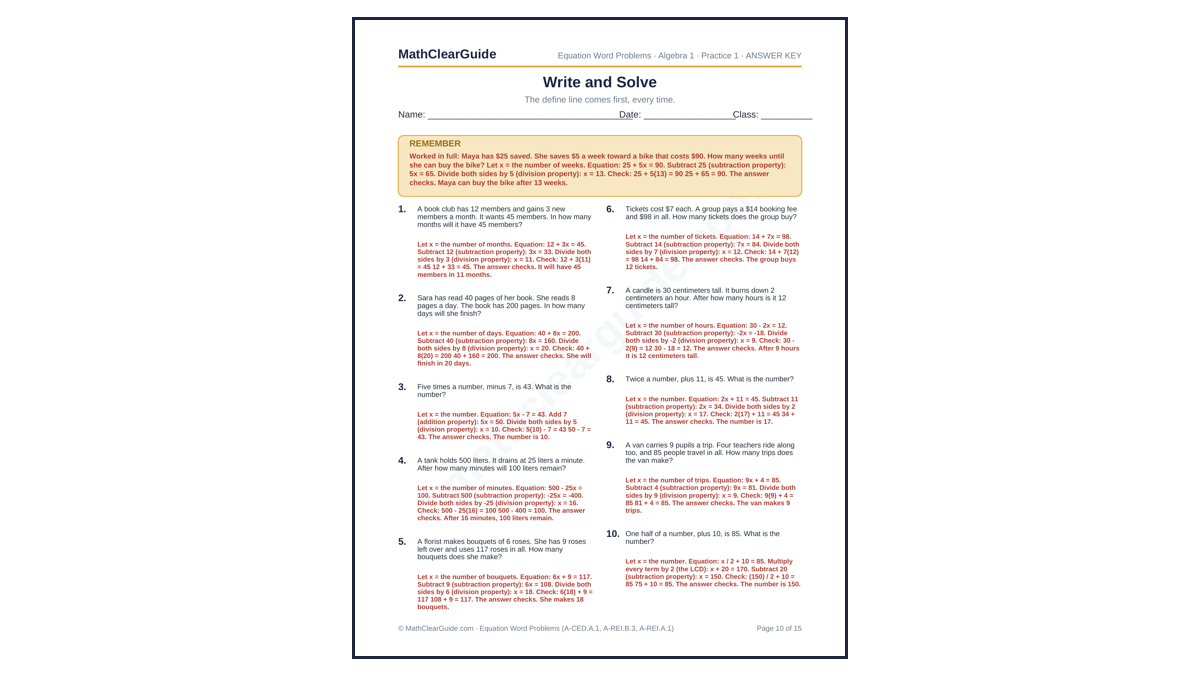
The middle level is where the class meets. The key above shows the working the way every key in the unit shows it: the define, the equation, the steps with their properties, the check, and the answer read back as a sentence.
Questions Teachers and Parents Ask
Is the first lesson really free?
Yes. Two-Step Equations is a complete lesson, slides, task cards, worksheet and filled in key, free with an email signup. It teaches the undo order fully. The paid lessons that follow are visibly deeper, and the free lesson names them honestly at its end.
What standards does the unit teach?
A-REI.B.3 and A-REI.A.1 run through all five lessons. Lesson 4 adds A-CED.A.4 for rearranging formulas. Lesson 5 adds A-CED.A.1 for creating equations from problems. Each code is quoted on its lesson’s cover and guide.
Does the unit teach inequalities or systems?
No. Equations here in full. Inequalities and systems wait for their own Algebra 1 units. Lesson 5 holds one labelled first look page at Unit 2 inequalities, two stories to write and two graphs to read, and nothing on it is solved.
What do I need to print?
The worksheet PDFs print in color or in black and white. The task cards want scissors. Slides are PPTX for any classroom screen. Every lesson prints the same way, so the routine is learned once.
When in the year does Algebra 1 teach solving equations?
Early. It is the first unit on our Grades 9 to 10 shelf because functions, systems and quadratics all spend it. Most classes meet it in the first weeks of the course, and intervention groups meet it again all year.
The pupil who can say why each step is allowed holds the key to every equation Algebra 1 will hand them. Steps can be memorized. Reasons transfer.
Start with the free lesson: Two-Step Equations. It arrives by email, and the Worksheet Generator keeps the practice fresh while you look. If the undo order lands and the checks become a habit, joining unlocks the full unit: both sides, clearing, the endings, formulas, and the capstone where pupils write the equations themselves. That is the shelf promise, and this unit keeps it: every step justified, every answer checked, every story read back in its own words.
Every topic clicks faster with practice. Our Resource Library has free lesson packs with slides, printable worksheets and full answer keys, ready to download and teach.
Members unlock every lesson in the library, including the full Fractions, Multiplication, Place Value, Addition & Subtraction, Time & Money and Geometry & Shapes units. See the full library


1 thought on “Algebra 1 Solving Equations: A Simple Guide for Teachers and Parents”