
A ten frame is one of the smallest tools in early math. It is just two rows of five boxes on a page.
But those ten boxes do a big job. They help young children see numbers, not just count them one by one.
This post explains what a ten frame is, how children learn to read it at a glance, and seven activities that build numbers to 10 and then to 20.
Every activity works with our free ten frame printable, which holds a big mat, a double mat and counters to cut out.
What is a ten frame?
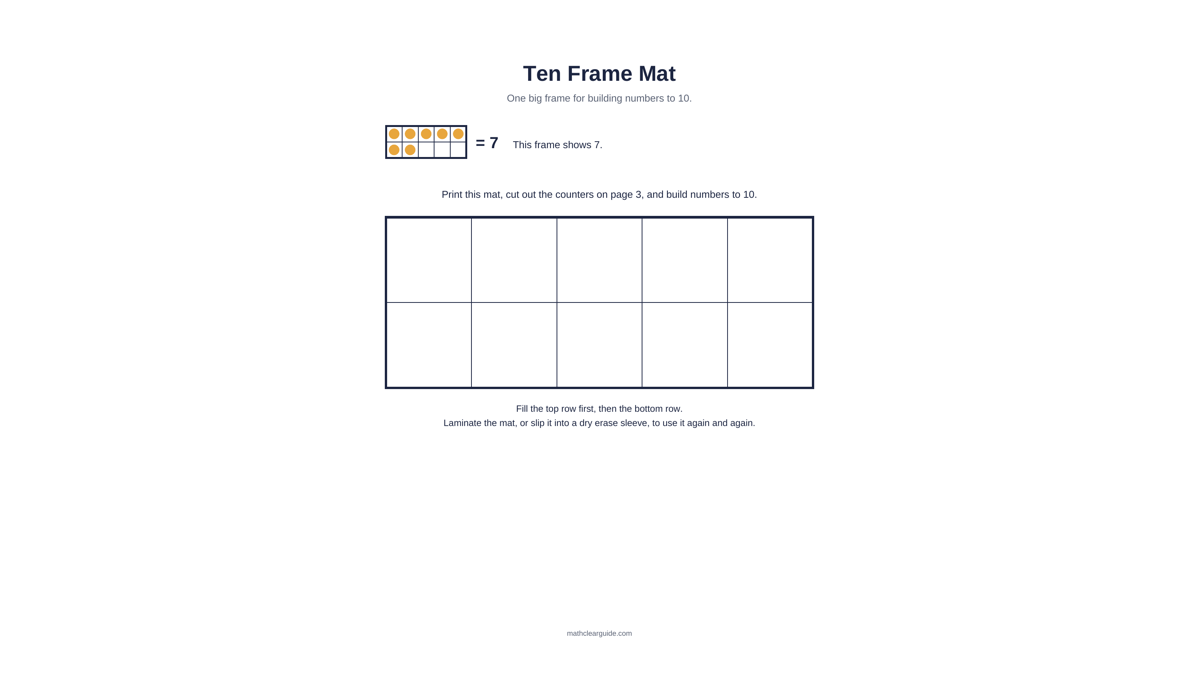
A ten frame is a grid with two rows and five columns. Children place counters in the boxes to build a number.
To build 7, a child fills the whole top row with five counters, then adds two more in the bottom row.
The frame is always the same size, and that is the point. A full frame always means 10, and a full top row always means 5.
Those two anchors turn counting into seeing. The child stops starting again from 1 for every number.
When your child outgrows ten boxes, the same idea grows into a hundreds chart, with ten rows of ten numbers to explore.
Seeing numbers without counting: subitizing
Subitizing is a long word for a simple skill. It means seeing how many things there are without counting them one by one.
You subitize every day. When you roll a dice, you see five dots at once. You do not count them.
A ten frame trains the same skill with numbers. At first, a child counts the counters one by one to check a frame.
With practice, the picture sticks. The child sees a full top row and two more, and says 7 straight away.
That picture matters later. A child who sees 7 as 5 and 2 is ready to split numbers apart and put them back together.
A ten frame turns counting into seeing. First the child counts the counters, then the picture does the work.
Seven ten frame activities
Print the mat from our free ten frame printable and cut out the counters. One mat per child is enough for the first five games.
1. Show Me a Number. Say a number from 0 to 10. Your child builds it on the mat and holds it up. Ask how they know it is right.
2. Ten Frame Flash. Show a filled frame for two seconds, then cover it. Your child says how many counters there were. Start with numbers to 5, then go higher.
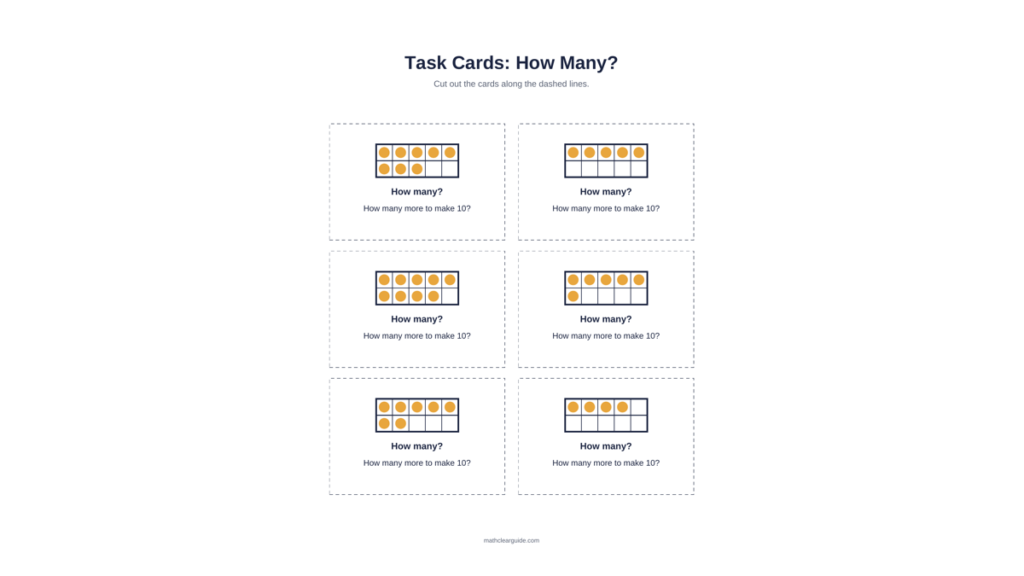
3. Make 10. Build a number like 6 on the mat. Ask how many more counters make 10. Your child fills the empty boxes and says the answer.
4. One More, One Less. Build a number and ask for one more and one less. Your child adds or takes away one counter to show each answer.
5. Race to 10. Two players, one mat each. Take turns rolling a dice and adding that many counters. The first player to fill the mat and make 10 wins.
6. Write the Bond. After building a number, your child writes the bond it makes, like 7 and 3 make 10. Keep a list and hunt for all eleven bonds.
7. Build to 20. Move to the double ten frame mat. Call out numbers from 11 to 20 and let your child build them, top frame first.
Worksheets, task cards and a ready made race game board sit in our Ten Frame Pack for members, with a full answer key.
Moving from 10 to 20 with a double ten frame
A double ten frame is two ten frames on one mat. The top frame fills first, then the bottom frame takes the rest.
So 13 is one full frame and 3 more. The child sees the teen number as 10 and a bit, which is exactly how our number system builds it.
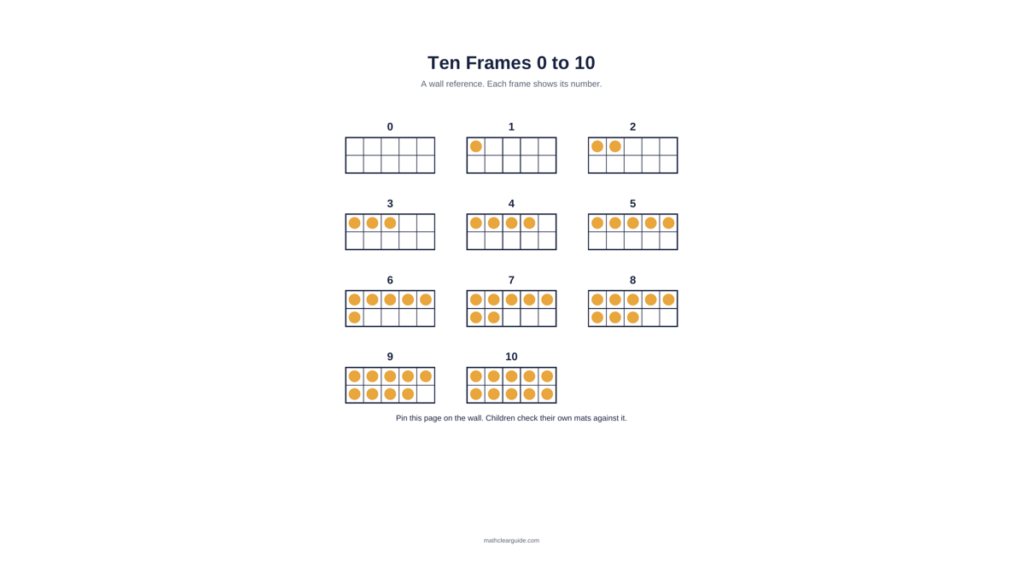
The wall reference in the free set shows every frame from 0 to 10. Children check their own mats against it while they work.
Numbers past 10 stop being a mystery list to memorize. They become 10 and some more, every single time.
Thirteen is not a new fact to learn by heart. It is a full frame and 3 more.
Common mistakes to watch for
Filling the frame in any order. Counters scattered across both rows hide the pattern. Teach one way: top row first, left to right, then the bottom row.
Counting every counter every time. If a child still counts from 1 on a full top row, cover the row and ask what it must be. The answer is always 5.
Skipping the empty boxes. Making 10 is about the boxes that are still empty. Ask your child to count the empty boxes too, not only the counters.
Jumping to 20 too soon. A child who is shaky to 10 will be lost at 17. Stay with one frame until numbers to 10 feel easy.
The empty boxes teach as much as the counters. Making 10 lives in the spaces that are left.
Questions teachers and parents ask
What age is a ten frame for? Most children meet the ten frame in kindergarten, around age 5. First graders keep using it for addition and subtraction within 20.
Why two rows of five? Because 5 is easy to see at a glance, and two fives make 10. Our counting system is built on 10, so the frame matches the system.
What can I use as counters? Buttons, coins, dried beans or small cubes all work. Keep them all about the same size, so they sit neatly inside the boxes.
How does a ten frame help with addition? It shows pairs that make 10, like 7 and 3. Knowing those pairs by heart makes later addition much faster.
Where can I find more early number resources? Our Resource Library holds Kindergarten lessons on counting, number bonds and addition, free and for members.
A ten frame costs one sheet of paper and a handful of buttons.
Used a little each day, it builds the number sense that every later topic stands on.
Print the free mat, cut out the counters, and try Show Me a Number today.
Every topic clicks faster with practice. Our Resource Library has free lesson packs with slides, printable worksheets and full answer keys, ready to download and teach.
Members unlock every lesson in the library, including the full Fractions, Multiplication, Place Value, Addition & Subtraction, Time & Money and Geometry & Shapes units. See the full library


