A warm, kid-friendly illustration of twelve red apples arranged in three neat groups of four on a wooden table, with a simple division sentence 12 ÷ 3 = 4 written above and the divisor circled.
A divisor is the number you divide by in a division problem. In 12 ÷ 4 = 3, the divisor is 4.
Where Is the Divisor in a Division Problem?
Look at the division sign and find the number right after it. In 20 ÷ 5 = 4, the 5 sits after the ÷ sign, so 5 is the divisor. In the fraction form 20/5 = 4, the divisor is the bottom number, which is also called the denominator.
In long division, the divisor stands outside the division bracket, like a guard at the door. For 36 ÷ 6, you write the 6 outside and the 36 inside the bracket. Its position never changes: the divisor is always the number doing the dividing.
A quick way to remember it: the divisor is the number that tells you how many equal groups to make, or how big each group should be. If you split 12 cookies among 3 friends, the 3 is the divisor and each friend gets 4 cookies.
What Do the Dividend, Divisor, Quotient, and Remainder Mean?
Every division problem has four players, and each one has a job. The dividend is the total you start with, the number being divided. The divisor is the number you divide by. The quotient is the answer. The remainder is what is left over.
Take 17 ÷ 5. The dividend is 17, the divisor is 5, the quotient is 3, and the remainder is 2. In words: 17 split into groups of 5 makes 3 full groups, with 2 left over.
These four words fit together in a tidy check: (divisor × quotient) + remainder = dividend. For our example, 5 × 3 + 2 = 17. If your numbers pass this check, your division is correct. Teachers love this check because it turns division into a multiplication puzzle, and multiplication is often easier to trust.
Can the Divisor Be Zero?
No, the divisor can never be zero. Division by zero does not work, and mathematicians say it is undefined.
Think about what division means. Splitting 12 cookies into 3 groups makes sense: each group gets 4. But splitting 12 cookies into 0 groups makes no sense at all. How many cookies would be in each group? There are no groups to put them in, so the question has no answer.
You can divide zero by another number, though. Zero cookies split into 4 groups gives 0 cookies per group, so 0 ÷ 4 = 0. The rule is one-directional: zero can be the dividend, but it can never be the divisor.
What Is the Difference Between a Divisor and a Factor?
A divisor is the number you divide by in any division problem, whether or not it divides evenly. A factor is a number that divides another number with nothing left over. Every factor is a divisor, but not every divisor is a factor.
Here is an example. In 10 ÷ 3, the 3 is the divisor, and the answer is 3 with a remainder of 1. But 3 is not a factor of 10, because it does not divide 10 evenly. In 12 ÷ 3 = 4, the 3 is both a divisor and a factor, because 12 splits into 3 equal groups with zero left over.
Common Mistake: Students often swap the divisor and the dividend. In 12 ÷ 4, they point to 12 as the divisor. Remember the order: the dividend is the big total being split, and the divisor is the number doing the splitting. In a fraction, the divisor is on the bottom, never on the top.
Try It: Hunt for All the Divisors of 12

A cheerful classroom illustration of a child’s hands arranging round counters on a desk into neat equal rows of 1, 2, 3, 4, and 6, with a notebook listing the divisors of 12.
Grab 12 small objects: counters, buttons, or dried beans all work. Your mission is to arrange all 12 into equal rows with nothing left over, and each row size that works is a divisor of 12.
Start with rows of 1: twelve rows of 1 uses all 12 counters, so 1 is a divisor. Try rows of 2: six neat rows, so 2 is a divisor. Rows of 3 give four rows, so 3 is a divisor. Keep going. Rows of 4 work, rows of 5 leave leftovers (so 5 is not a divisor), rows of 6 work, and rows of 12 give one long row.
Write down every divisor you found: 1, 2, 3, 4, 6, and 12. Notice the pairs: 1 × 12 = 12, 2 × 6 = 12, and 3 × 4 = 12. Divisors always come in pairs like this. Now try the same hunt with 10, 15, or 20, and see how the pairs change.
Quick Practice
In the problem 45 ÷ 9 = 5, which number is the divisor, and which is the dividend?
Answer: The divisor is 9, because it is the number doing the dividing. The dividend is 45, because it is the total being split. Check with multiplication: 9 × 5 = 45, so the division is correct.
Related Terms
Frequently Asked Questions
Is the divisor the number inside or outside the long division bracket?
The divisor goes outside the bracket, and the dividend goes inside. For 48 ÷ 6, you write 6 outside and 48 inside. A handy picture: the divisor is the “divider,” standing outside and handing out equal shares to the number waiting inside.
What happens when the divisor is bigger than the dividend?
You get an answer smaller than 1. For example, 4 ÷ 8 = 1/2. The divisor 8 is bigger than the dividend 4, so each share is only half. In elementary grades this comes up with fractions, and it becomes more common in later grades with decimals.
Are divisors always whole numbers?
In elementary math, yes. Students work with whole-number divisors like 2, 5, or 10. In later grades you can divide by fractions and decimals too, but the idea stays the same: the divisor is the number you divide by.
How is the divisor related to multiplication?
Division undoes multiplication. In the fact family 3 × 4 = 12, 12 ÷ 3 = 4, and 12 ÷ 4 = 3, the numbers 3 and 4 take turns being the divisor. If you know your multiplication facts, you already know your divisors.
What grade learns about divisors?
Students start dividing in third grade, and the word “divisor” usually arrives in third or fourth grade along with long division. It stays important through fraction work, greatest common factors, and beyond.
To practise division with a divisor of your choice, use our free long division calculator.
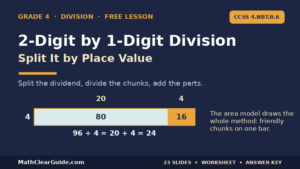
Reading about it is one thing, practising it is another. Our free What Is Division? lesson builds the idea step by step, with slides, a printable worksheet and a full answer key.
Members unlock every lesson in the library, including the full Fractions, Multiplication, Place Value, Addition & Subtraction, Time & Money and Geometry & Shapes units. See the full library