
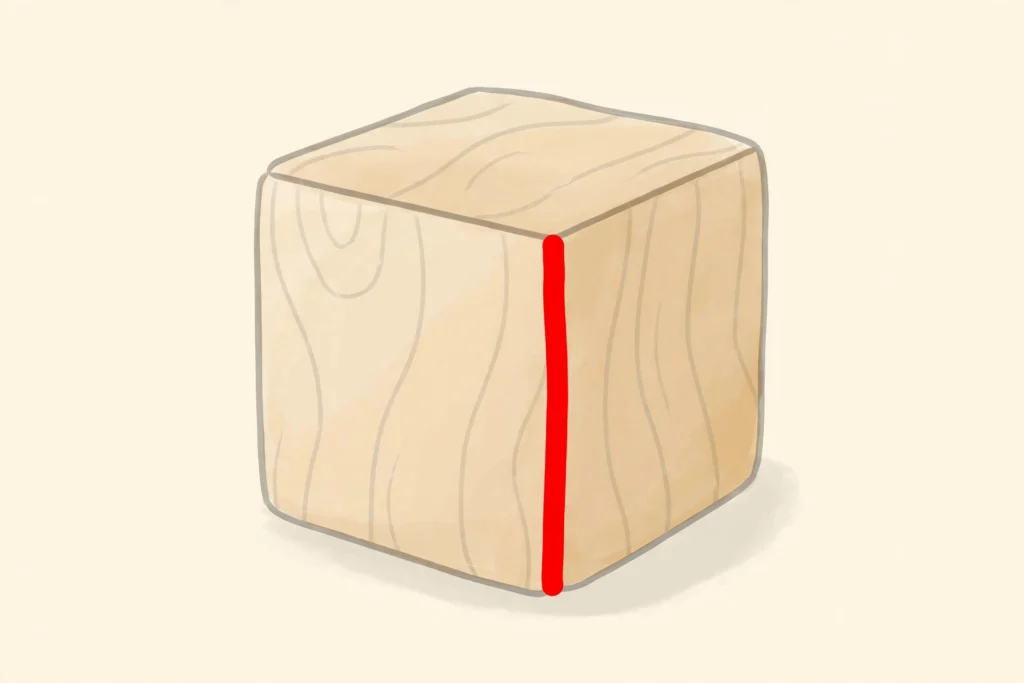
An edge is a line segment where two faces of a solid shape meet. On a flat shape, an edge is simply one of its sides.
What Is an Edge in Geometry?
Run your finger along the bottom of a tissue box. Feel that sharp line where the front face meets the bottom face? That line is an edge. It is the place where two flat surfaces join, and every solid shape is built out of them.
Here is the definition mathematicians use. On a three-dimensional shape, an edge is the line segment formed where two faces meet. A cube has 6 square faces, and every place where two of those squares touch is an edge. Count them all and you get 12 edges.
The idea works for flat shapes too. On a two-dimensional polygon, an edge is a straight line segment on the boundary of the shape. A triangle has 3 edges. A square has 4. In flat-shape land, the words edge and side mean the same thing, so teachers often use them interchangeably.
Edges on Flat Shapes and Solid Shapes
Flat shapes and solid shapes use the word edge a little differently, and keeping the two straight saves a lot of confusion.
On a flat (2D) shape, the edges are the straight sides that form the outline. Trace a rectangle with your finger and you travel along 4 edges. The edges meet at corners, and they never leave the flat surface of the paper.
On a solid (3D) shape, edges are the lines where two faces come together. Pick up a wooden block. Each of its 6 faces is a square, and the block holds together because its 12 edges join those squares into one solid object. Without edges, you would just have six loose squares.
A quick classroom trick helps students feel the difference. Give each child a square of paper (flat) and a small box (solid). Ask them to point to an edge on each. On the paper, they point to a side of the square. On the box, they run a finger along the crease where two faces meet. Same word, two slightly different meanings, and now their hands know both.
How Many Edges Does a Cube Have?
A cube has 12 edges. It is the most famous edge count in elementary math, and there is a neat way to find it without guessing.
Look at the top face of the cube. It is a square with 4 edges around it. The bottom face is another square with 4 more edges. That makes 8. Then 4 edges run up and down connecting the top square to the bottom square, one at each corner. Add those in: 8 + 4 = 12.
Teachers love this counting routine because it works for other boxes too. A rectangular prism, like a cereal box, has the same structure: 4 edges on top, 4 on the bottom, and 4 holding the two together. Twelve edges again. Once students see the pattern, they can count edges on any box-shaped object in the room.
Other shapes have their own counts. A triangular pyramid has 6 edges. A square pyramid has 8. Each count comes from the same idea: find every place where two faces meet, and count each one exactly once.
What Is the Difference Between an Edge, a Face, and a Vertex?
Quick Answer: A face is a flat surface, an edge is the line where two faces meet, and a vertex is the corner point where edges meet. Faces are flat, edges are lines, and vertices are points.
Use the cube to lock in all three. It has 6 faces (the square surfaces), 12 edges (the lines between faces), and 8 vertices (the corner points). Say the numbers like a chant: 6 faces, 12 edges, 8 vertices. Kids remember it because it rhymes in rhythm even if it does not rhyme in words.
A common mix-up is calling every corner an edge. If you can put your fingertip on it and it is a single point, that is a vertex, not an edge. If you can run your finger along it and it has length, that is an edge. Points versus lines is the whole test.
Try It: Build-a-Cube Edge Hunt

You need 12 straws cut to the same length (coffee stirrers work too) and 8 small balls of clay or playdough. Each straw will become an edge, and each clay ball will become a vertex.
Step 1: Build the bottom. Connect 4 straws into a square, pushing a clay ball onto each corner. You just built 4 edges. Count them out loud and touch each straw as you count.
Step 2: Raise the walls. Push one straw straight up out of each of the 4 clay balls. These 4 straws are 4 more edges. Count all 8 edges so far.
Step 3: Close the top. Connect the tops of the 4 standing straws with 4 more straws, adding a clay ball at each new corner. Count every straw one final time. You should land on 12.
Step 4: The edge hunt. Now that your cube is built, play detective. Point to one edge and name the two faces it joins: “This edge joins the front face and the top face.” Mark each counted edge with a small sticker so you know you got them all. Twelve stickers means a perfect hunt.
Bonus: Build a triangular pyramid with 6 straws and 4 clay balls. Count its edges the same way and check that you land on 6.
Quick Practice
Question: How many edges does a cereal box have? Explain how you counted.
Worked answer: A cereal box is a rectangular prism, and it has 12 edges, just like a cube. Count 4 edges around the top face, 4 edges around the bottom face, and 4 edges connecting the top to the bottom. 4 + 4 + 4 = 12 edges.
Related Terms
- Pyramid – a solid with a polygon base and triangular faces that meet at one vertex.
- Rectangular Prism – a box-shaped solid with 12 edges, like a cereal box.
- Acute Angle – the sharp corner angle where two edges of a polygon meet.
- Obtuse Angle – a wide corner angle formed where two edges meet.
Frequently Asked Questions
How many edges does a triangle have?
A triangle has 3 edges. On a flat shape, edges are the straight sides, and a triangle is made of exactly 3 straight sides that meet at 3 corners.
Do circles have edges?
In elementary math, we say a circle has no edges and no vertices. It has one curved side that goes all the way around. Edges are straight line segments, so a shape made only of curves has none.
Can an edge be curved?
Yes. Most edges students meet are straight, but some solids have curved edges. A cylinder has two curved edges where its flat circular bases meet the curved side, and it has no vertices at all.
What is the difference between an edge and a side?
On flat shapes, there is no difference: edge and side both mean one straight boundary line. On solid shapes, teachers say edge for the line where two faces meet, and save the word side for flat-shape talk.
Reading about it is one thing, practising it is another. Our free What Are 2D Shapes? lesson builds the idea step by step, with slides, a printable worksheet and a full answer key.
Members unlock every lesson in the library, including the full Fractions, Multiplication, Place Value, Addition & Subtraction, Time & Money and Geometry & Shapes units. See the full library


