

The tens place is the second position from the right in a number. A digit sitting in the tens place stands for that many groups of ten.
What Does the Tens Place Mean?
Numbers are built from places, and each place is worth ten times the one to its right. The ones place on the far right holds single units. Right next to it, the tens place holds groups of ten. A digit in the tens place is worth the digit times ten.
Take the number 36. The 3 is in the tens place, so it means 3 tens, which is 30. The 6 is in the ones place, so it means 6 ones, which is 6. Put them together and you get 30 + 6 = 36. The same digit would mean something completely different in another spot. In 63, the 3 sits in the ones place and means just 3.
This is the big idea of place value: where a digit sits decides what it is worth. Once students feel that in their bones, two-digit numbers stop being mysterious.
How Do You Read a Number with Tens and Ones?
Reading a two-digit number is a two-step job. First, name the tens. Then, name the ones. In 57, say “five tens” and “seven ones.” Five tens is 50, so the number is fifty-seven.
A place value chart makes this visible. Draw two columns labeled Tens and Ones. Write 5 under Tens and 7 under Ones. Students can point to each column as they read, which slows them down just enough to think.
Zeros deserve special attention. In 40, the tens place holds 4 and the ones place holds 0. Read it as four tens and zero ones, which is forty. The zero is not nothing doing nothing. It holds the ones place so the 4 stays in the tens place where it belongs.
What Is the Place Value of a Digit in the Tens Place?
The place value of a digit is the digit times the value of its place. In the number 72, the digit 7 sits in the tens place, so its place value is 7 × 10 = 70. The digit 2 sits in the ones place, so its place value is 2.
Students sometimes mix up place value and face value. The face value of a digit is the digit itself, always. In 72, the face value of 7 is 7, but its place value is 70. The face value never changes, but the place value changes with the position.
A handy question to ask: “How much is this digit truly worth?” Point to the 4 in 48. The answer is 40, not 4. Students who answer quickly and correctly are reading place value like pros.
How Can Base-Ten Blocks Show the Tens Place?
Base-ten blocks turn the tens place into something students can hold. The small cubes stand for ones. The long rods stand for tens, and each rod is exactly ten cubes long. Line up ten ones next to a rod and the match is obvious.
To build the number 43, take four tens rods and three ones cubes. The four rods are the tens place made visible: 4 tens, or 40. The three cubes are the ones place: 3. Push them together and the whole number sits on the desk in front of you.
The trading game is where the learning deepens. When a student collects ten ones cubes, they trade them in for one tens rod. That single trade is the whole base-ten system in miniature: ten ones make one ten. Students who have traded cubes for rods dozens of times rarely forget what the tens place means.
Common Mistake: Reading the tens digit as ones. In 36, the 3 means 30, not 3. Point to the place value chart and ask, “Which place is this digit in?” If the answer is the tens place, the digit is worth that many tens.
Try It: Build Tens Towers
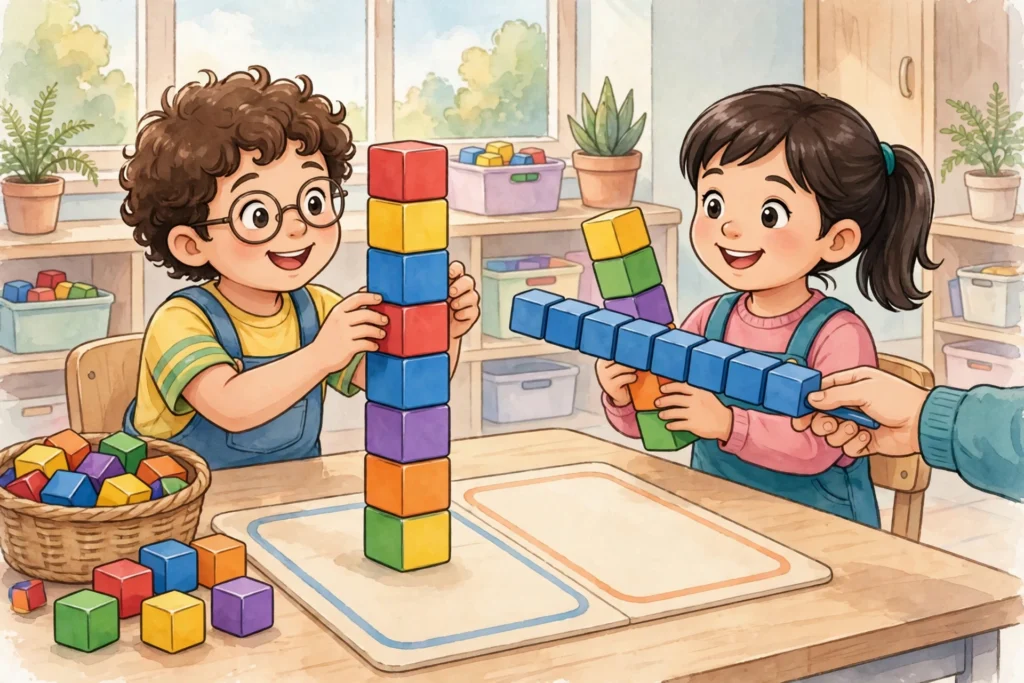
This building activity takes about twenty minutes and needs linking cubes, a place value mat with Tens and Ones columns, and a basket of tens rods. It makes grouping by ten a full-body experience.
Step 1: Roll and build. Call out a two-digit number, like 35. Students snap cubes into towers. Every time a tower reaches ten cubes, it moves to the Tens column as one tower of ten.
Step 2: Trade up. Once a student has towers of ten sitting in the Tens column, they trade each tower for a tens rod. Three towers of ten become three tens rods. Leftover single cubes stay in the Ones column.
Step 3: Read the number. Students read their mat: “3 tens and 5 ones. That is 35.” Ask them to point to the digit in their number that matches the rods. The 3 in 35 and the three rods are the same idea in two forms.
Step 4: Compare. Build 53 next to 35. Both use the same digits, but the mats look different. Ask which number is greater and why. The answer lives in the tens place: 5 tens beats 3 tens every time.
Quick Practice
Question: In the number 72, which digit is in the tens place? What is its place value?
Answer: The digit 7 is in the tens place. Its place value is 70, because 7 tens equals 70. The digit 2 is in the ones place with a place value of 2, and 70 + 2 = 72.
Related Terms
- Place Value: the idea that a digit’s worth depends on its position in a number.
- Hundreds Place: the next place to the left of tens, worth ten times as much.
- Base Ten: our number system, built on groups of ten.
- Regrouping: trading ten ones for one ten, or breaking a ten into ten ones.
Frequently Asked Questions
What is the tens place in simple words?
The tens place is the spot in a number that counts groups of ten. In 45, the 4 is in the tens place and means 40. It is the second digit from the right.
Which place comes right after the tens place?
The hundreds place comes next, one step to the left. It is worth ten times the tens place. In 345, the 3 means 300, the 4 means 40, and the 5 means 5.
What is the difference between face value and place value?
Face value is the digit itself. Place value is the digit times its place. In 64, the face value of 6 is 6, but its place value is 60 because it sits in the tens place.
How many ones make one ten?
Ten ones make one ten. That is the trade at the heart of the base-ten system. Ten ones cubes can be swapped for a single tens rod, and both sides are worth 10.
Why does the tens place matter?
The tens place lets us write big numbers with just ten digits. Without it, we would need a new symbol for every number. With it, two digits can name every number from 10 to 99.
Reading about it is one thing, practising it is another. Our free What Is Place Value? lesson builds the idea step by step, with slides, a printable worksheet and a full answer key.
Members unlock every lesson in the library, including the full Fractions, Multiplication, Place Value, Addition & Subtraction, Time & Money and Geometry & Shapes units. See the full library


