
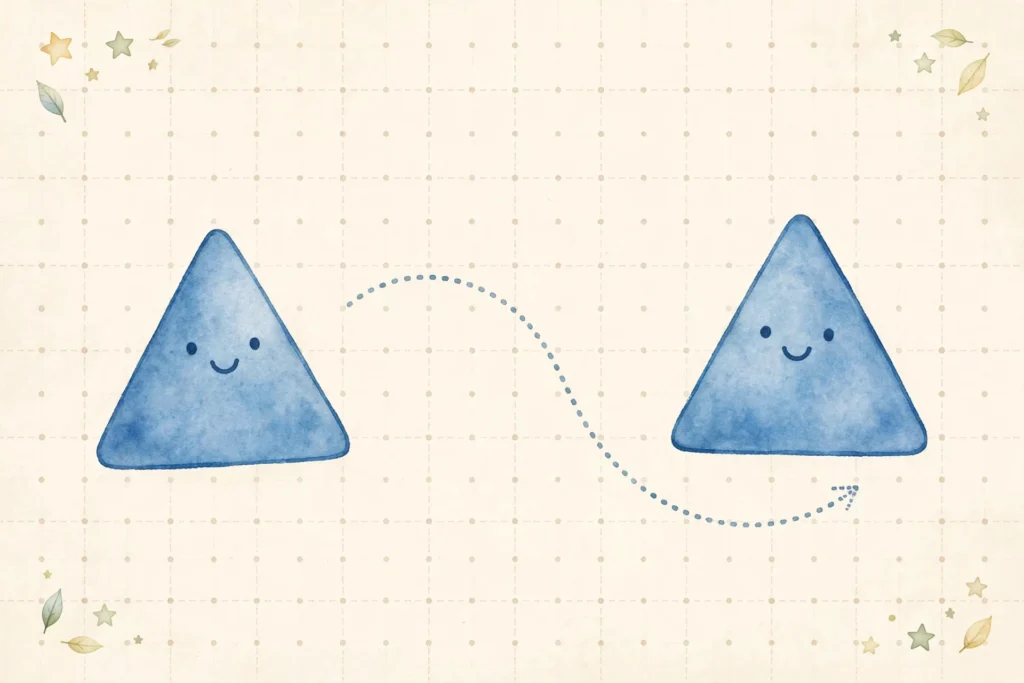
In math, a translation is a slide. You move a shape to a new spot without turning it, flipping it, or changing its size.
What Does a Translation Look Like?
Picture a triangle drawn on a sheet of graph paper. Now push it four squares to the right, keeping it perfectly level as it moves. The triangle lands in a new place, but it still points the same way and it is exactly the same size. That slide is a translation.
Every point of the shape travels the same distance in the same direction. If the top corner moves four squares right, the bottom corners move four squares right too. Nothing stretches, nothing spins, and the shape never turns into a mirror image of itself. Mathematicians have special names for the before and after: the starting shape is called the preimage, and the shape after the slide is called the image.
Because nothing about the shape changes except its position, the image is congruent to the preimage. Congruent is a math word that means same size and same shape. Two translated triangles match perfectly if you lay one on top of the other.
How Is a Translation Different from a Reflection?
A reflection is a flip, and a flip is not a slide. Imagine pressing a shape against a mirror line and stamping its mirror image on the other side. The new shape faces the opposite way, like your left hand facing your right hand in a mirror.
Common Mistake: Calling every moved shape a translation. If the shape flipped like a mirror image, that is a reflection, not a translation. A translation never turns the shape around and never flips it. Check the direction the shape points: if it still points the same way, you are looking at a translation.
Ms. Park teaches the difference with her hands. She holds up a paper letter L and slides it across her desk. “Translation,” the class chants. Then she flips the L over like a pancake. “Reflection,” they shout. By the third round, even her wiggliest students can spot the difference from across the room.
How Is a Translation Different from a Rotation?
A rotation is a turn. The shape spins around a fixed point, like a pinwheel on a stick or the hands of a clock. After a rotation, the shape points in a new direction. After a translation, the shape points exactly the way it did before.
Try this with a book on your desk. Slide the book straight forward without turning it: that is a translation. Now spin the book a quarter turn in place: that is a rotation. Both moves change where the book sits, but only the rotation changes which way it faces.
Translation, reflection, and rotation are three of the four geometric transformations, and dilation is the fourth. Dilation grows or shrinks a shape while keeping its proportions. Translations are the gentlest of the four because they change nothing except location.
Where Do We See Translations in Real Life?
Translations happen all day long. Push a toy car in a straight line across the floor and you have translated it. Slide a chess piece forward one square and you have translated it. Push a shopping cart straight down the supermarket aisle and the whole cart translates, every part moving the same distance in the same direction.
Elevators translate straight up and down. Escalators carry people along a straight slanted path, which counts as a translation too. Sliding glass doors glide along their tracks without turning. Even the cursor on a computer screen translates when you drag a file from one folder to another.
Video game designers use translations constantly. When your character walks across the screen, the program slides the character’s image a few pixels at a time. The character does not flip or spin with each step. It simply translates, over and over, until it reaches the other side.
Try It: Slide the Shape

Grab paper, a pencil, scissors, and a ruler. You are about to translate with your own hands.
- Step 1: Draw a simple star or arrow on the paper and cut it out. This is your preimage.
- Step 2: Place the cutout on a fresh sheet and trace around it lightly. Mark one corner with a dot so you can track it.
- Step 3: Slide the cutout three inches to the right without turning or flipping it. Trace around it again. This is your image.
- Step 4: Measure from the dot on the first tracing to the dot on the second tracing. Now measure from another corner. Both distances match: every point moved the same distance.
Try sliding up, down, and diagonally. Each time, check that the shape still points the same way. Then try flipping the cutout once on purpose and compare: the flipped version is a reflection, and it looks clearly different.
Quick Practice
Question: A triangle sits on a grid. You slide it 5 units to the left and 2 units down, without turning or flipping it. Which of these is true: the triangle got smaller, the triangle flipped over, or the triangle stayed the same size and shape?
Answer: The triangle stayed the same size and shape. A slide is a translation, and translations never change size, shape, or direction. The triangle simply sits in a new spot on the grid.
Related Terms
Keep exploring geometry with Horizontal, X-Axis, and Y-Axis.
Frequently Asked Questions
What is a translation in math for kids?
A translation is a slide. You move a shape to a new place without turning it, flipping it, or resizing it. The shape looks exactly the same, just somewhere else.
What is the difference between translation and slide?
There is no difference. Slide is the everyday word, and translation is the math word. Teachers often say “slide” first and then introduce “translation” as the official name.
Does a translation change the size of a shape?
No. A translation changes only the position of a shape. Size, shape, and direction all stay exactly the same, which is why the image is congruent to the preimage.
What are the four types of transformations?
The four geometric transformations are translation (slide), reflection (flip), rotation (turn), and dilation (grow or shrink). The first three keep the shape congruent. Dilation changes the size.
Can a translation move a shape diagonally?
Yes. A translation can move a shape in any straight-line direction: left, right, up, down, or diagonal. The only rule is that every point moves the same distance in the same direction.
Every topic clicks faster with practice. Our Resource Library has free lesson packs with slides, printable worksheets and full answer keys, ready to download and teach.
Members unlock every lesson in the library, including the full Fractions, Multiplication, Place Value, Addition & Subtraction, Time & Money and Geometry & Shapes units. See the full library


