

To compose in math means to put smaller numbers together to build one larger number. When a child slides 4 blocks and 3 blocks into the same pile and counts 7, they just composed the number 7.
What Does It Mean to Compose a Number?
Composing is the act of combining parts to make a whole. In kindergarten and first grade, it looks like this: a teacher pours out a cup of counters and asks, “How many ways can we make 6?” One student pushes 5 red counters to the left and 1 yellow counter to the right. Another makes 2 and 4. A third lines up 3 and 3. Each pair is a small act of composing, and each one ends with the same whole: 6.
Composing shows up inside addition long before kids write a plus sign. When a child counts 2 apples in the fruit bowl, then counts 3 more on the counter, then announces “5 apples in all,” they are composing 2 and 3 into 5. The word itself comes from Latin and simply means “to put together.” In math class, putting together is the whole job.
Teachers lean on composing because it builds number sense. A student who knows that 8 can be built as 5 and 3, or 6 and 2, or 7 and 1, is not just memorizing facts. They are learning how numbers fit inside each other, and that flexibility makes harder math easier later on.
Quick Answer: Composing a number means joining two or more smaller numbers to make a larger number, like composing 10 from 6 and 4.
What Is the Difference Between Compose and Decompose?
Compose and decompose are opposites. Composing builds up. Decomposing breaks down. If composing is stacking blocks into a tower of 9, decomposing is knocking that tower apart into 5 and 4.
Kids meet both at the same time, and that is on purpose. Working back and forth between building and breaking helps them see that numbers are flexible. A student who can compose 8 from 3 and 5 can usually decompose 8 back into 3 and 5 when it helps, such as when solving a trickier problem. The two skills grow together, and both feed straight into addition and subtraction.
How Do Kids Compose Numbers to 10?
The number 10 gets special treatment in early math, and for good reason. Our whole number system is built on tens, so knowing the pairs that make 10 is like learning the alphabet before reading. Kids compose 10 from 1 and 9, 2 and 8, 3 and 7, 4 and 6, and 5 and 5.
In class, this often starts with a ten-frame. A teacher flashes a ten-frame with 6 dots and asks what is missing. Hands shoot up. A student says 4, because 6 needs 4 more to fill the frame. That “needs 4 more” is composing in action: 6 and 4 make 10.
Number bonds work the same way. A whole number sits on top, two parts branch below it, and kids fill in the missing part. A bond that shows 10 on top with 7 on one branch and a blank on the other becomes a small puzzle, and solving it means composing 7 and 3 into 10.
Finger work counts too. A teacher holds up 8 fingers and asks how many more make 10. Kids fold and unfold their own fingers until 2 pop up. Their hands are doing the composing, ten times over, every single day.
How Does Composing Help with Place Value?
Composing leads straight into place value. The teen numbers, 11 through 19, are just a ten with some ones on the side. A kindergartner who lays out 10 cubes in a stick, then sets 4 loose cubes beside it, has composed the number 14 from 1 ten and 4 ones. That is the K.NBT.1 standard in action, and it is a big deal.
Later, composing becomes the engine behind regrouping. Adding 27 and 35 asks kids to compose 10 ones into 1 ten. Nothing about the idea is new. It is the same putting-together they learned with counters in kindergarten, now happening inside bigger numbers.
Try It: Build It with Blocks
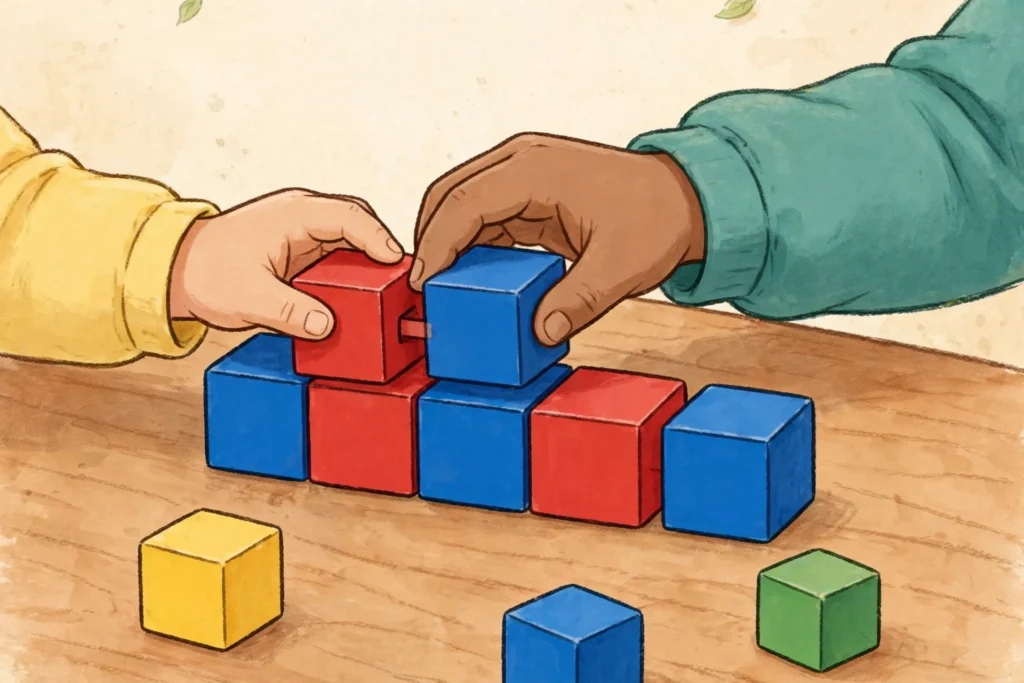
Grab a tub of interlocking cubes or wooden blocks in two colors. This five-minute activity turns composing into something kids can hold.
- Pick a target number between 5 and 10 and write it on a whiteboard or sticky note.
- Ask your child to build that number using both colors. How many of each color did they use? Write the pair down: “6 is made of 4 red and 2 blue.”
- Challenge them to find a second way to compose the same number with different color counts.
- Ask: “How many ways can we make this number?” Let them hunt for every pair.
- Finish by having them read each pair aloud: “4 and 2 make 6. 3 and 3 make 6. 5 and 1 make 6.”
For a harder round, raise the target to a teen number and ask kids to build it as 1 ten plus ones.
Quick Practice
Question: Maya has 5 yellow counters and 2 red counters. She puts them all in one cup. What number did she compose?
Worked answer: Maya is joining two smaller groups into one larger group, which is composing. Add the parts: 5 + 2 = 7. Maya composed the number 7 from 5 and 2.
Related Terms
Frequently Asked Questions
What does compose mean in math for kids?
Compose means to put smaller numbers together to make a bigger number. If a child joins 2 toy cars with 3 toy cars to get 5 cars, they composed 5.
What is an example of composing numbers?
Composing 10 from 7 and 3 is a classic example. So is composing 14 from 1 ten and 4 ones. Any time parts join into a whole, composing is happening.
Why do kids learn to compose and decompose numbers?
These skills build number sense. Kids who can break numbers apart and put them back together handle addition, subtraction, and place value with far less struggle.
When do students learn composing in school?
Composing starts in kindergarten with numbers to 10 and teen numbers built as tens and ones. First grade extends it with strategies like making ten to add within 20.
Every topic clicks faster with practice. Our Resource Library has free lesson packs with slides, printable worksheets and full answer keys, ready to download and teach.
Members unlock every lesson in the library, including the full Fractions, Multiplication, Place Value, Addition & Subtraction, Time & Money and Geometry & Shapes units. See the full library


