
A quadrilateral is a flat shape with four straight sides, four corners, and four angles. Squares, rectangles, and trapezoids are all quadrilaterals.
What Are the Types of Quadrilaterals?
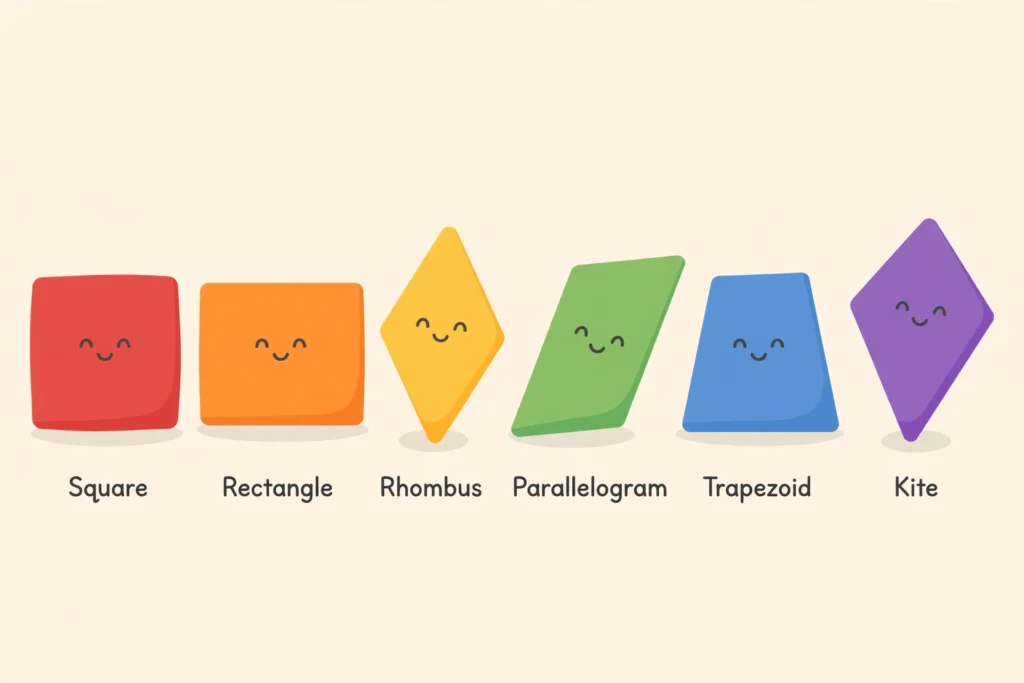
The quadrilateral family has six famous members, and each one earns its name from its sides and angles. Here they are, from most regular to most relaxed about the rules.
A square has four equal sides and four right angles. It is the most regular quadrilateral, with two pairs of parallel sides. A rectangle also has four right angles and two pairs of parallel sides, but only its opposite sides must be equal. Every square is a rectangle, but not every rectangle is a square.
A rhombus has four equal sides like a square, but its angles are not necessarily right angles. Think of a square that got pushed sideways. A parallelogram has two pairs of parallel sides with opposite sides equal, but unlike a rectangle, its angles are not all 90 degrees. Both the square and the rhombus are special parallelograms.
A trapezoid has exactly one pair of parallel sides. Picture a tabletop that is wider at the bottom than the top. A kite has two pairs of adjacent equal sides, like the toy you fly on a windy day, with one pair of equal opposite angles.
| Quadrilateral | Parallel side pairs | Special trait |
|---|---|---|
| Square | 2 | 4 equal sides, 4 right angles |
| Rectangle | 2 | Opposite sides equal, 4 right angles |
| Rhombus | 2 | 4 equal sides, pushed-over square |
| Parallelogram | 2 | Opposite sides equal and parallel |
| Trapezoid | 1 | Only one pair of parallel sides |
| Kite | 0 | Two pairs of adjacent equal sides |
Common Mistake: thinking a quadrilateral must have equal sides. It does not. Any shape with four straight sides counts, even a wobbly-looking one with four different side lengths. Equal sides only matter when naming the special types, like squares and rhombuses.
Is a Square a Quadrilateral?
Yes, absolutely. A square has four straight sides, four corners, and four angles, which is the entire definition of a quadrilateral. It is the most well-behaved member of the family.
This question trips up kids because squares feel like their own special category. But categories nest inside each other in geometry. A square is a quadrilateral, and it is also a rectangle (four right angles), a rhombus (four equal sides), and a parallelogram (two pairs of parallel sides). One shape, many true names. Mathematicians love that kind of overlap.
Try this logic chain with your class: every square is a rectangle, every rectangle is a parallelogram, and every parallelogram is a quadrilateral. Each step adds more shapes and loosens the rules a little.
What Are the Properties of a Quadrilateral?
Every quadrilateral, from the neatest square to the wildest kite, shares four properties. Four straight sides that connect end to end. Four vertices, which is the math word for corners. Four interior angles. And two diagonals, which are lines connecting opposite corners.
The angle property hides the best surprise. Add up the four interior angles of any quadrilateral and you always get 360 degrees. It does not matter whether the shape is a perfect square or a lopsided kite. The total never changes.
Why 360? Draw one diagonal across any quadrilateral and it splits the shape into two triangles. Each triangle’s angles add up to 180 degrees. Two triangles give 180 + 180 = 360. That neat little proof is often a student’s first taste of geometric reasoning, and it feels like cracking a code.
Where Do We See Quadrilaterals in Real Life?
Quadrilaterals are everywhere once kids start hunting for them. The book on a desk is a rectangle. A tablet screen is a rectangle. A picture frame, a window, and a television are all rectangles. Floor tiles are often squares. A stop sign is not one (it has eight sides), but many street signs are rectangles.
Kites are the shape’s namesake in the sky, and diamond road signs are rhombuses standing on one corner. Tabletops can be trapezoids, wider at one end than the other. Doors, whiteboards, and notebook pages all qualify. One teacher challenge that never fails: “Find ten quadrilaterals in this room in one minute.” Kids sprint around pointing at everything, and the room suddenly looks like a geometry museum.
How Can You Tell Quadrilaterals Apart?
Sorting shapes is the skill that turns memorizing into understanding. Give kids a pile of cut-out quadrilaterals and two sorting questions: “How many pairs of parallel sides do you see?” and “Are the sides equal?”
Two pairs of parallel sides narrows the field to squares, rectangles, rhombuses, and parallelograms. From there, equal sides plus right angles means square. Right angles without all sides equal means rectangle. Equal sides without right angles means rhombus. Two pairs of parallel sides with none of those extras means parallelogram.
One pair of parallel sides means trapezoid, and no parallel sides with two pairs of adjacent equal sides means kite. Kids who can talk through that sorting tree truly understand the family, not just its mugshots.
Try It: The Quadrilateral Hunt

Grab clipboards, paper, and pencils for this shape scavenger hunt.
- Set a timer for five minutes. Hunt through one room and sketch every four-sided shape you spot: books, screens, tiles, frames.
- Label each sketch with its type: square, rectangle, rhombus, parallelogram, trapezoid, or kite. If you are unsure, count the pairs of parallel sides first.
- Compare finds with a partner. Did anyone spot a rhombus? A trapezoid? Award a bonus point for the rarest quadrilateral found.
- Finish by checking angles: pick one rectangle you found and confirm its four corners look like square corners. Those are right angles.
For an extra round, hunt for non-examples too: a triangle, a circle, a pentagon. Explaining why each one fails the four-side test sharpens the definition even more.
Quick Practice
Question: A shape has four straight sides and four right angles, but its sides are not all equal. Which quadrilateral is it?
Worked answer: Four sides makes it a quadrilateral. Four right angles with opposite sides equal, but not all sides equal, points to a rectangle. (A square also has four right angles, but its sides are all equal, so it does not fit here.)
Related Terms
Frequently Asked Questions
Is a square a quadrilateral?
Yes. A square has four straight sides, four vertices, and four angles, which meets the full definition. It is also a rectangle, a rhombus, and a parallelogram all at once.
Is a rectangle a square?
Not always. Every square is a rectangle, because a square has four right angles. But a rectangle is only a square when all four of its sides are equal too. Think of squares as the special members of the rectangle club.
What is the difference between a trapezoid and a parallelogram?
Count the pairs of parallel sides. A trapezoid has exactly one pair. A parallelogram has two pairs. That single difference changes the shape’s whole personality.
Do a quadrilateral’s angles always add up to 360 degrees?
Yes, every time. One diagonal splits any quadrilateral into two triangles, and each triangle contributes 180 degrees. This works for squares, kites, and every shape in between.
When do kids learn about quadrilaterals?
Second graders learn to identify quadrilaterals and other shapes by their attributes. Third through fifth graders go deeper, classifying quadrilaterals by side and angle properties and exploring hierarchies like the square-inside-rectangle relationship.
Reading about it is one thing, practising it is another. Our free What Are 2D Shapes? lesson builds the idea step by step, with slides, a printable worksheet and a full answer key.
Members unlock every lesson in the library, including the full Fractions, Multiplication, Place Value, Addition & Subtraction, Time & Money and Geometry & Shapes units. See the full library


